
Oruka Therapeutics' ORKA-001: A High-Risk, High-Reward Bet in the IL-23 Inhibitor Space
In the crowded landscape of biotech innovation, few programs have captured investor attention as swiftly as OrukaORKA-- Therapeutics' ORKA-001. This half-life extended monoclonal antibody targeting IL-23p19 represents a bold attempt to redefine treatment paradigms for chronic skin diseases like psoriasis. With recent Phase 1 data underscoring its exceptional pharmacokinetic profile and safety, ORKA-001 has emerged as a compelling case study in the risk-reward dynamics of early-stage biotech.
Mechanism and Innovation: A Leap Beyond Current Standards
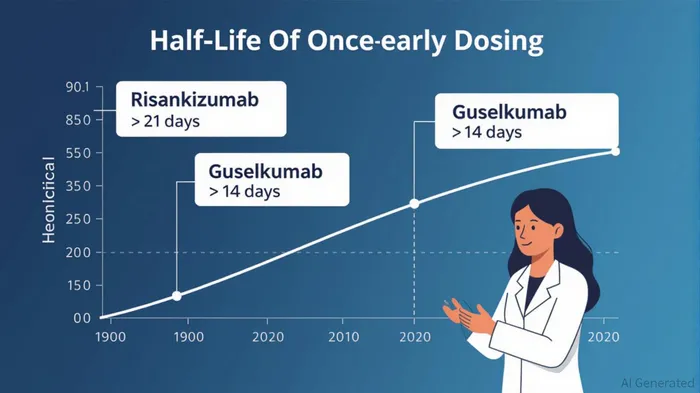
ORKA-001's core innovation lies in its engineered half-life, which could reduce dosing frequency to once annually—a stark contrast to existing IL-23 inhibitors like risankizumab (administered every 12 weeks) and guselkumab (every 16 weeks). Preclinical studies in non-human primates demonstrated a half-life of 30.3 days post-subcutaneous administration, over three times that of risankizumab [1]. Early clinical data from a Phase 1 trial in healthy volunteers further validated this, reporting a half-life of approximately 100 days and sustained inhibition of STAT3 signaling through 24 weeks [2]. Such durability could translate to improved patient adherence and reduced healthcare costs, addressing critical gaps in current therapies.
The drug's mechanism also aligns with a well-validated therapeutic target. IL-23p19 is a key driver of Th17-mediated inflammation, and preclinical assays show ORKA-001 matches or exceeds the potency of approved IL-23 inhibitors in inhibiting STAT3 activity and IL-17 production [3]. This functional equivalence, combined with its extended half-life, positions ORKA-001 to compete directly with market leaders while offering a differentiated dosing profile.
Risk-Reward Dynamics: Balancing Promise and Uncertainty
While the data is promising, early-stage biotech investments inherently carry significant risks. Oruka's Phase 2a trial, EVERLAST-A, is the critical inflection point for ORKA-001. The trial's primary endpoints—efficacy in moderate-to-severe plaque psoriasis—will determine whether the drug's preclinical and Phase 1 results translate to meaningful clinical outcomes. Failure to demonstrate robust efficacy could derail the program, as psoriasis therapies are highly competitive and patient expectations for rapid, durable responses are high.
Regulatory and commercial risks also loom. Even if ORKA-001 succeeds in Phase 2, the path to approval will require navigating complex endpoints and demonstrating cost-effectiveness to payers. Additionally, Oruka's partnership with Paragon Therapeutics for licensing outside inflammatory bowel disease introduces dependency on third-party execution, which could delay market access or dilute margins.
Yet, the potential rewards are substantial. If ORKA-001 achieves its projected once-yearly dosing and high rates of disease clearance, it could capture a significant share of the $6.5 billion psoriasis market [4]. The drug's extended half-life also opens opportunities for expansion into other IL-23-driven diseases, such as atopic dermatitis or Crohn's disease, broadening its commercial footprint.
Strategic Positioning and Investor Considerations
Oruka's focus on minimizing dosing frequency aligns with a broader industry trend toward patient-centric therapies. The ability to offer annual dosing in a class where quarterly or biannual regimens are standard could create a strong value proposition for both patients and healthcare providers. However, investors must weigh this against the company's limited financial resources and reliance on capital raises—a common vulnerability for early-stage biotechs.
From a technical perspective, ORKA-001's safety profile appears favorable. Phase 1 data reported only mild treatment-emergent adverse events (TEAEs), such as headache and upper respiratory tract infections, with no severe incidents [2]. This consistency with the IL-23p19 class is reassuring, as safety concerns have historically limited the adoption of biologics in dermatology.
Conclusion: A High-Stakes Innovation Play
ORKA-001 embodies the dual-edged nature of early-stage biotech innovation. Its preclinical and Phase 1 results suggest a transformative potential in psoriasis treatment, but the path to commercialization remains fraught with clinical, regulatory, and financial hurdles. For investors with a high risk tolerance, Oruka's program offers an intriguing opportunity to capitalize on a novel approach to IL-23 inhibition. However, prudence is warranted: the biotech sector's history is littered with promising candidates that failed to deliver in later-stage trials.
As Oruka advances EVERLAST-A and eyes 2026 for initial efficacy data, the coming months will be pivotal. Success could redefine the psoriasis treatment landscape; failure, however, would underscore the inherent volatility of betting on unproven science. In the end, the story of ORKA-001 is not just about a drug—it's a microcosm of the high-risk, high-reward ethos that defines biotech innovation.





Comentarios
Aún no hay comentarios