
OrthoPediatrics' Q3 2025 Performance and Growth Outlook: Assessing Market Position and Strategic Momentum in Pediatric Orthopedic Innovation
OrthoPediatrics Corp. (NASDAQ: KIDS) has long positioned itself as a leader in the niche but high-growth pediatric orthopedic devices market. Its Q3 2025 results, however, reveal a mixed picture of resilience and vulnerability. While the company reported a 12% year-over-year increase in net revenue to $61.2 million, driven by robust domestic growth and a diversified product portfolio, its revised full-year guidance signals lingering uncertainties in international markets and capital sales. For investors, the key question is whether OrthoPediatricsKIDS-- can sustain its strategic momentum amid evolving competitive dynamics and macroeconomic headwinds.
Q3 2025 Financials: Strength in Domestic Growth, Hurdles Abroad
OrthoPediatrics' Q3 2025 performance underscores its dominance in the U.S. pediatric orthopedic market. Domestic revenue rose 14% year-over-year to $48.7 million, reflecting strong adoption of its trauma and deformity solutions, according to a preliminary release. Excluding 7D capital sales-a category critical for long-term revenue but subject to timing fluctuations-the company's net revenue grew 17% to $60.7 million, according to Quiver Quant. This outperformance highlights the company's ability to capitalize on its core competencies in pediatric-specific implants and surgical tools.
However, international markets remain a drag. International revenue grew 6% to $12.5 million, but the company cited delays in 7D capital sales and "set sales timing" issues in Latin and South America as key factors behind its downward revision of full-year guidance to $233.5 million–$234.5 million, according to the preliminary release. This represents a 3–4% reduction from prior expectations, underscoring the volatility of cross-border operations in a sector where reimbursement policies and regulatory hurdles vary widely.
Strategic Initiatives: Innovation and Collaboration as Growth Levers
To mitigate these challenges, OrthoPediatrics has doubled down on strategic initiatives aimed at solidifying its market position. A pivotal move was its 2025 Crossroads partnership, a collaboration designed to accelerate the commercialization of pediatric medical devices. By leveraging Crossroads' expertise in regulatory navigation and clinical trials, OrthoPediatrics aims to shorten the development cycle for next-generation trauma and deformity solutions-a critical advantage in a market where first-mover status often dictates long-term success.
The company is also reconfiguring its international sales strategy. Plans to convert European distributor markets to a direct sales model and expand into the Asia-Pacific region reflect a broader ambition to replicate its U.S. success globally, according to a recent SWOT analysis. This shift aligns with the ortho-pediatric devices market's projected 7.18% CAGR through 2030, driven by rising pediatric musculoskeletal trauma cases and favorable reimbursement in developed economies, per a Mordor report.
Product innovation remains another cornerstone. OrthoPediatrics is set to launch new offerings in pediatric sports medicine, a high-growth subsegment, while advancing its pipeline of 3D-printed implants and digital health tools through its Enabling Technologies Division, as noted in a CTOL article. These innovations not only address unmet clinical needs but also create barriers to entry for competitors reliant on generic or adult-adapted devices.
Competitive Landscape: Navigating a Crowded but Fragmented Market
OrthoPediatrics operates in a medium-concentration market where no single player dominates. Its primary competitors include Atrion, Nevro, and Treace Medical Concepts, all of which focus on broader orthopedic technologies (e.g., spine, sports medicine) rather than pediatric-specific solutions, according to a MarketBeat listing. This specialization is a key differentiator: while larger firms like Stryker or Zimmer Biomet have dabbled in pediatric orthopedics, OrthoPediatrics' laser focus on pediatric trauma, deformity correction, and growth-plate-friendly devices has allowed it to capture a disproportionate share of niche demand.
Yet the competitive threat is not static. Companies like SI-BONE and Artivion are investing in extremity and spine technologies that could encroach on OrthoPediatrics' turf. Meanwhile, the rise of 3D printing and AI-driven surgical planning-areas where OrthoPediatrics is investing-could either amplify its lead or invite new entrants with disruptive business models.
Growth Outlook: Balancing Optimism and Caution
For 2025, OrthoPediatrics' revised guidance reflects a pragmatic approach to managing expectations. While the $233.5 million–$234.5 million range is below prior projections, it still implies a 10–11% year-over-year revenue increase, assuming the company meets the midpoint. This trajectory hinges on two factors: stabilizing international sales and accelerating adoption of its new product pipeline.
The company's long-term prospects also depend on its ability to execute its Crossroads partnership and digital health initiatives. If successful, these efforts could unlock new revenue streams in telemedicine and data-driven surgical planning, areas where pediatric orthopedics has lagged behind other specialties.
However, risks persist. Delays in 7D capital sales could persist into 2026, particularly in regions with fragmented healthcare systems. Additionally, the ortho-pediatric market's growth rate, while healthy, is outpaced by broader orthopedic segments like robotics and biologics. Investors must weigh these factors against OrthoPediatrics' strong EBITDA margins (projected at $15–17 million for 2025) and its reputation for clinical innovation, per the company's earnings report. Historically, the stock has shown mixed performance around earnings releases, with a 30-day average cumulative return of -0.25%-marginally outperforming the benchmark but with a win-rate below 50% for most of the window. Notably, the stock has tended to drift lower for about two weeks post-earnings before showing signs of mean-reversion, suggesting potential opportunities for contrarian strategies beyond the immediate post-earnings period.
Conclusion
OrthoPediatrics' Q3 2025 results affirm its leadership in pediatric orthopedic devices but also highlight the fragility of its international expansion. While the company's strategic initiatives-ranging from cross-industry partnerships to product diversification-position it to capitalize on market tailwinds, execution risks remain. For investors, the stock represents a bet on the company's ability to navigate these challenges while maintaining its edge in a sector where pediatric-specific innovation is still in its infancy.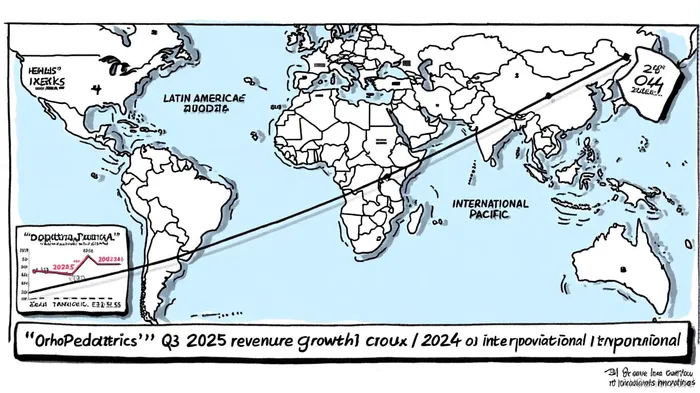







Comentarios
Aún no hay comentarios