
Orla Mining's Stock Volatility Post-Newmont Exit: Strategic Investor Implications in Junior Mining Equities
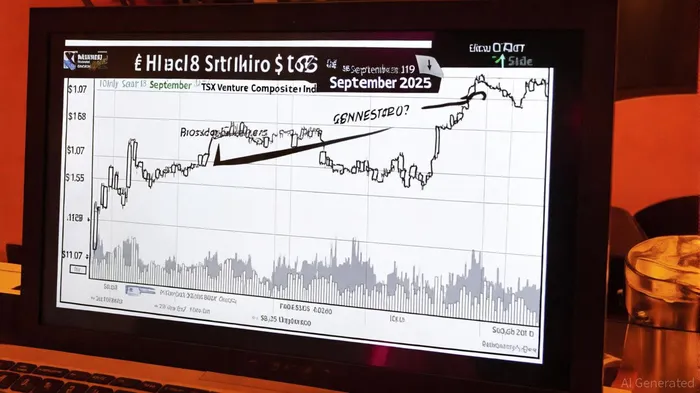
The recent exit of Newmont CorporationNEM-- from its 13.3% stake in Orla Mining Ltd.ORLA-- (ORLA) has ignited significant volatility in the junior mining equity, offering a case study in the strategic risks and opportunities inherent to the sector. Newmont's $439 million sale of 43 million shares at $10.14 per share on September 19, 2025, marked a decisive move to streamline its portfolio and prioritize capital allocation[1]. While the transaction generated immediate gains for NewmontNEM--, it also triggered a mixed market response for OrlaORLA--, reflecting the broader challenges and dynamics of junior mining stocks.
Immediate Market Reaction and Sentiment Shifts
Orla Mining's stock closed at $11.07 on September 18, 2025, and surged to $11.50 the following day, a 4.3% increase, as Newmont's exit became public[2]. Analysts attribute this upward movement to a combination of factors: the validation of Orla's asset base by a major player like Newmont, the company's recent acquisition of the Musselwhite mine, and improved investor sentiment around gold prices and exploration potential[3]. However, the stock's post-sale trajectory remains precarious. Junior mining equities are notoriously volatile, with historical data showing price swings of 30–40% even in the absence of major news events[4]. For instance, the TSX Venture Composite Index, a bellwether for junior miners, has experienced a three-year decline, underscoring the sector's susceptibility to macroeconomic headwinds like inflation and rising interest rates[5].
Strategic Implications for Investors
Newmont's exit highlights a critical dynamic in junior mining equities: the dual role of major shareholders as both validators and stabilizers. When a large investor like Newmont divests, it often signals a reallocation of capital to higher-priority projects, but it can also destabilize smaller peers reliant on institutional backing. According to a 2025 report by Discovery Alert, junior miners face a “binary outcome environment,” where only a fraction of exploration projects reach production, amplifying uncertainty for investors[6]. Orla's case is no exception. While the company has benefited from Newmont's infrastructure and expertise (e.g., the Musselwhite mine acquisition), its future performance will depend on its ability to attract new capital and execute on exploration targets without the safety net of a major partner[7].
The transaction also underscores the cyclical nature of the junior mining sector. As noted by New Age Metals, junior stocks often lag behind commodity price trends due to their speculative focus on exploration rather than production[8]. For example, despite gold prices hitting record highs in 2025, junior gold equities underperformed, with Orla's year-to-date gain of 99.82% outpacing the broader sector's decline[9]. This divergence suggests that while macroeconomic tailwinds (e.g., geopolitical tensions, central bank demand) can boost commodity prices, junior stocks require additional catalysts—such as Newmont's stake sale—to unlock value.
Risk/Reward Dynamics and Investor Due Diligence
For investors, the Orla-Newmont saga illustrates the importance of rigorous due diligence in junior mining. As Joe Mazumdar of Exploration Insights emphasizes, success in the sector hinges on evaluating factors like geological continuity, management track records, and jurisdictional stability[10]. Orla's current market cap of $3.61 billion and its focus on gold and uranium—critical for energy transition—position it as a high-risk, high-reward play[11]. However, the company's reliance on equity financing and its exposure to exploration risks (with over 70% of junior projects failing to reach production[12]) necessitate a long-term, patient approach.
Moreover, the sale aligns with a broader trend of strategic consolidation in the junior mining space. Newmont's $900 million in 2025 equity divestitures, including the Musselwhite mine transfer, reflects a sector-wide shift toward optimizing capital efficiency[13]. For Orla, this means competing in a landscape where smaller players are increasingly pressured to demonstrate near-term production potential or face dilution through equity raises.
Conclusion: Navigating the Volatility
Orla Mining's stock volatility post-Newmont exit encapsulates the strategic complexities of junior mining equities. While the transaction has injected short-term optimism, investors must weigh the company's exploration risks against its potential to capitalize on gold and uranium demand. The broader lesson for the sector is clear: junior miners thrive in environments of strong commodity prices and disciplined capital allocation but require robust fundamentals to weather the inherent volatility. As the market digests Newmont's move, Orla's ability to maintain momentum will depend on its operational execution and the sector's cyclical upturn—a reminder that in junior mining, patience and precision are as valuable as gold itself.





Comentarios
Aún no hay comentarios