
Orion Properties' Strategic Shift: A Path to Earnings Stabilization in a Challenging Real Estate Landscape
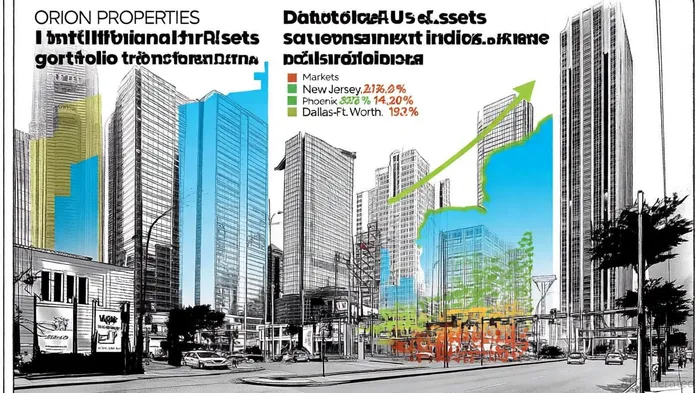
In the face of a turbulent real estate market, Orion PropertiesONL-- Inc. (ONL) has embarked on a strategic pivot to stabilize earnings and position itself for long-term resilience. The company's shift from traditional office properties to dedicated-use assets (DUA)—including government, medical, laboratory/R&D, and flex operations facilities—reflects a calculated response to sector-specific headwinds and evolving demand patterns. This analysis examines Orion's near-term financial strength, its alignment with 2025 market trends, and the structural advantages of its portfolio repositioning.
Near-Term Financial Resilience: Liquidity and Strategic Dispositions
Orion's first-half 2025 results underscore its focus on liquidity and capital efficiency. The company reported $243.9 million in cash and revolver availability as of April 2025[4], a critical buffer amid a challenging operating environment. This liquidity has enabled Orion to execute strategic dispositions, including the sale of three vacant properties for $19.1 million and two additional properties under contract for $27.3 million[4]. These transactions not only reduce non-core exposure but also provide capital for debt management and value-enhancing investments.
The company's Q2 2025 results, while showing a net loss of $0.45 per share[1], highlight operational progress. Orion completed 639,000 square feet of leasing year-to-date, including a 15.7-year lease in Parsippany, New Jersey[4], which provides long-term cash flow visibility. Additionally, the firm increased its 2025 Core FFO guidance range and adjusted its Net Debt to Adjusted EBITDA target, signaling confidence in its capital structure optimization[1].
Sector Positioning: Capitalizing on Industrial and DUA Demand
The 2025 real estate market is witnessing robust demand in industrial and commercial sectors, driven by e-commerce growth and supply chain resiliency strategies. According to CBRE, U.S. industrial vacancy rates remain at 6.8% (Q3 2024), well below pre-pandemic levels, while e-commerce is projected to account for 25% of retail sales by year-end[1]. Orion's pivot to DUAs aligns with these trends, as government and medical tenants—less sensitive to economic cycles—offer stable cash flows. As of March 2025, 32% of Orion's portfolio by annualized base rent is classified as DUA[1], a figure expected to rise as traditional office assets are divested.
The company's geographic focus further strengthens its positioning. Orion is targeting high-growth Sun Belt and Western U.S. markets, such as Phoenix and Dallas-Ft. Worth, where population growth and business-friendly environments drive demand for industrial and multifamily assets[3]. For example, Colorado Springs and Tucson are projected to see combined home sale growth of 39.8% in 2025, supported by improved housing inventory and lower mortgage rates[3]. Orion's repositioning of multifamily properties in these markets through capital improvements is designed to enhance value and occupancy.
Challenges and Mitigation Strategies
Despite these strengths, Orion faces near-term revenue pressures. Q2 2025 revenue fell to $37.3 million from $40.1 million in the prior-year period[1], and analyst forecasts predict a 7% year-over-year decline in Q3 2025 revenue[2]. However, the company's strategic focus on long-term leases and DUAs mitigates exposure to short-term market volatility. The 15.7-year lease in Parsippany, for instance, locks in income for over a decade, reducing the risk of tenant turnover.
Orion's dividend policy also reflects prudence. The firm declared a $0.02 per share dividend for Q3 2025[1], a modest payout that balances shareholder returns with capital preservation. This approach aligns with its broader strategy to prioritize debt reduction and portfolio optimization over aggressive distribution growth.
Conclusion: A Foundation for Earnings Stabilization
Orion Properties' strategic shift to DUAs and industrial assets, coupled with disciplined capital management, positions the company to navigate near-term challenges while capitalizing on long-term sector trends. The firm's liquidity, geographic diversification, and alignment with e-commerce-driven industrial demand create a resilient foundation for earnings stabilization. While revenue declines and operational losses persist in the short term, Orion's proactive repositioning—backed by strong liquidity and a focus on high-growth markets—suggests a path toward sustainable cash flow and value creation.
Historical context from recent market behavior adds nuance to this outlook. A backtest of ONL's stock performance around earnings releases since 2022 reveals a mixed picture: the average 30-day return is negative (~-2.5%), with statistically significant declines emerging by day 16–18 post-announcement[1]. The win rate (positive price movement relative to the event date) hovers around 45-50%, indicating no strong bullish edge immediately after earnings. These findings suggest that while Orion's fundamentals are robust, market reactions to its earnings events have been inconsistent, underscoring the importance of a long-term, fundamentals-driven investment approach.





Comentarios
Aún no hay comentarios