
Origin Energy's FY25 Resilience: A Defensive Play in a Decarbonizing Energy Transition
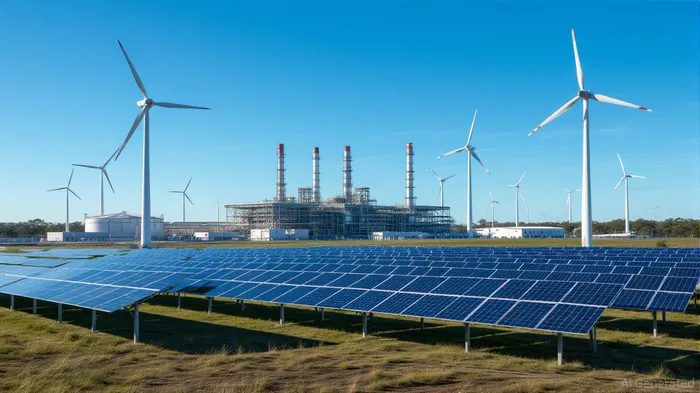
The global energy sector in 2025 remains a landscape of paradoxes: soaring demand for clean energy coexists with volatile fossil fuel markets, while geopolitical tensions and climate policies create a tug-of-war for investors. Against this backdrop, Origin Energy's fiscal 2025 results offer a compelling case study in balancing short-term resilience with long-term decarbonization. For investors seeking stability in a shifting energy paradigm, the company's performance and strategic direction warrant closer scrutiny.
Navigating Volatility: FY25 Financials in Context
Origin Energy's FY25 statutory profit of $1.48 billion and underlying profit of $1.49 billion reflect a disciplined approach to cost management and operational efficiency. While underlying EBITDA dipped slightly to $3.41 billion from $3.53 billion in FY24, this decline was mitigated by a 14.6% return on capital employed (ROCE), outpacing many peers in the sector. The adjusted net debt-to-EBITDA ratio of 1.9x, though higher than the previous year, remains within manageable limits for a company with a 60-cent-per-share fully franked dividend yield.
The Integrated Gas segment, a cornerstone of Origin's operations, faced headwinds from lower LNG prices and natural field decline, yet production stabilized at 682 petajoules (PJ) for the year. This resilience is critical in a market where gas remains a transitional fuel. Meanwhile, the Energy Markets division demonstrated agility, with a narrowed EBITDA guidance of $1.3–1.4 billion driven by strong wholesale portfolio performance and reduced green certificate costs.
Strategic Diversification: The Octopus Factor
Origin's international armARM--, Octopus Energy, has emerged as both a growth engine and a risk. The acquisition added 600,000 net customer accounts in FY25, expanding its global footprint to 14 million in the UK and 2.7 million internationally. However, the segment's EBITDA contribution turned negative due to unseasonably warm UK weather and aggressive investments in energy services. This underscores the challenges of scaling renewable retail operations in a volatile climate, yet it aligns with Origin's long-term vision of becoming a net-zero company by 2050.
The Kraken Technologies division, part of Octopus, further illustrates this duality. With 74 million contracted accounts and a 45% growth in the US market, Kraken's expansion into battery storage and smart grid solutions positions Origin at the forefront of decentralized energy. While these investments may dilute short-term margins, they are essential for capturing value in a decarbonizing economy.
Future Outlook: EBITDA Guidance and Capital Allocation
Origin's FY26 EBITDA guidance of $1.4–1.7 billion hinges on two key factors: the stabilization of gas prices and the acceleration of renewable projects. The company plans to invest $800 million to $1.1 billion in batteries and generation projects, including the Eraring and Mortlake facilities, which are critical for Australia's energy security. This capital allocation reflects a strategic pivot toward energy transition infrastructure, a sector expected to grow at a 12% CAGR through 2030.
The Energy Markets segment's cost reduction target of $100–150 million by FY26 further strengthens its defensive profile. By optimizing generation plant availability and leveraging market volatility, Origin can maintain profitability even as fossil fuel demand wanes. Meanwhile, the Integrated Gas division's production guidance of 635–680 PJ for FY26, though lower than FY25, remains competitive in a market where gas is expected to retain 20% of global energy demand by 2030.
Investment Thesis: Balancing Risk and Reward
For investors, Origin Energy presents a hybrid opportunity: a utility-like dividend yield (60 cents per share, or ~4.5% based on its current stock price) paired with growth potential in renewables. The company's adjusted net debt-to-EBITDA ratio of 1.9x is slightly elevated but manageable, especially given its exposure to regulated markets and long-term power purchase agreements.
However, risks persist. The Octopus Energy segment's EBITDA drag and the capital intensity of battery projects could pressure short-term returns. Additionally, regulatory shifts in Australia's energy market, such as changes to green certificate pricing, may impact the Energy Markets division.
Conclusion: A Defensive Play with Transition Potential
In a decarbonizing economy, Origin Energy's dual focus on transitional gas and renewable infrastructure makes it a unique defensive play. While its FY25 results highlight the challenges of navigating a volatile market, the company's strategic investments in batteries, solar, and smart grid technologies position it to thrive in the long term. For investors prioritizing resilience and alignment with global climate goals, Origin offers a compelling mix of stability and growth—provided they are willing to tolerate near-term volatility in exchange for a stake in the energy transition.
As the world grapples with the dual imperatives of energy security and sustainability, companies like Origin Energy will be pivotal in bridging the gapGAP--. Whether as a core holding in a diversified portfolio or a speculative bet on the renewables boom, Origin's journey is one worth watching.







Comentarios
Aún no hay comentarios