
Origin Energy's Fiscal 2025 Performance: A Durable Energy Transition or a Fleeting Wind?
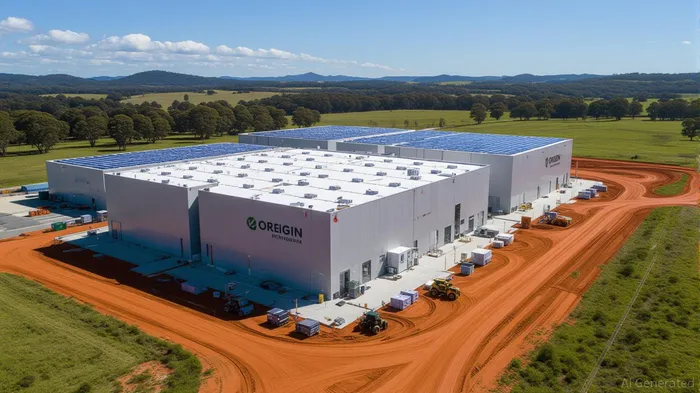
Origin Energy's Fiscal 2025 results, marked by a 26% profit growth and AU$17.22 billion in revenue, present a compelling case for investors seeking exposure to the energy transition. However, the question remains: does this performance signal a durable shift toward long-term value creation, or is it a product of short-term market tailwinds in a volatile sector?
Financial Resilience Amid Volatility
Origin's Integrated Gas segment delivered a 25% year-on-year increase in underlying EBITDA to $1,251 million, driven by LNG trading gains and higher sales volumes. This segment's ability to generate $797 million in fully franked dividends underscores its role as a cash-flow engine. Meanwhile, the Energy Markets division, despite a 29% drop in EBITDA to $738 million due to lower wholesale electricity prices and higher coal costs, added 57,000 customer accounts, bringing its total to 4.7 million. The Octopus Energy segment, now serving 7.6 million UK customers and 14 million accounts globally, added 600,000 net customers in the June quarter, though it posted a $24 million EBITDA loss due to reinvestment in low-carbon technologies.
The company's statutory profit of $1,017 million for H1 FY25, up from $995 million in the prior year, reflects operational discipline and tax efficiency. A 30-cent-per-share interim dividend, fully franked, signals confidence in cash generation. Yet, the slight decline in underlying EBITDA to $1,926 million from $1,995 million highlights the fragility of margins in a sector prone to commodity price swings.
Energy Transition: Ambition vs. Execution
Origin's decarbonization strategy hinges on two pillars: retiring coal assets and scaling renewables. The accelerated closure of the Eraring coal plant by 2025—a 7-year advance—aims to cut 57% of its 2030 emissions target. This bold move aligns with the Paris Agreement's 1.5°C pathway but carries risks. Delays in decommissioning could overshoot carbon budgets, while the plant's temporary extension until 2027 under a government agreement introduces operational uncertainty.
The company's renewable investments, however, are robust. A $1.7 billion commitment to battery storage (Eraring, Mortlake) and 4–5 GW of renewables by 2030 positions Origin as a key player in grid resilience. The Eraring battery, set to become the Southern Hemisphere's largest, and the Navigator North offshore wind project (1.5 GW potential) demonstrate technical and strategic depth. Additionally, the acquisition of Climatech Zero, a decarbonisation solutions provider, expands Origin's value proposition to industrial clients.
Yet, contradictions persist. Origin's continued gas exploration in the Canning and Cooper-Eromanga basins, despite divesting Beetaloo Basin interests, raises concerns about alignment with climate goals. Critics argue that offtake agreements with new operators like Tamboran ResourcesTBN-- risk locking in fossil fuel infrastructure. Regulatory scrutiny of its membership in pro-fossil fuel associations (APPEA, QRC) further complicates its green credentials.
Market Volatility and Shareholder Value
Origin's FY25 performance benefits from a unique confluence of factors: high LNG prices, strong customer acquisition, and renewable project momentum. However, these gains may not be sustainable. The Integrated Gas segment's projected LNG trading gains of $400–$450 million in FY25 taper to $50–$150 million in FY26, reflecting market normalization. Energy Markets' reliance on coal, now 5–6 million tonnes at $30/tonne higher costs, exposes it to further margin compression.
For long-term value creation, Origin must balance near-term profitability with decarbonization. Its $1.2 billion cash reserve and strong balance sheet provide flexibility, but capital allocation toward renewables must outpace fossil fuel investments. The 5 GW renewable target by 2030 is ambitious, yet execution risks—supply chain bottlenecks, regulatory delays—could delay returns.
Investment Implications
Origin's stock has historically traded at a premium to peers due to its integrated model and transition narrative. shows a 15% gain, outperforming the ASX 200 Energy Index. However, valuations remain sensitive to energy prices and policy shifts.
Key risks for investors include:
1. Gas exposure: Continued investment in unconventional gas could undermine climate credibility.
2. Regulatory headwinds: Pressure from groups like the Australasian Centre for Corporate Responsibility may force policy changes.
3. Execution risks: Delays in renewable projects or battery storage could erode margins.
Opportunities lie in:
- Renewable scale: The 5 GW target and battery storage projects position Origin to benefit from Australia's energy transition.
- Customer growth: Octopus Energy's 7.6 million UK accounts and Kraken's 74 million contracted accounts offer recurring revenue streams.
- Diversification: Climatech Zero's industrial decarbonisation services open new markets.
Conclusion: A Calculated Bet
Origin Energy's FY25 results reflect a company navigating a complex transition. While its 26% profit growth and AU$17.22 billion revenue are impressive, durability hinges on its ability to phase out fossil fuels and deliver on renewable targets. Investors should monitor three metrics:
1. Eraring's closure timeline: A delay to 2030 would signal poor execution.
2. Renewable capacity additions: Progress toward 5 GW by 2030 will validate the transition narrative.
3. Gas exploration activity: A full exit from Canning and Cooper-Eromanga basins would strengthen climate alignment.
For now, Origin offers a compelling mix of near-term cash flow and long-term transition potential. However, investors must weigh the risks of regulatory and market volatility against the company's strategic clarity. In a sector where the energy transition is both a challenge and an opportunity, Origin's success will depend on its ability to walk the line between profitability and sustainability.







Comentarios
Aún no hay comentarios