
ORIC's 2026 Catalysts: Assessing the Event-Driven Setup
The setup is now clear. ORIC's stock has already moved, rallying 12% over the past five days. That pop signals the market is pricing in the company's ambitious 2026 milestone calendar. The near-term risk/reward hinges on whether the upcoming data can justify this advance or if the stock has gotten ahead of itself.
The catalysts are specific and sequential. ORICORIC-- expects to report four clinical data readouts across its two lead programs through mid-2026, a steady stream designed to keep the stock in focus. The first major event is the anticipated Phase 3 start for rinzimetostat in the first half of 2026. This is the most immediate potential inflection point, a definitive step toward registrational studies that could validate the program's potential. The company has already laid the groundwork, with Phase 1b data showing potential best-in-class efficacy and safety in metastatic prostate cancer.
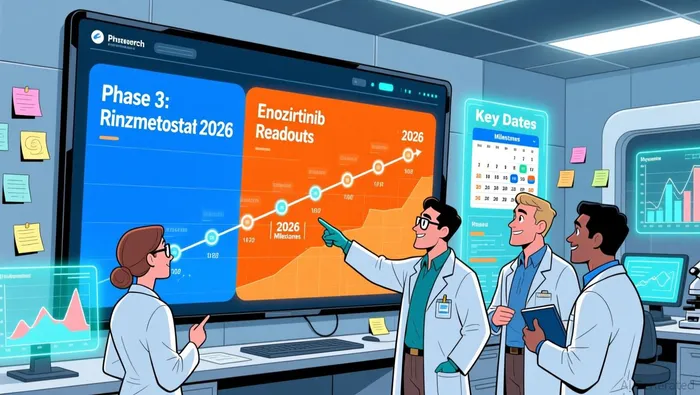
Following that, the focus shifts to enozertinib. The second half of the year is packed with multiple Phase 1b data readouts for this lung cancer candidate. These will be crucial for building momentum and confirming its competitive edge, particularly its highly competitive systemic and intracranial activity in specific EGFR mutations. Success here would strengthen the case for a rapid Phase 3 transition.
The bottom line is a series of binary events. The stock's recent rally suggests the market is optimistic about these milestones. The tactical question is whether the current price reflects a fair valuation for the upcoming data, or if there's still room for a pop if the readouts meet or exceed expectations. The cash runway is solid, with $413 million in cash and investments providing ample time to execute this plan. The catalysts are now in motion.
The Financial Engine: Cash Runway and Strategic Shift
The financial foundation for ORIC's 2026 push is now robust. The company raised $244 million in 2025, bringing its total cash and investments to $413 million. This capital provides a runway into the second half of 2028, effectively removing any near-term dilution risk and giving the company ample time to execute its planned clinical milestones.
This strength enabled a decisive strategic shift. In anticipation of potential Phase 3 starts in 2026, ORIC has substantially reduced investment in discovery research. This reprioritization, coupled with a 20% workforce reduction, streamlines operations to focus resources exclusively on advancing its two lead programs toward registrational trials. The move creates a cleaner, more focused path to catalysts.
The bottom line is a capital-efficient setup. The extended cash runway, combined with a leaner operating plan, allows ORIC to fund its ambitious 2026 data readout schedule without financial strain. This financial discipline supports the tactical thesis: the stock's recent rally may be justified if the company can demonstrate progress toward those critical Phase 3 starts. The financial engine is now primed for the next leg of the journey.
The Competitive Landscape: Best-in-Class Claims vs. Real-World Pressure
The bullish narrative for ORIC rests on its claim of "best-in-class" potential for rinzimetostat in metastatic castrate-resistant prostate cancer (mCRPC). The Phase 1b data provides a solid foundation, showing a PSA50 rate of 55% and a ctDNA reduction greater than 50% in 76% of patients. These are strong signals of biological activity. Yet the competitive landscape is now shifting, testing the durability of that claim.
The immediate threat is direct and well-funded. Pfizer has just initiated a first-line Phase 3 trial, MeVpro-2, for its EZH2 inhibitor mevrometostat in treatment-naive mCRPC patients. This adds a major, late-stage competitor to the same space where ORIC is planning its pivotal study. While ORIC's EED-targeting approach is mechanistically distinct, the market will now compare the two head-to-head on efficacy and safety. Pfizer's move is a clear signal that the EZH2/PRC2 pathway is a high-value target, but it also means ORIC's path to differentiation is more crowded than previously assumed.
On the other side of the pipeline, enozertinib's story is more nuanced. Its 100% intracranial ORR in measurable CNS disease is a powerful differentiator in the EGFR exon 20 lung cancer market. However, that market is not a vacuum. It is crowded, with multiple agents vying for position. Enozertinib's systemic activity, with a 1L ORR of 67% in EGFR exon 20, is competitive, but it must now prove it can maintain that edge in the face of established and emerging therapies.
The bottom line is that ORIC's "best-in-class" positioning is credible on paper but vulnerable in practice. The company has built a strong clinical profile, but the entry of a Phase 3 competitor like Pfizer's drug introduces significant near-term uncertainty. For the stock's event-driven setup to hold, ORIC's upcoming Phase 3 start must not only be successful but also demonstrate a clear, measurable advantage over this new benchmark. The competitive pressure is now a tangible part of the risk/reward equation.
Catalysts and Risks: What to Watch in 2026
The forward view is now defined by a clear set of watchpoints. The stock's recent 12% pop shows the market is betting on ORIC's 2026 milestones, but the broader trend tells a more cautious story. Over the past 120 days, the shares have fallen 17.27%, indicating deep-seated skepticism that a series of positive readouts will be needed to reverse. The primary near-term risk is that the data fails to materially outperform existing benchmarks or internal expectations, leading to a re-rating.
The first major test is the Phase 3 start for rinzimetostat in the first half of 2026. This is the most immediate potential inflection point. A delay would be a negative catalyst, but more importantly, the data profile presented at that start must demonstrate a clear advantage. The competitive landscape has hardened with Pfizer's MeVpro-2 trial for its EZH2 inhibitor mevrometostat in first-line mCRPC. ORIC's EED-targeting approach is distinct, but the market will now compare the two head-to-head. Success here requires not just efficacy, but a measurable edge that justifies the registrational investment.
Following that, the focus shifts to enozertinib. The company expects multiple clinical data readouts for enozertinib in 2026. These are crucial for building momentum and confirming its competitive edge, particularly its 100% intracranial ORR in measurable CNS disease. The risk is that these readouts, while strong, do not significantly differentiate the drug in a crowded EGFR exon 20 market, leaving its path to a rapid Phase 3 transition less certain.
The bottom line is a binary event calendar. For the stock to sustain its rally and close the gap with its 120-day decline, ORIC must deliver a steady stream of data that validates its "best-in-class" claims against a more competitive backdrop. The financial runway is secure, but the investment thesis now hinges entirely on clinical execution. Watch for the Phase 3 start and the subsequent readouts; they are the only catalysts that can reset the narrative.





Comentarios
Aún no hay comentarios