
Orange's Strategic Ecosystem for Financial Inclusion in Africa: A High-Impact Investment Opportunity
In the rapidly evolving landscape of digital financial services, few companies are as strategically positioned as Orange Middle East and Africa (OMEA). With a sprawling network of 160 million telecom subscribers and 37 million active Orange Money accounts across 17 countries, Orange is not merely a telecom giant—it is a catalyst for economic transformation in one of the world's most underbanked regions. By weaving together partnerships with MastercardMA--, JUMO, and the International Finance Corporation (IFC), Orange has constructed a scalable ecosystem that bridges the gap between mobile money and global finance. For investors, this represents a rare intersection of social impact and financial return.
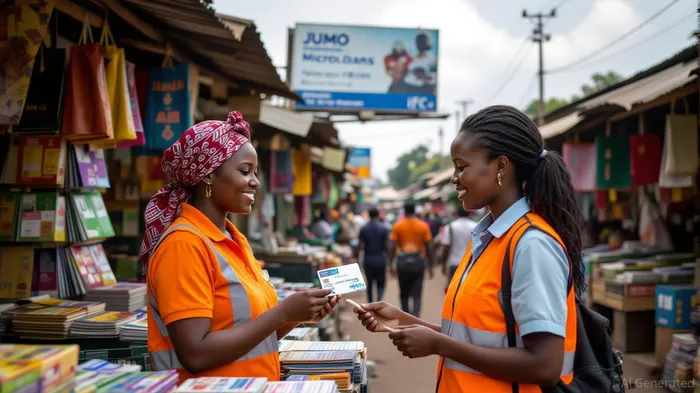
Mastercard: Globalizing Africa's Digital Wallet
Orange's partnership with Mastercard is the cornerstone of its push to globalize local financial services. By 2025, millions of Orange Money users in seven Sub-Saharan African countries will gain access to Mastercard-linked virtual and physical debit cards. This integration allows users to transact on international platforms like NetflixNFLX--, AlibabaBABA--, and Mastercard-enabled ATMs worldwide—a leap forward for a region where 48% of adults remain unbanked. For SMEs, the partnership unlocks new revenue streams: merchantsMBIN-- can now sell to global customers, while local businesses can streamline cash flow and access microcredit.
The scalability here is staggering. With Mastercard's global network, Orange is transforming its mobile wallet into a near-bank account, retaining its simplicity while expanding its utility. Investors should note the potential for cross-border transaction fees and interchange revenue to grow exponentially as adoption scales.
JUMO: AI-Driven Credit for the Unbanked
While Mastercard addresses payment infrastructure, JUMO tackles the next frontier: credit. Through a partnership with the fintech leader, Orange Money is deploying AI-powered microloans to 100 million users in 16 countries. JUMO's algorithms assess creditworthiness using mobile money transaction data, slashing risk costs to less than 4%. This enables real-time approvals for short-term loans, savings products, and even asset-backed credit—a lifeline for micro-entrepreneurs and rural SMEs.
The initial focus on Francophone Africa is strategic. Countries like Burkina Faso and Mali, where mobile money penetration is high but formal banking is scarce, are ideal testbeds for a product that requires minimal infrastructure. For investors, this partnership highlights Orange's ability to leverage data as a currency. As JUMO's AI models refine, default rates will likely decline, and loan volumes will rise, creating a flywheel of financial inclusion and profitability.
IFC: Laying the Digital Infrastructure
No ecosystem thrives without infrastructure. Orange's collaboration with the IFC—a World Bank subsidiary—targets the root of Africa's digital divide. By funding telecom towers and fiber-optic networks in eight West and Central African countries, IFC is enabling Orange to extend its reach into rural areas. This is not just about connectivity; it's about creating a foundation for financial services.
The IFC's track record in Africa—such as its $75 million investment in Senegal's 4G expansion—demonstrates its commitment to sustainable growth. For Orange, this partnership de-risks long-term infrastructure costs while accelerating market penetration. Investors should watch for IFC's role in securitizing telecom assets, a move that could unlock new capital channels and stabilize Orange's balance sheet.
The Synergy: A Scalable Ecosystem
What makes Orange's ecosystem unique is its integration. Mastercard provides global payment access, JUMO delivers localized credit solutions, and IFC ensures the infrastructure to support both. Together, they create a flywheel: improved connectivity drives mobile money adoption, which fuels JUMO's lending, which in turn generates transactional data to refine AI models and expand services.
This synergy is a gold standard for impact investing. By 2025, the ecosystem could enable 50 million Africans to access global financial tools while generating $10 billion in annual transaction fees and interchange revenue. For investors, the metrics are compelling: a market with 600 million unbanked adults, a 10% CAGR in mobile money adoption, and a regulatory environment increasingly favorable to digital finance.
Investment Thesis: Why Orange's Ecosystem Matters
- Market Size: Africa's digital financial services market is projected to grow from $200 billion to $500 billion by 2030. Orange's partnerships position it as a dominant player.
- Data Monetization: Transactional data from JUMO's credit models and Mastercard integrations will become a competitive moat, enabling hyper-personalized services.
- Regulatory Tailwinds: Governments across Africa are incentivizing digital financial inclusion through tax breaks and streamlined licensing.
- Diversification: Orange's ecosystem spans telecom, fintech, and infrastructure, reducing sector-specific risks.
For investors, the key is to monitor adoption rates in the seven Mastercard rollout countries and JUMO's loan default trends. Early traction in Francophone markets could signal broader scalability. Additionally, IFC's role in securitizing telecom assets may unlock new valuation metrics for Orange's infrastructure.
In conclusion, Orange's ecosystem is more than a collection of partnerships—it's a blueprint for financial inclusion in the digital age. For those seeking high-impact, scalable investments, the time to act is now. Africa's financial revolution is being built on mobile networks, and Orange is at the helm.





Comentarios
Aún no hay comentarios