
Oracle's Q2 2025 Earnings Signal a Re-Rating of Enterprise Software and Infrastructure
The industrial sector's momentum in 2025 has been reshaped by Oracle's Q2 earnings, which underscore a seismic shift in enterprise software and infrastructure. The company's results—driven by AI infrastructure demand and strategic cloud expansion—have not only exceeded expectations but also signaled a broader re-rating of the sector. For investors, this represents a pivotal moment to reassess the value proposition of cloud and software plays, particularly those aligned with AI-driven industrial transformation.
Earnings Highlights: AI as the Catalyst
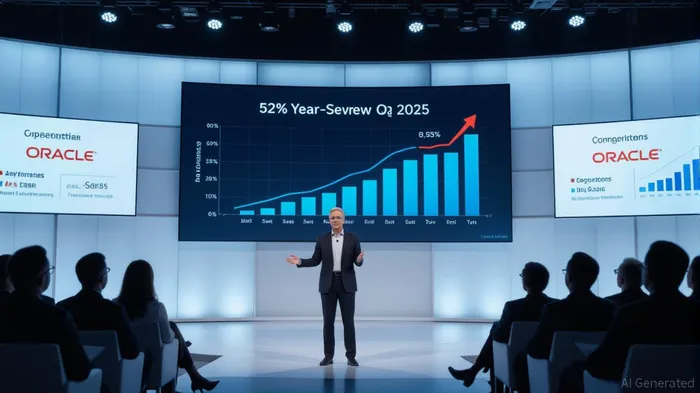
Oracle's Q2 2025 earnings report revealed a 9% year-over-year revenue increase to $14.1 billion, with cloud services emerging as the star performer. Cloud Infrastructure (IaaS) revenue surged 52% to $2.4 billion, fueled by a 336% spike in GPU consumption—a direct reflection of AI workloads[1]. Total cloud revenue hit $5.9 billion, up 24% year-over-year, with SaaS revenue growing 10% to $3.5 billion[1]. These figures outpace industry benchmarks, as competitors like AWS and MicrosoftMSFT-- grapple with slower growth in their cloud divisions.
The company's forward-looking guidance further amplifies its dominance. OracleORCL-- now projects a 77% year-over-year growth in cloud infrastructure revenue for fiscal 2026, targeting $18 billion, with a long-term goal of $144 billion by 2030[2]. This trajectory is underpinned by a 359% year-over-year increase in remaining performance obligations (RPO) to $455 billion, signaling sustained demand for its AI-optimized infrastructure[2].
Strategic Partnerships and AI Leadership
Oracle's partnerships with AI pioneers like OpenAI, MetaMETA--, and xAI have cemented its role as a critical player in the AI infrastructure ecosystem. A $30 billion annual contract with OpenAI alone—requiring the construction of multiple U.S. data centers—demonstrates the scale of demand for Oracle's low-cost, high-efficiency model[5]. CEO Safra Catz emphasized that Oracle's infrastructure trains “several of the world's most important generative AI models more efficiently and cost-effectively than other hyperscale competitors”[4], a claim validated by the 1,529% surge in revenue from multicloud collaborations with AmazonAMZN--, Alphabet, and Microsoft[5].
This strategic positioning has also reshaped industry dynamics. Oracle's Cloud@Customer offering, which provides on-premises cloud infrastructure, saw a 104% year-over-year revenue increase[3], while its SaaS applications—such as Fusion Cloud ERP and NetSuite—grew 18–22% year-over-year[3]. These solutions are increasingly vital for enterprises seeking AI-driven automation, as evidenced by customer success stories like DHL Supply Chain and Ocado Retail[3].
Industrial Sector Momentum and Re-Rating Thesis
Oracle's performance is not an isolated success but a harbinger of broader industrial sector momentum. The company's AI infrastructure expansion has triggered a chain reaction across the tech ecosystem. For instance, Oracle's premarket stock surge of 31% in Q2 2025 sent positive ripples to cloud and chipmakers like AMDAMD--, NvidiaNVDA--, and BroadcomAVGO--, which all saw gains of over 1.5%[5]. Analysts, including JPMorgan's Mark Murphy, highlight Oracle's “AI-related bookings momentum” as a key driver of sector-wide optimism[2].
The re-rating of enterprise software and infrastructure plays is further supported by Oracle's capital-light approach. With a $35 billion capex forecast for fiscal 2026, Oracle is poised to outpace rivals like Amazon and Microsoft in growth efficiency[5]. This model, combined with its full-stack AI capabilities—including 100 embedded AI agents in applications—positions Oracle to dominate the next phase of industrial digitalization[3].
Investment Implications
For investors, Oracle's Q2 results validate a re-rating thesis centered on AI-driven infrastructure. The company's ability to secure large-scale contracts, innovate in multicloud solutions, and integrate AI into core enterprise workflows suggests a sustainable growth trajectory. Analysts from Morgan StanleyMS-- and BarclaysBCS-- have raised price targets on Oracle stock, reflecting confidence in its ability to maintain this momentum[2].
However, risks remain. While Oracle's AI infrastructure is gaining traction, competition from AWS and Google Cloud remains fierce. Additionally, the long-term success of Oracle's multicloud strategy hinges on maintaining partnerships and delivering on its AI roadmap.
Historical backtesting of Oracle's earnings releases from 2022 to 2025 reveals a mixed picture. Averaged over the 30-day event window, post-earnings drift was positive but modest and statistically insignificant versus the benchmark. The strongest relative performance occurred around day 21 (+3.25% vs. benchmark +2.98%), though still below significance thresholds. While 1-day and 2-day reactions showed high hit rates (75% and 50%, respectively), they did not produce statistically significant alpha. These findings suggest that while Oracle's earnings events have historically generated positive momentum, their predictive power for sustained outperformance remains limited[2].
Conclusion
Oracle's Q2 2025 earnings have redefined the enterprise software and infrastructure landscape. By capitalizing on AI demand, strategic partnerships, and multicloud innovation, the company has not only outperformed expectations but also catalyzed a sector-wide re-rating. For investors, this represents a compelling case to overweight positions in cloud and AI infrastructure plays, particularly those with Oracle's level of execution and vision.





Comentarios
Aún no hay comentarios