
Oracle's Cloud Ambition: Why Its $138 Billion RPO and 70% Infrastructure Growth Signal a High-Conviction Buy Opportunity
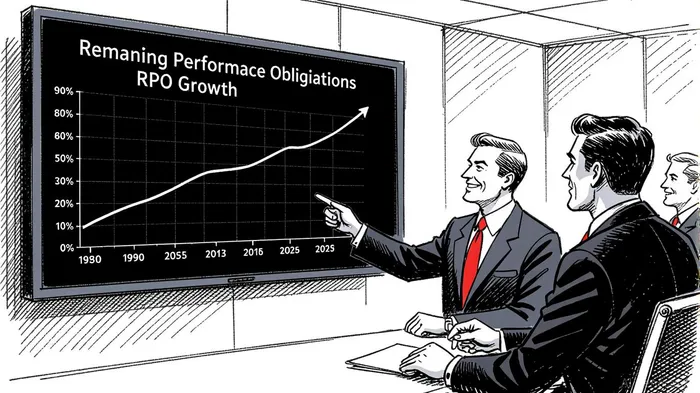
Oracle's cloud infrastructure division has emerged as a seismic force in the tech sector, driven by a perfect storm of AI demand, strategic innovation, and unparalleled revenue visibility. With remaining performance obligations (RPO) surging to $138 billion in Q4 2025—a 41% year-over-year increase—and a projected 70% growth rate in cloud infrastructure revenue for fiscal 2026, OracleORCL-- is rewriting the rules of cloud computing dominance. For investors, these figures are not just numbers; they are a masterclass in how to weaponize long-term contracts and AI-driven infrastructure to secure a multiyear growth trajectory.
RPO as a Strategic Moat: Why $138 Billion Matters
Oracle's RPO—a metric representing non-cancelable future revenue commitments—has become a critical barometer of its cloud ambitions. As of Q4 2025, the company's RPO ballooned to $138 billion, up from $97 billion in Q2 2025 and $48.5 billion in FY2024 [2]. This represents a 180% increase in just 18 months, signaling a shift from speculative growth to institutional-grade reliability. Unlike competitors like AWS or MicrosoftMSFT-- Azure, which rely on short-term consumption-based billing, Oracle's contract-heavy model creates a “land-and-expand” strategy that locks in clients for years.
The RPO surge is particularly potent in the cloud infrastructure segment, where Oracle's AI-focused offerings are reshaping the market. The deployment of the world's largest AI supercomputer—featuring 65,000 NVIDIANVDA-- H200 GPUs—has driven a 336% year-over-year increase in GPU consumption, outpacing even the most aggressive AI adoption forecasts [3]. This infrastructure, combined with Oracle's Stargate partnership for AI model deployment, has created a flywheel effect: clients commit to long-term contracts for GPU capacity, which in turn fuels Oracle's ability to invest in next-generation hardware and software.
Infrastructure Growth: A 70% CAGR Play on AI's Future
Oracle's cloud infrastructure revenue growth has accelerated from 24% in FY2025 to a projected 70% in FY2026 [1]. This exponential leap is not a one-off but a calculated response to the AI arms race. According to a Bloomberg report, CEO Safra Catz has explicitly stated that Oracle's infrastructure sales will “dramatically outpace” competitors in 2026, driven by three pillars:
1. AI-Optimized Hardware: Oracle's custom-built infrastructure, including the H200 GPU supercomputer, is tailored for large-scale AI training and inference.
2. Enterprise Adoption: Global enterprises are migrating to Oracle's cloud to avoid vendor lock-in with AWS and Azure while leveraging AI capabilities.
3. Strategic Partnerships: Collaborations with AI startups and enterprise software providers are expanding Oracle's ecosystem, creating a network effect.
This growth is further validated by Oracle's Q2 2025 results, where cloud infrastructure revenue hit $3 billion—a 52% increase—despite macroeconomic headwinds [2]. The company's ability to convert RPO into recurring revenue is now a self-fulfilling prophecy: clients sign multiyear contracts, Oracle deploys cutting-edge infrastructure, and the cycle repeats with higher margins and deeper client integration.
Competitive Positioning: Why Oracle Outpaces the Hyperscalers
While AWS and Microsoft Azure dominate the cloud market by sheer scale, Oracle's niche strategy is proving more lucrative. A key differentiator is Oracle's focus on AI infrastructure as a standalone offering, rather than embedding it within broader cloud services. This allows Oracle to charge premium pricing for GPU capacity and AI model deployment, as seen in its Stargate platform, which enables clients to deploy AI models in minutes [3].
Moreover, Oracle's RPO provides a level of revenue visibility that rivals cannot match. For instance, AWS's revenue is heavily tied to monthly usage, making it vulnerable to economic downturns. In contrast, Oracle's $138 billion RPO represents a backlog of future revenue that is largely insulated from short-term volatility. As noted in an analysis by Indmoney, Oracle's cloud RPO grew by 80% in Q1 2025 alone, reaching $99 billion—a testament to its ability to secure long-term commitments in a competitive landscape [3].
The Investment Case: High-Conviction Buy for the Long Term
Oracle's cloud infrastructure momentum is underpinned by three irrefutable facts:
1. RPO as a Growth Engine: The $138 billion backlog ensures a steady pipeline of revenue for years, with 70% of it tied to AI infrastructure.
2. AI-Driven Infrastructure: Oracle's supercomputer and GPU ecosystem position it as a critical player in the AI era, where compute power is the new oil.
3. Margin Expansion: The shift to contract-based billing and AI hardware sales is boosting gross margins, which now exceed 65% for cloud infrastructure [2].
For investors, the question is not whether Oracle can achieve its growth targets but whether the market is underestimating the durability of its RPO-driven model. With a P/E ratio of 28x and a forward PEG ratio of 0.8x (based on FY2026 guidance), Oracle is trading at a discount to its growth potential. As Bloomberg analysts argue, the company's ability to convert RPO into cash flow—coupled with its AI-first strategy—makes it a “high-conviction buy” for investors with a 3–5 year horizon [1].





Comentarios
Aún no hay comentarios