
Oracle's AI Growth and the Expanding AI Bubble
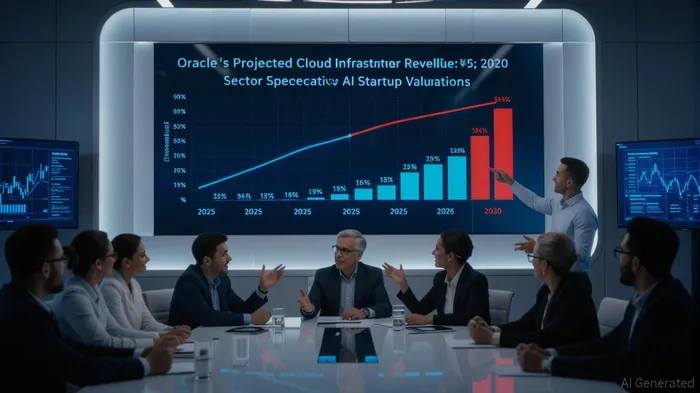
Oracle's AI-driven cloud infrastructure business has become a juggernaut, with OracleORCL-- Cloud Infrastructure (OCI) revenue surging 52% year-over-year to $2.4 billion in Q2 2025, fueled by a 336% spike in GPU consumption[1]. This growth is underpinned by Oracle's strategic bets, including a partnership with MetaMETA-- to deploy AI agents using Llama models and its integration of AI into cloud applications for drug design, diagnostics, and fraud detection[1]. CEO Safra Catz has positioned Oracle as a cost- and speed-efficient alternative to hyperscalers like AWS and Azure, a claim bolstered by its deployment of 65,000 NVIDIANVDA-- H200 GPUs—the world's largest AI supercomputer[1].
Yet, Oracle's financials tell a story of both promise and peril. Its trailing P/E ratio of 54.15 as of September 2025 is 100% above its 10-year historical average and significantly higher than peers like MicrosoftMSFT-- (36.53) and AdobeADBE-- (22.29)[2]. Meanwhile, Oracle's remaining performance obligations (RPO) ballooned 359% year-over-year to $455 billion, signaling robust future revenue visibility[3]. However, this valuation surge mirrors broader trends in the AI sector, where speculative funding has inflated valuations to unsustainable levels. Over 500 AI startups are valued at $1 billion or more despite lacking revenue, and high-profile failures like Humane Inc.'s AI Pin underscore the sector's volatility[4].
The disconnect between Oracle's fundamentals and its premium valuation raises critical questions. While the company's 31.45% operating margin and 21.68% net margin[3] justify some optimism, its projected OCI revenue growth—from $2.4 billion in Q2 2025 to $144 billion by 2030—relies on sustained AI demand and execution risks. For context, MIT research reveals that 95% of corporate AI projects fail to deliver measurable profit benefits[4], suggesting Oracle's clients may face similar challenges.
The AI sector's parallels to the dot-com bubble are hard to ignore. Economist Torsten Slok has called current conditions “even more unrealistic” than 2000, while OpenAI's Sam Altman admits an AI bubble exists[4]. Oracle's P/E ratio of 69.5x, though lower than its peers' 75.7x average[2], still exceeds the US software industry's 35.2x benchmark[2]. This premium reflects investor faith in Oracle's AI infrastructure but also exposes it to corrections if growth slows or AI adoption falters.
For investors, Oracle represents a high-stakes bet: its AI-driven cloud growth could redefine enterprise computing, but the sector's speculative fervor risks a reckoning. While Oracle's profitability and RPO metrics provide a buffer, the broader AI bubble's burst could erode valuations regardless of individual company performance. As Oracle races to dominate AI infrastructure, the question remains whether its ambitions align with reality—or if it's merely riding a speculative tide.





Comentarios
Aún no hay comentarios