
Oracle's AI-Driven Cloud Strategy: A Catalyst for Wall Street's Renewed Optimism
Oracle's recent financial performance has ignited Wall Street's interest, driven by a strategic pivot toward AI-driven cloud infrastructure that is reshaping its competitive narrative. In Q2 2025, OracleORCL-- reported a 52% year-over-year surge in cloud infrastructure revenue, reaching $2.4 billion—a figure that underscores its emergence as a formidable player in the AI-optimized cloud market[1]. Total revenue for the quarter hit $14.1 billion, with cloud services and license support contributing $10.8 billion, reflecting a 12% YoY increase[1]. This momentum is not merely a short-term spike but a reflection of sustained demand, as Oracle's remaining performance obligations (RPO) ballooned by 50% to $97 billion, signaling robust long-term contract visibility[1].
While Oracle's recent earnings have driven strong growth, historical data suggests that a simple buy-and-hold strategy around earnings dates may not offer a reliable edge. A backtest of Oracle's earnings releases from 2022 to 2025 reveals that short-term (1–5 trading-day) average excess returns were positive but statistically insignificant, and over a 30-day window, cumulative performance lagged the benchmark. The win rate hovered around 60% in the first month post-earnings, though this lacked statistical significance. These findings highlight the importance of focusing on Oracle's long-term fundamentals—such as its 52% YoY cloud growth and $25 billion infrastructure investment—rather than attempting to time the market around earnings events[2].
Enterprise Adoption and Strategic Partnerships: Fueling Growth
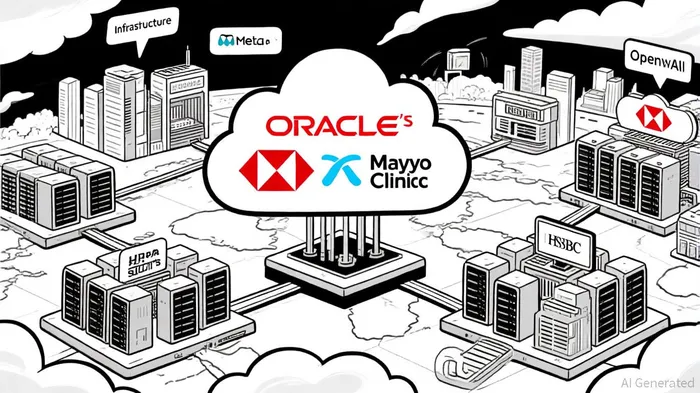
Oracle's aggressive capital expenditure plan—$25 billion allocated to expand its global cloud infrastructure—has positioned it to capitalize on the AI boom. The company is deploying 20 new cloud regions and 8 high-density AI superclusters powered by NVIDIANVDA-- and AMDAMD-- GPUs, directly addressing the surging demand for AI workloads[2]. This infrastructure expansion is complemented by strategic partnerships, such as its collaboration with MetaMETA-- to support AI development[1] and a landmark $300 billion computing power commitment with OpenAI[3]. The latter deal, which spans a decade, is projected to elevate Oracle's cloud revenue to $1 trillion by 2030, leveraging its expertise in secure, compliant solutions for industries like healthcare, finance, and defense[3].
Enterprise adoption trends further validate Oracle's positioning. Its cloud infrastructure revenue grew 52% YoY in Q4 FY 2025, outpacing AWS and MicrosoftMSFT--, while database revenue from AmazonAMZN--, Google, and Azure surged 115% sequentially[2]. Major clients, including HSBCHSBC--, Mayo Clinic, and the U.S. Air Force, are increasingly relying on Oracle's infrastructure for mission-critical workloads, drawn by its focus on open standards, multicloud orchestration, and predictable pricing[2].
Competitive Positioning: Challenging the “Big Three”
While AWS (30% market share) and Microsoft Azure (20%) dominate the global cloud market[4], Oracle's niche strategy is carving out a unique value proposition. Unlike hyperscalers, Oracle avoids vendor lock-in by offering tools for multicloud integration and transparent pricing models[2]. Its expansion into sovereign cloud regions—such as the UAE Government Cloud and EU Sovereign Cloud—aligns with global regulatory trends, attracting enterprises prioritizing data sovereignty[2].
In the AI-specific arena, Oracle's 52% growth rate in cloud infrastructure revenue outpaces AWS's 33% and Microsoft's hybrid cloud-driven gains[1]. CEO Safra Catz has projected cloud infrastructure growth exceeding 70% in FY 2026, fueled by AI workloads and enterprise demand for secure, high-performance solutions[2]. This trajectory positions Oracle to challenge Google Cloud (13% market share), which is also gaining traction in AI[4], while maintaining a credible threat to the “Big Three.”
Risks and Opportunities
Despite its momentum, Oracle faces headwinds. The $300 billion OpenAI deal, while transformative, hinges on sustained AI demand and regulatory approvals. Additionally, AWS and Microsoft's first-mover advantages in AI infrastructure (e.g., AWS's broad service portfolio, Microsoft's Azure OpenAI integration) remain formidable[4]. However, Oracle's focus on enterprise-specific use cases—such as AI training for regulated industries—and its $25 billion infrastructure investment provide a buffer against these challenges[2].
Conclusion: A Compelling Investment Thesis
Oracle's AI-driven cloud strategy has redefined its narrative from a legacy software vendor to a high-growth cloud innovator. With cloud infrastructure revenue growing at a pace outstripping its peers, a robust RPO of $138 billion[2], and strategic partnerships with industry leaders, Oracle is well-positioned to capture a larger share of the $99 billion global cloud infrastructure market[4]. For investors, the company's ability to balance aggressive expansion with enterprise-centric solutions presents a compelling case for long-term value creation.





Comentarios
Aún no hay comentarios