
Oracle's AI Data Software Edge and Cloud Ecosystem Integration: A Strategic Play for Enterprise AI Dominance in 2026
In the race to dominate enterprise artificial intelligence, OracleORCL-- has emerged as a formidable contender, leveraging its AI data software and cloud infrastructure to address the most pressing challenges of digital transformation. As businesses increasingly prioritize AI-driven decision-making and operational efficiency, Oracle's unique blend of multicloud flexibility, AI-native architecture, and deep enterprise integration positions it to outpace rivals like AWS, Microsoft, and Google Cloud. This analysis examines why Oracle is uniquely poised to lead enterprise AI adoption in 2026 and beyond, drawing on recent market trends, technological advancements, and sector-specific case studies.
The AI-First Cloud Infrastructure
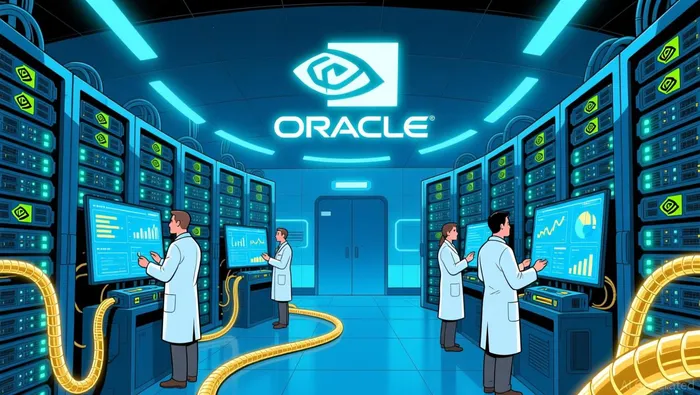
Oracle's competitive edge begins with its AI-native cloud infrastructure, which is designed to handle the computational demands of large-scale AI workloads. The company's OCI Supercluster, equipped with up to 131,072 NVIDIA GPUs, provides enterprises with the raw power needed for model training and inference, a critical differentiator in an era where AI performance directly correlates with business outcomes according to Oracle's announcement. Unlike competitors that rely on generic cloud hardware, Oracle's infrastructure is optimized for AI, reducing latency and improving throughput for data-intensive applications.
This focus on AI infrastructure is complemented by Oracle's multicloud strategy, which allows customers to deploy workloads across Oracle Cloud, AWS, Azure, and Google Cloud without incurring data transfer fees or performance penalties. By offering services like Oracle Database@Azure and Oracle Database@Google Cloud, Oracle addresses a key pain point for enterprises wary of vendor lock-in while maintaining control over data security and compliance. According to the 2025 IDC MarketScape report, this approach has elevated Oracle to a "Leader" position in public cloud infrastructure, challenging the dominance of hyperscalers according to the report.
Enterprise Trust and Regulatory Resilience
Oracle's decades-long expertise in enterprise databases and software has fostered trust in highly regulated industries such as finance, healthcare, and government. For instance, its autonomous database capabilities automate tasks like patching, backups, and security updates, reducing operational overhead while ensuring compliance with stringent data governance standards. This is particularly valuable in sectors where regulatory scrutiny is intense, such as healthcare, where Oracle's AI-driven data platforms are already streamlining workflows for providers and payers according to Oracle's healthcare solutions.
A 2025 Gartner review underscores Oracle's strength in enterprise integration, noting that its cloud applications-spanning ERP, HR, and supply chain management-offer seamless interoperability with legacy systems according to Gartner analysis. This capability is critical for large organizations burdened by outdated IT infrastructures, as it enables a gradual, cost-effective migration to AI-enhanced cloud solutions.
Case Studies: Healthcare as a Bellwether
The healthcare sector provides a compelling case study for Oracle's AI and cloud strategy. In 2025, institutions like Billings Clinic-Logan Health and Children's Hospital Los Angeles adopted Oracle Fusion Cloud Applications to unify finance, HR, and supply chain operations. These implementations reduced administrative workloads by up to 30%, allowing caregivers to focus more on patient care.
Oracle's next-generation EHR system, launched in late 2024, further exemplifies its AI-driven approach. By embedding real-time data intelligence and predictive analytics into electronic health records, the platform addresses long-standing inefficiencies in clinical workflows. For example, it automates documentation tasks, which account for nearly 40% of a physician's time, thereby reducing burnout and improving diagnostic accuracy.
Challenges and Counterarguments
Despite its strengths, Oracle faces headwinds. Hyperscalers like AWS and Azure dominate the cloud market, leveraging their first-mover advantages and vast ecosystems to attract enterprises. Additionally, Oracle's lack of high-profile case studies in finance and government-sectors where it has traditionally excelled-raises questions about the scalability of its AI solutions. However, Oracle's recent investments in AI infrastructure and multicloud partnerships suggest a long-term strategy to address these gaps. For instance, its Health Data Intelligence suite has already demonstrated measurable ROI in cost reduction and forecasting accuracy for healthcare leaders according to inclusionCloud insights.
The Investment Thesis
Oracle's ability to combine AI-native infrastructure with enterprise-grade security and multicloud flexibility creates a compelling value proposition. As AI adoption accelerates, enterprises will prioritize platforms that offer both technical agility and regulatory compliance-areas where Oracle excels. The company's focus on vertical-specific solutions, such as its healthcare ecosystem, further differentiates it from generalist cloud providers.
For investors, Oracle represents a strategic play on the convergence of AI and enterprise cloud computing. While the road to dominance is fraught with competition, Oracle's unique positioning-rooted in its heritage of enterprise software and its forward-looking AI investments-makes it a strong candidate to lead the next phase of digital transformation.





Comentarios
Aún no hay comentarios