
Oracle's $190 Billion Valuation Surge: A Case for Cloud Infrastructure Dominance and Enterprise AI Adoption
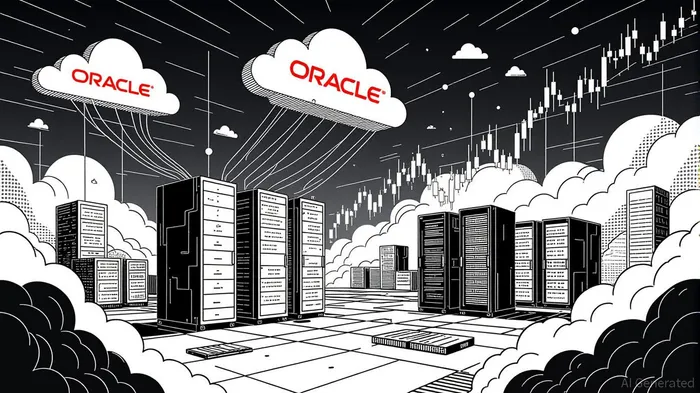
The global cloud computing market is undergoing a seismic shift, driven by the exponential adoption of artificial intelligence (AI) and the relentless pursuit of scalable infrastructure. At the forefront of this transformation is OracleORCL--, a company that has transitioned from a niche player to a formidable challenger in the cloud arena. With its Oracle Cloud Infrastructure (OCI) growing at a blistering 52% year-over-year pace in Q2 2025 and GPU consumption surging by 336%[1], Oracle is not merely participating in the AI revolution—it is defining its architecture. This analysis argues that Oracle's strategic investments, enterprise-grade AI solutions, and financial trajectory position it to achieve a $190 billion valuation, warranting urgent investor attention.
Financial Trajectory: A Foundation for Growth
Oracle's Q2 2025 results underscore its accelerating momentum. Total revenue reached $14.1 billion, with cloud services and license support contributing $10.8 billion—a 12% year-over-year increase[1]. The standout performer was OCI, which generated $2.4 billion in revenue, reflecting a 52% growth rate[1]. This outpaces the broader cloud market, where AWS, Azure, and GoogleGOOGL-- Cloud dominate but face margin pressures from discounting[4]. Oracle's remaining performance obligations (RPO) have ballooned to $97 billion, signaling robust future cash flows[1]. Analysts project cloud revenue to grow 40% in fiscal 2026, with infrastructure revenue alone expected to expand 70%[4]. Such figures suggest Oracle is not just capitalizing on current demand but securing long-term contracts that lock in enterprise clients.
Market Positioning: AI-Driven Differentiation
While AWS, Azure, and Google Cloud collectively hold 63% of the cloud infrastructure market[2], Oracle's niche strategy is paying dividends. Its focus on AI infrastructure—exemplified by the deployment of the world's largest AI supercomputer with 65,000 NVIDIANVDA-- H200 GPUs[1]—has attracted enterprises seeking high-performance computing without the premium pricing of competitors. Oracle's cost-effectiveness for AI training, combined with its expertise in enterprise databases, creates a unique value proposition[3]. For instance, its collaboration with MetaMETA-- to train Llama models on OCI[4] highlights its ability to secure partnerships with AI leaders, further cementing its role as a critical infrastructure provider.
Oracle's multi-cloud strategy also strengthens its position. By enabling customers to run Oracle databases on AWS, Azure, and Google Cloud[4], the company is expanding its ecosystem reach in a hybrid cloud era. This approach mitigates the risk of being confined to a single cloud provider while reinforcing Oracle's relevance in a fragmented market.
Strategic Investments: Building for the Future
Oracle's aggressive capital expenditures underscore its commitment to sustaining growth. A $30 billion data center project in Texas, dubbed “Stargate,” is designed to meet surging demand for AI infrastructure[2]. Additionally, the company has secured partnerships with hyperscalers like OpenAI and Microsoft[1], ensuring a steady pipeline of high-margin contracts. These investments are not speculative; they are aligned with enterprise demand for AI-driven solutions in healthcare, finance, and logistics, where Oracle's AI agents are automating drug design and fraud detection[4].
The company's RPO of $455 billion—a 359% increase from previous quarters[2]—further validates its ability to convert current demand into future revenue. This backlog, coupled with a projected $25 billion in 2026 capital expenditures[2], positions Oracle to outpace competitors in infrastructure scalability.
Valuation and Analyst Projections: Justifying the Premium
Oracle's valuation multiples—price-to-sales of 10.8 and price-to-book of 30—are elevated compared to industry averages[2]. However, these metrics are justified by its projected revenue growth and market positioning. Analysts have raised price targets to $190 (Piper Sandler) and $200 (Jefferies)[4], reflecting confidence in Oracle's ability to deliver sustained AI-driven growth. The company's stock surged 8% pre-market to $190 following its Q2 earnings report, signaling investor optimism[4].
While skeptics may question the sustainability of such high multiples, Oracle's unique infrastructure, strategic partnerships, and enterprise trust in data sovereignty[3] provide a strong moat. The company's ability to maintain profit margins despite aggressive spending will be critical, but its current trajectory suggests it is well-positioned to justify its valuation.
Conclusion: A Compelling Case for Urgent Action
Oracle's ascent in the cloud and AI markets is not a fleeting trend but a structural shift driven by strategic foresight and execution. With cloud infrastructure revenue projected to reach $144 billion by 2030[2] and a robust RPO backlog, the company is poised to capture a disproportionate share of the AI-driven cloud market. For investors, the combination of Oracle's financial strength, technological differentiation, and analyst optimism creates a compelling case for long-term capital appreciation. The $190 billion valuation is not a stretch—it is a logical outcome of Oracle's dominance in a market that is only beginning to realize its potential.





Comentarios
Aún no hay comentarios