
Oracle's $15 Billion Corporate Bond Sale: Strategic Financing or Market Signal?
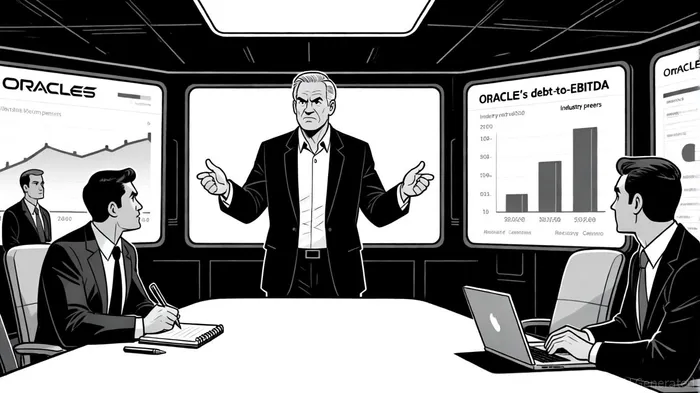
In the ever-shifting landscape of corporate finance, Oracle's $15 billion bond issuance has sparked a critical debate: Is this a calculated move to fund transformative AI infrastructure, or a red flag signaling deteriorating credit discipline in the high-yield tech debt market? The answer lies in dissecting Oracle's capital allocation choices, its credit risk profile, and how it stacks up against peers like Microsoft, Salesforce, and Adobe.
Credit Risk: A Double-Edged Sword
Oracle's recent bond sale, structured across six tranches with maturities ranging from 2026 to 2061, underscores its aggressive capital strategy. The shortest-term notes carry a 1.65% coupon, while the longest-term 2061 bonds yield 4.1%, reflecting investor appetite for Oracle's perceived stability despite the downgrades[2]. Fitch and Moody's both cut Oracle's ratings, citing concerns over its departure from “expected debt reduction practices”[6]. The company's debt-to-EBITDA ratio now stands at 3.90x, a marked increase from historical levels, while its debt-to-equity ratio hit 5.09x in 2025[6].
These metrics highlight a delicate balancing act. Oracle's CAPEX surged to $21.21 billion in FY2025, driven by AI infrastructure investments, which pushed free cash flow into negative territory (-$394 million) for the first time in years[6]. While operating income remains robust ($17.68 billion, 30.8% margin), the company's interest coverage ratio—though improved to 5.01—still lags behind peers[3]. For context, Microsoft's interest coverage ratio in 2025 was 52.84, and Salesforce's stood at 28.12[4]. Oracle's leverage, while not yet speculative-grade, is notably higher in a sector where deleveraging is the norm[1].
Capital Allocation: Growth at What Cost?
Oracle's capital allocation strategy has shifted from disciplined debt reduction to funding long-term growth. The proceeds from the bond sale will be used for debt repayment, dividends, buybacks, and acquisitions—a mix that analysts have split on. Thirty-six analysts raised their price targets in 2025, averaging $239.39 (up 21.19%), citing Oracle's “sales efficiency and market positioning”[2]. Yet, the negative free cash flow and elevated leverage ratios raise questions about sustainability.
Historical data on Oracle's stock performance around earnings releases offers additional context. A backtest of Oracle's stock from 2022 to 2025 reveals that the average excess return on the first trading day after an earnings release is +1.4%, with a statistically significant positive skew persisting for about a week. The win rate peaks at ~79% around day 5, but the effect fades quickly. From day 10 onward, cumulative excess returns oscillate between +1% and +5% without reaching conventional significance levels. This suggests that while Oracle's stock has historically outperformed the S&P 500 in the immediate aftermath of earnings, the market typically prices in the news within two weeks. A tactical “buy-on-close, sell-after-3-4-days” approach has historically captured most of the edge, while holding longer delivers no additional statistical payoff.
Compare this to Microsoft, which reduced its debt-to-equity ratio to 0.26 in 2025 while maintaining a 52.84 interest coverage ratio[4]. Salesforce, with a debt-to-equity ratio of 0.14, has similarly prioritized low leverage and high profitability (ROE of 11.20%)[4]. Adobe, though more leveraged (debt-to-EBITDA of 0.75x), maintains a stronger liquidity position (quick ratio of 0.82) than Oracle's strained free cash flow[5].
Oracle's approach reflects a bet on AI-driven growth, but the trade-off is increased financial risk. As Fitch noted, the downgrade was driven by “concerns over the trajectory of leverage”[6], particularly as Oracle's debt-to-capital ratio remains at 0.82—well above the sector average of 0.48[1].
High-Yield Tech Debt: A Sector in Transition
The broader high-yield tech debt market in 2025 appears resilient, with average leverage ratios at 7.54 and interest coverage at 6.72[1]. However, Oracle's case is unique. Unlike peers who are deleveraging, OracleORCL-- is re-leveraging to fund CAPEX. This divergence could signal either visionary leadership or misaligned priorities.
Investors must weigh Oracle's strategic rationale—expanding AI infrastructure against a backdrop of $23.91 billion in EBITDA and $12.44 billion in net income[6]—against the risks of over-leveraging. The bond market's willingness to fund Oracle at relatively low rates (e.g., 4.1% for 30-year notes) suggests confidence in its core business, but credit rating agencies remain cautious[2].
Conclusion: A Calculated Gamble
Oracle's $15 billion bond sale is neither a clear victory nor a definitive warning. It is a calculated gamble to secure its position in the AI arms race, executed at favorable rates but at the cost of higher leverage. While the company's operating margins and EBITDA growth are enviable, the shift to negative free cash flow and elevated debt metrics demand scrutiny.
For now, Oracle's credit profile remains investment-grade, but the path forward will hinge on its ability to convert AI investments into sustainable cash flow. As the tech sector continues to deleverage, Oracle's strategy will be a litmus test for whether aggressive reinvention justifies increased financial risk.





Comentarios
Aún no hay comentarios