
Options Traders and Implied Volatility: A Catalyst for The Lovesac (LOVE) Stock?
The Lovesac (LOVE) stock has long been a volatile proposition for investors, with its shares swinging between optimism and despair. Recent data suggests that options traders are once again signaling potential catalysts for the stock, driven by shifts in implied volatility (IV) and earnings revisions. However, the alignment of these factors with strategic trading opportunities remains a nuanced question.
Implied Volatility and Earnings Revisions: A Tenuous Link
LOVE's 30-day implied volatility (IV30) currently stands at 46.3, placing it in the 3rd percentile of its historical range over the past year. This elevated IV reflects market anticipation of near-term price swings, likely tied to the company's upcoming Q4 2026 earnings report in early 2026. Historically, LOVE's IV30 has experienced an average 35% drop after earnings announcements, a pattern consistent with broader market behavior where implied volatility often contracts post-earnings, a phenomenon known as "IV crush."
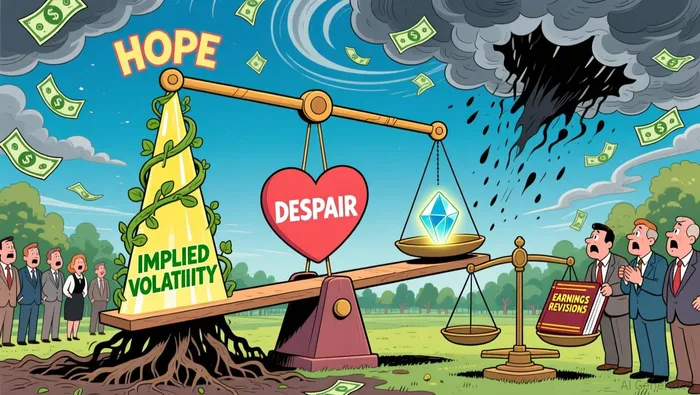 The Q3 2026 earnings report, released on December 11, 2025, underscored the risks of relying on IV as a proxy for positive outcomes. The company reported a net loss of $0.72 per share-worse than the estimated $0.70-and revenue of $150.17 million, below the $157.23 million forecast. This performance, coupled with weaker-than-expected holiday quarter guidance, triggered a sharp decline in LOVE's stock price. The subsequent IV crush-where actual price movement (-7.8%) fell far short of the predicted ±16.2% range-highlighted the disconnect between implied volatility and realized outcomes.
Analyst Revisions: Mixed Signals Amid Strategic Uncertainty
Analyst ratings for LOVELOVE-- have remained cautiously optimistic, with six firms maintaining a "Buy" rating and an average price target of $24.67. However, recent revisions reveal a bifurcated outlook. Maxim Group, for instance, lowered its price target from $38 to $33, while others reduced targets to as low as $18. These adjustments reflect skepticism about LOVE's ability to offset margin pressures from tariffs, transportation costs, and aggressive promotions.
The company's Q4 2026 guidance further complicates the picture. LOVE projected EPS of $1.88–$2.22 (vs. consensus $2.29) and revenue of $236–$256 million (vs. $259.5 million), signaling continued operational challenges. Despite these downgrades, institutional ownership remains robust at 91.3%, suggesting confidence from large investors. This divergence between retail and institutional sentiment creates a fertile ground for options strategies that capitalize on volatility differentials.
Strategic Options Trading: Selling Premium or Avoiding Risk?
For options traders, the interplay of high IV and weak fundamentals presents a dilemma. Selling premium-such as writing covered calls or short straddles-could be attractive if traders anticipate a post-earnings IV crush, as LOVE's historical pattern suggests a 35% decline in IV after reporting results. The recent Q3 IV crush, where actual price movement undershot expectations, raises concerns about the reliability of such strategies.
Conversely, avoiding risk ahead of key events in early 2026 may be prudent. LOVE's beta of 2.36 and 5-year historical volatility of 89.1% indicate a stock prone to sharp swings, which could amplify losses for short-term traders. The Q4 2026 earnings report, expected in early 2026, could trigger further volatility if the company fails to meet revised guidance or if broader market conditions deteriorate.
Conclusion: A Calculated Approach
While options traders are signaling elevated volatility for LOVE, the alignment of this with positive catalysts remains tenuous. The stock's earnings revisions and guidance suggest ongoing operational headwinds, even as analysts maintain a cautiously optimistic stance. For traders, a calculated approach-leveraging IV decay while hedging against downside risks-may offer the best path forward. However, given LOVE's history of IV crush and earnings underperformance, prudence is warranted.







Comentarios
Aún no hay comentarios