
Opportunistic Entry into Undervalued Altcoins: Hashdex's ETF Expansion and the XRP-Solana Play
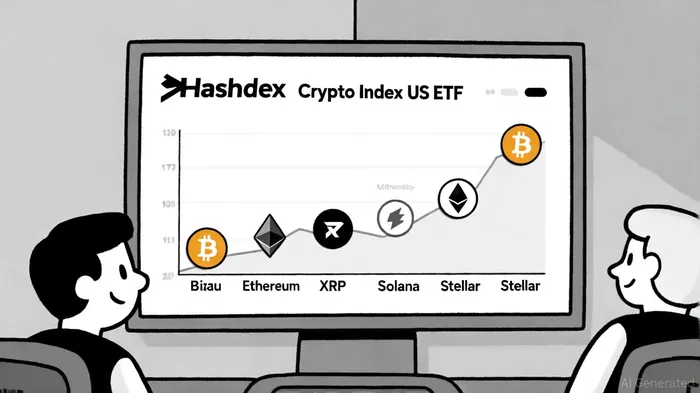
The U.S. crypto market is undergoing a pivotal shift as institutional-grade products bridge the gap between traditional finance and digital assets. Hashdex's Nasdaq Crypto Index US ETF (ticker: NCIQ), launched in February 2025, has become a cornerstone of this transition. On September 19, 2025, the ETF expanded to include XRPXRP--, SolanaSOL-- (SOL), and StellarXLM-- (XLM), joining BitcoinBTC-- (BTC) and EthereumETH-- (ETH) in a diversified basket representing over $3 trillion in market capitalization [1]. This move, enabled by the SEC's newly adopted generic listing standards [4], underscores a growing appetite for regulated, multi-asset crypto exposure. For investors, the timing is critical: XRP and Solana, now embedded in the ETF, are positioned as undervalued altcoins with distinct catalysts that could drive outsized returns in a volatile market.
The SEC's Role in Enabling Diversification
The SEC's regulatory evolution has been a game-changer. Previously, crypto ETF approvals were a labyrinthine process, often taking 270 days. The new generic listing standards, which allow products to be cleared in as little as 75 days [4], have democratized access to altcoins. Hashdex's NCIQNCIQ-- is the first ETF to leverage these rules, offering investors a streamlined way to gain exposure to XRP and Solana—assets that, until now, were largely confined to speculative trading or over-the-counter markets. This regulatory tailwind not only reduces entry barriers but also legitimizes altcoins as viable components of a diversified portfolio.
XRP: Regulatory Clarity and Institutional Momentum
XRP's inclusion in the NCIQ ETF is a watershed moment. After years of legal uncertainty, the resolution of the SEC vs. Ripple case in late 2024 has injected clarity into XRP's regulatory status [5]. Institutional demand has surged: XRP futures open interest on the CME hit $1 billion in August 2025 [5], and XRP-focused investment products attracted $300 million in inflows during the same period. At $2.84, XRP is trading near critical support levels. Historical data suggests that when XRP breaks key support levels, the immediate post-breakout period (1–2 trading days) has historically shown a 66.7% win rate with an average excess return of +1.9% versus the benchmark. However, the edge fades rapidly: 30-day cumulative excess returns turn negative (~–3.8%) after three days, underscoring the importance of tactical timing for short-term strategies. Analysts project a potential rise to $3.20–$3.40 by year-end and $5 in bullish scenarios if ETF approvals materialize [3]. The asset's utility in cross-border payments, coupled with its 400% year-over-year price gain, positions it as a compelling play for investors seeking exposure to a post-regulatory-risk altcoin.
Solana: Ecosystem Resilience and Institutional Adoption
Solana, trading at $206, has faced near-term headwinds, including a 12% price drop in 48 hours and liquidity challenges in its memecoinMEME-- ecosystem [4]. However, its fundamentals remain robust. The blockchain's 100,000+ transactions per second throughput and $500 million in tokenized real-world assets [5] make it a scalable infrastructure play. Institutional adoption is accelerating: firms like Bitwise and 21Shares are pursuing Solana spot ETFs, while the NCIQ's 4.2% allocation signals broader market confidence. Analysts project Solana could reach $240–$250 in the near term and $1,100 in bullish scenarios [5], driven by its transition from speculative activity to utility-driven applications like stablecoin trading.
Broader Market Trends: Altcoin Season and Bitcoin Dominance
The altcoin market is showing early signs of an “altcoin season.” Bitcoin dominance has declined from 65% in May 2025 to 58–60% by mid-August [6], while the Altcoin Season Index has climbed into the low 40s—a threshold below the traditional 75 mark for a full-blown rotation but indicative of growing momentum. Regulatory clarity (e.g., the GENIUS Act) and macroeconomic factors, including anticipated Fed rate cuts and $7.2 trillion in unlocked retail capital from money market funds, are fueling this shift [6]. Ethereum's 50% market cap surge since July 2025 [6] further highlights the trend. For XRP and Solana, this environment creates a tailwind: as capital rotates into altcoins, their inclusion in a regulated ETF like NCIQ could amplify their appeal to both retail and institutional investors.
Strategic Allocation and Risk Mitigation
Hashdex's NCIQ ETF offers a strategic entry point. By allocating 7.1% to XRP and 4.2% to Solana, the ETF balances exposure to high-growth altcoins with the stability of Bitcoin and Ethereum. This structure mitigates the volatility inherent in individual altcoin investments while capturing the upside of a diversified basket. For opportunistic investors, the ETF's launch coincides with a unique confluence of factors: regulatory tailwinds, institutional inflows, and macroeconomic conditions favoring altcoins. However, risks remain. Solana's short-term liquidity issues and XRP's dependence on regulatory outcomes require careful monitoring.
Conclusion: A Window of Opportunity
The expansion of Hashdex's NCIQ ETF marks a turning point in the crypto market's institutionalization. For investors, the inclusion of XRP and Solana offers a rare opportunity to access undervalued altcoins through a regulated, diversified vehicle. With XRP's regulatory clarity and Solana's ecosystem resilience, both assets are well-positioned to outperform in a market increasingly primed for altcoin rotation. As the Altcoin Season Index approaches the 75 threshold [6], now is the time to act—leveraging the NCIQ ETF to capitalize on a market shift that could redefine the crypto landscape.





Comentarios
Aún no hay comentarios