
OpenSea's Multi-Chain Expansion and Its Implications for Web3 Commerce
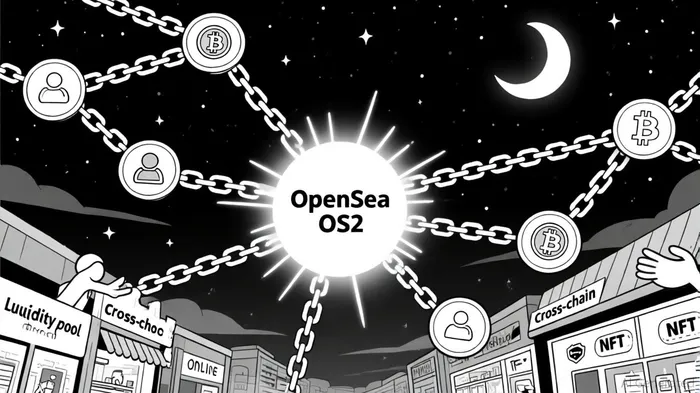
In October 2025, OpenSea unveiled OS2, a strategic reimagining of its platform that positions it as a multi-chain crypto trading hub. By supporting 22 blockchains-including EthereumETH--, SolanaSOL--, Base, Polygon, and Avalanche-OpenSea has transformed from a niche NFT marketplace into a decentralized infrastructure for trading both fungible and non-fungible assets, according to a PR News release. This shift reflects a broader industry trend: the fragmentation of Web3 commerce into chain-specific ecosystems, which OpenSea now seeks to unify. For investors, the implications are profound.
Strategic Shift and Market Context
OpenSea's pivot to multi-chain operations follows a 90% decline in NFT trading volumes since 2021's peak, according to a Cryptopolitan report. The platform's response has been twofold: diversifying into tokenized assets (e.g., memecoins, fungible tokens) and aggregating liquidity from decentralized exchanges like UniswapUNI-- and Meteora, as described in an OpenSea blog post. This move notNOT-- only mitigates reliance on volatile NFT markets but also taps into the $1.6 billion in crypto trades and $230 million in NFT transactions recorded in October 2025 alone, as reported by the PR News release. By enabling cross-chain purchasing-where users can trade assets seamlessly without manual bridging-OpenSea is addressing a critical pain point in Web3 adoption: interoperability.
Reshaping Digital Asset Liquidity
Decentralized marketplaces like OpenSea are redefining liquidity in digital assets. Traditionally, liquidity was siloed within individual blockchains, limiting access for users and inflating transaction costs. OS2's integration of cross-chain tools and real-time pricing data disrupts this model. For instance, a user on Solana can now swap tokens for an Ethereum-based NFT without exiting their chain, reducing friction and expanding market reach - a capability outlined in the OpenSea blog post. This liquidity aggregation is further amplified by OpenSea's 1% trading fee on NFTs and 0.85% on token swaps, with half of the proceeds funding a rewards pool for active users, per the Cryptopolitan report.
Investor Opportunities: The $SEA Token and Gamified Engagement
OpenSea's native $SEA token is central to its new ecosystem. Scheduled for a token generation event (TGE) in October 2025, $SEA offers governance rights, fee discounts, and staking opportunities, as noted in the PR News release. The airdrop, which targets both historical and active users, is gamified through a system called Voyages, where users earn XP for on-chain activities like minting NFTs or curating galleries, according to the Cryptopolitan report. This gamification not only drives user retention but also creates a loyalty economy that could boost $SEA's utility and demand.
For investors, the $SEA token represents a dual opportunity: speculative value from its TGE and long-term utility as OpenSea's governance asset. Early adopters who linked their EVM-compatible wallets by October 15, 2025, gained access to a rewards pool worth over $1 million in OptimismOP-- (OP) and ArbitrumARB-- (ARB) tokens, per the Cryptopolitan report. This strategy mirrors successful airdrops in the crypto space, such as Uniswap's 2020 token launch, which saw a 100x return for early participants.
Implications for Web3 Commerce
OpenSea's multi-chain expansion signals a maturation of Web3 commerce. By simplifying cross-chain transactions and integrating token swaps, the platform is lowering barriers for mainstream users. As stated by OpenSea CEO Devin Finzer, this repositioning aims to make OpenSea the "central hub for all on-chain assets," according to the PR News release. For investors, this means exposure to a platform that is not only adapting to market demands but also shaping the future of digital asset trading.
However, risks remain. The success of $SEA hinges on user adoption and the platform's ability to sustain high trading volumes. Regulatory scrutiny of tokenized assets could also impact its growth trajectory. Yet, given OpenSea's dominance in the NFT space and its strategic pivot to multi-chain, the platform is well-positioned to capitalize on the next phase of Web3 adoption.






Comentarios
Aún no hay comentarios