
OpenSea's Cross-Chain Gambit: A New Era of Interoperability and Token-Driven Value Capture
In 2025, OpenSea's transformation from a niche NFT marketplace to a multi-chain aggregation powerhouse has redefined the digital asset landscape. The launch of its OS2 platform marked a pivotal shift, integrating cross-chain token trading, fungible token support, and a gamified rewards system. This strategic pivot addresses the fragmented nature of blockchain ecosystems while introducing novel value capture mechanisms through its native $SEA token. For investors, the implications are profound: OpenSea is notNOT-- merely adapting to market demands but actively shaping the future of decentralized trading.
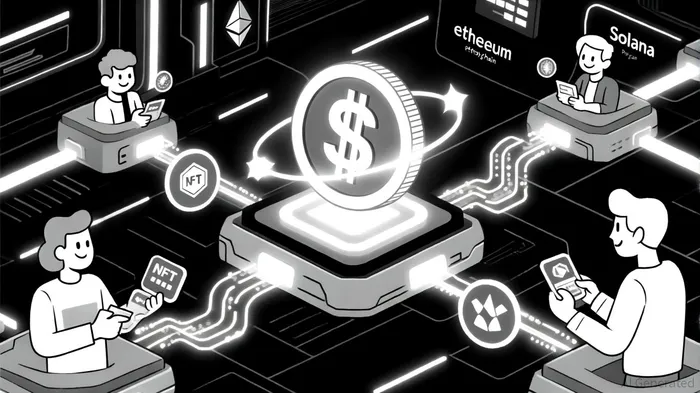
Cross-Chain Interoperability: Unifying Liquidity in a Fragmented Ecosystem
OpenSea's OS2 platform now supports transactions across 22 blockchains, including EthereumETH--, SolanaSOL--, and Polygon, enabling seamless cross-chain purchasing without manual bridging or swapping, as reported in the OS2 launch announcement. This functionality is powered by third-party liquidity aggregators, which source competitive pricing from decentralized exchanges (DEXs) and automated market makers (AMMs), according to a Regolith analysis. By eliminating friction in cross-chain transactions, OpenSea has positioned itself as a critical infrastructure layerLAYER-- for digital asset liquidity.
The platform's expansion is not just technical but strategic. By October 2025, OpenSea reported over $1.6 billion in crypto trades and $230 million in NFT transactions, underscoring the demand for multi-chain accessibility, according to that Regolith analysis. The integration of 14 new chains at OS2's launch—such as Flow, ApeChain, and Soneium—demonstrates OpenSea's commitment to inclusivity, ensuring that creators and collectors can engage with diverse ecosystems without sacrificing usability, as noted in vTrader coverage.
Tokenomics and Value Capture: The $SEA Ecosystem
Central to OpenSea's value proposition is the $SEA token, set to launch in Q1 2026. The token's design reflects a community-first approach, with 50% of the total supply allocated to users, prioritizing OG participants and those engaged in prior rewards programs, according to a Blockonomi report. Additionally, 50% of OpenSea's platform revenue at launch will fund token buybacks, creating a deflationary mechanism to reinforce $SEA's value, as explained in the Cryptomaniaks guide.
The token's utility extends beyond passive rewards. Users can stake $SEA on their favorite NFT collections, aligning token usage with platform engagement, a detail also covered by Blockonomi. This gamified model—exemplified by activities like "Voyages" and "Treasure Chests"—incentivizes active participation, driving network effects. By October 2025, these pre-token generation event (TGE) activities had already seeded a $1 million reward vault with OPOP-- and ARBARB-- tokens, signaling OpenSea's intent to bootstrap liquidity and user incentives, as reported in the Cryptomaniaks guide.
Strategic Partnerships and Infrastructure: Building a Full-Spectrum Platform
OpenSea's cross-chain ambitions are further bolstered by strategic infrastructure moves. The acquisition of Rally, a mobile wallet company, in July 2025, underscores its focus on accessibility, integrating cross-chain and AI-powered tools into a mobile app, as Blockonomi reported. Partnerships with CoinbaseCOIN-- One and NFT galleries also highlight OpenSea's role as a universal on-ramp for digital assets, as noted in the Regolith analysis.
Moreover, OpenSea's fee structure—reduced from 2.5% to 0.5% for marketplace trades and eliminated entirely for swaps—positions it as a direct competitor to platforms like BlurBLUR--, a change covered in vTrader's reporting. These adjustments, combined with OS2's AI-driven analytics and wallet-side navigation, create a user experience that rivals centralized exchanges while preserving decentralization's core principles, as described in the OS2 launch announcement.
Investment Considerations: Opportunities and Risks
OpenSea's cross-chain expansion and token-driven ecosystem present compelling opportunities. The platform's ability to aggregate liquidity across 22 chains could cement its dominance in a market projected to grow as NFTs and memecoins gain mainstream adoption. However, risks persist: regulatory scrutiny of token airdrops, competition from chain-specific marketplaces, and the technical challenges of maintaining interoperability across disparate protocols.
Conclusion: A Paradigm Shift in Digital Asset Trading
OpenSea's OS2 platform and $SEA token represent more than incremental upgrades—they signal a paradigm shift in how value is created and captured in blockchain ecosystems. By unifying liquidity, reducing friction, and aligning incentives through tokenomics, OpenSea is building a self-sustaining network poised to dominate the next phase of the crypto economy. For investors, the key question is not whether OpenSea will succeed, but how quickly it will reshape the industry.





Comentarios
Aún no hay comentarios