
Opendoor's Trump Surge: A Tactical Trade or a Regulatory Trap?
The market's reaction to President Trump's housing policy announcements was a study in extreme volatility. Just last week, OpendoorOPEN-- shares were caught in a regulatory trap, plunging over 11% on Wednesday after Trump signaled a ban on institutional home buyers. The catalyst was a Truth Social post stating he was "immediately taking steps to ban large institutional investors from buying more single-family homes." That news sent a shock through the sector, with Opendoor and peers like Invitation Homes and Blackstone all falling sharply.
Yet by Friday, the narrative had completely reversed. Shares surged 13.37% to close at $7.29, with trading volume spiking 64% above its three-month average. The new catalyst was a different Truth Social post, where Trump called for the purchase of $200 billion in mortgage bonds to drive down rates. The mechanics are straightforward: buying mortgage-backed securities pushes bond prices up and interest rates down, theoretically unlocking housing demand. Investors piled in, with shares briefly up over 20% during the session.
This creates a clear tactical question. Is the Friday rally a direct, near-term tailwind from a policy that could lower mortgage costs and boost Opendoor's transaction volume? Or is it a dangerous regulatory trap, where a policy that helps the broader market may ultimately target the company's core business model? The conflicting signals-from a ban on institutional buyers to a massive stimulus for the housing market-have left the stock swinging wildly on the whims of political announcements.
The Mechanics: How Policy Moves the Needle
The new policy is a direct shot at Opendoor's primary revenue driver: transaction volume. The company is an "iBuyer," purchasing homes from sellers and reselling them to buyers. Its profit comes from seller fees and resale margins, which are directly tied to the number of homes it can move through its platform. When housing affordability improves, more people can buy, which increases the pool of potential sellers and buyers, accelerating the company's turnover.
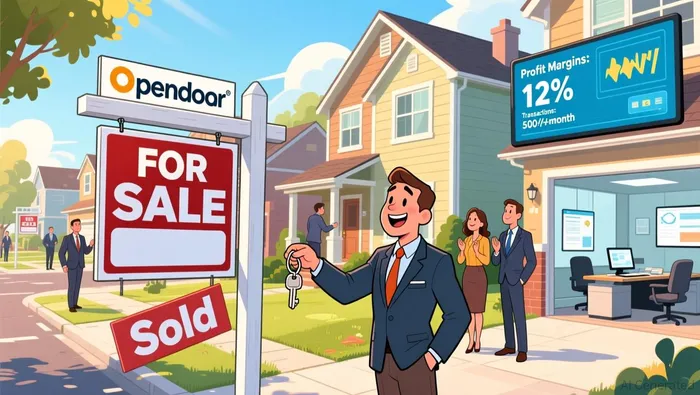
The mechanism is straightforward. By directing the purchase of $200 billion in mortgage bonds, President Trump aims to push bond prices higher and interest rates lower. The policy's stated goal is to drive mortgage rates down, monthly payments down, and make the cost of owning a home more affordable. Lower rates make homes more affordable for buyers, which should stimulate demand and, in turn, increase the overall transaction volume in the housing market. For Opendoor, this is a clear tailwind that could boost its core business.
The market is already pricing in this effect. The announcement caused long-term Treasury yields to tick lower, and the policy is expected to follow that trend. This sets up a potential acceleration for Opendoor's recovery. The company recently reported a weak fourth quarter, and the stock's subsequent rebound suggests investors are betting on this policy to help reverse that trend. If lower mortgage rates successfully unlock housing demand, it could directly fuel the transaction volume Opendoor needs to improve its financials.
The Risk: Regulatory Uncertainty vs. Wall Street Consensus
The immediate catalyst for the rally is a policy that could boost Opendoor's business. But the stock's setup is defined by a stark conflict between that potential tailwind and a deep-seated regulatory threat. The market is pricing in the stimulus, but Wall Street is pricing in the risk.
The regulatory uncertainty is real and hinges on a ban that targets investors with significant portfolios. President Trump announced his administration is taking immediate steps to stop large institutional investors from buying single-family homes, a move that directly threatens the model of companies like Invitation Homes and Blackstone. The key ambiguity is in the definition: the administration has not defined "institutional investor," leaving room for interpretation. While proposed legislation offers thresholds like $50 million or $100 million in net assets, the final rule is unclear. More critically, the ban is not yet law. It requires Congressional codification, a process that is far from guaranteed and could face legal challenges. This creates a prolonged period of uncertainty for the entire sector, even if the policy's impact on the overall housing stock is relatively small.
This regulatory overhang stands in direct contrast to the bearish Wall Street consensus. Despite the recent surge, the stock's fundamental view remains deeply skeptical. The consensus rating is a mere "Hold," with a mean price target of just $2.52. That target implies a potential decline of roughly 70% from recent trading levels. The disconnect is clear: the market is reacting to a political announcement that could help Opendoor's transaction volume, while analysts are focused on the company's core vulnerabilities-its history of net losses, thin margins, and reliance on sentiment-driven volatility.
The immediate risk/reward setup is therefore sharply bifurcated. The reward is a policy that, if implemented, could lower mortgage rates and stimulate the housing market Opendoor depends on. The risk is that the regulatory threat to institutional buyers is a more durable overhang, and that Wall Street's dire price target reflects a fundamental view of the company's business model as unsustainable. For a tactical trade, the event-driven pop is a clear catalyst. But the bearish consensus and regulatory fog suggest this rally may be a trap for those who overlook the long-term fundamentals.
Catalysts and What to Watch
For a tactical trade, the immediate question is which catalyst will dominate in the coming weeks. The policy tailwind is real, but its impact and the regulatory risk are both evolving. Here are the key watchpoints.
First, monitor the execution of the $200 billion bond purchase and its market impact. The directive is clear, but the mechanics matter. Federal Housing Finance Director Bill Pulte confirmed Fannie Mae and Freddie Mac will carry out the president's directions, but the exact timeline and scale of the buying are unknown. The market will be watching for the first signs of large-scale purchases in the coming weeks. If bond prices start to move higher and mortgage rates tick down meaningfully, that will validate the policy's tailwind for Opendoor. The company's business model depends on this transaction volume, so any measurable improvement in affordability would be a direct positive signal.
Second, watch for details on the institutional ban. President Trump has promised to discuss additional housing proposals during an upcoming speech in Davos in two weeks. This event is critical for reducing the regulatory fog. The key will be any clarification on the definition of "institutional investor" and whether there are exemptions. Opendoor CEO Kaz Nejatian has already expressed support for the ban and clarified the company's model, but the final rule is what matters. If the speech provides a clear, narrow definition that excludes Opendoor's platform, it could remove a major overhang. If it remains vague or expansive, the regulatory risk will persist.
Finally, be aware of a seasonal risk that could compound any policy-related volatility. Historically, Opendoor shares have crashed over 11% on average in February. This pattern suggests a period of heightened selling pressure, often tied to year-end portfolio rebalancing and tax-loss harvesting. If the stock is caught in a regulatory debate or if the bond-buying policy fails to deliver quick results, this seasonal headwind could trigger a sharp drop. For a trader, this means the February period is a high-risk window regardless of the broader policy narrative.
The setup is a classic event-driven trade. The catalysts are now in motion, but their outcomes are uncertain. The bond purchase's success and the ban's definition will be tested in the coming weeks, while the stock's inherent volatility and seasonal quirks add layers of risk.







Comentarios
Aún no hay comentarios