
Opendoor Technologies' Sharp Decline: A Tale of Capital Flight to AI
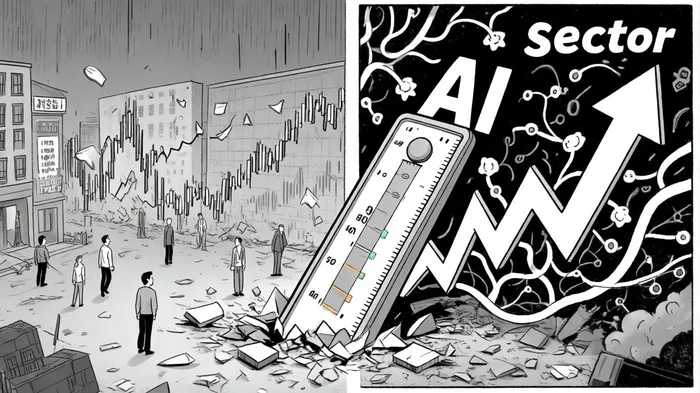
The recent 43% plunge in OpendoorOPEN-- Technologies' (OPEN) stock price in 2025 is not merely a story of mismanagement or housing market headwinds—it is a symptom of a broader, systemic shift in capital allocation. Investors are increasingly diverting funds from real-estate tech to AI-driven equities, a trend that has left companies like Opendoor struggling to justify their valuations. This analysis unpacks the interplay between Opendoor's financial struggles and the seismic reallocation of capital toward artificial intelligence, offering insights for investors navigating this evolving landscape.
Opendoor's Financial Crossroads
Opendoor's Q1 2025 revenue of $1.2 billion, while up 6% from the prior quarter, fell short of previous projections, signaling ongoing operational challenges [1]. The company's net loss of $85 million, though improved from $109 million in Q1 2024, still highlights its inability to achieve consistent profitability [1]. Analysts have responded by slashing price targets: Keefe Bruyette reduced its target to $1.55 from $1.90, while UBS dropped it to $1.20 from $2, reflecting concerns over cash flow and capital stability [1].
The company's pivot from a capital-intensive iBuying model to a software-and-services approach has yet to yield convincing results. While Q2 2025 saw a rare Adjusted EBITDA profit of $23 million, the net loss of $29 million underscores the fragility of this transition [2]. Opendoor's inventory balance of $1.5 billion at quarter-end—down 32% from Q2 2024—suggests a strategic retrenchment, but its reliance on agent partnerships and products like Cash Plus remains unproven [2].
The AI Capital Exodus
The broader context for Opendoor's struggles lies in the explosive growth of AI investment. In Q2 2025, 85.87% of venture capital funding for tech companies flowed into AI and infrastructure, amounting to $25.15 billion—a stark contrast to the fragmented and slower-moving real-estate tech sector [4]. This trend is not limited to startups: Meta's $14.3 billion investment in Scale AI and OpenAI's $6.5 billion acquisition of io Products exemplify the sector's dominance [5].
Real-estate tech, meanwhile, faces structural challenges. According to NAIOP, the sector's reliance on offline transactions and unstructured data hampers AI adoption in capital markets [5]. While AI is streamlining property management and predictive maintenance, these gains are incremental compared to the transformative potential of foundational AI technologies. As BlackRock notes, the U.S. index's growing concentration in AI has pushed investors to seek diversification, but real-estate tech remains a niche beneficiary at best [2].
Strategic Paradox: Innovation vs. Execution
Opendoor's leadership has acknowledged the need to adapt. CEO Carrie Wheeler's emphasis on an “agent-led distribution platform” and AI-driven tools like the Key Agent app signals a recognition of the sector's evolving demands [2]. However, these initiatives face an uphill battle. The company's Q3 2025 guidance—projected revenue of $800–875 million and Adjusted EBITDA losses of $21–28 million—reveals a lack of confidence in its ability to scale profitability [6].
The irony is that Opendoor's core business could benefit from the very AI trends it struggles to leverage. For instance, the rise of data centers and AI infrastructure is creating demand for commercial real estate, potentially stabilizing markets Opendoor serves [4]. Yet, the company's current focus on reducing inventory risk and capital requirements appears reactive rather than proactive.
Implications for Investors
For investors, Opendoor's plight underscores the risks of investing in sectors facing capital flight. While the company's Q2 2025 results showed glimmers of hope—such as a 4% year-over-year revenue increase and its first Adjusted EBITDA profit since 2022—the broader market's skepticism is well-founded [2]. Analysts' consensus “Sell” rating and $1.26 average price target imply a potential 78% downside from current levels [3].
However, the situation is not entirely bleak. Opendoor's strategic pivot, if executed successfully, could position it to capitalize on AI-driven efficiencies in real estate. For instance, its Cash Plus product aims to reduce capital requirements, aligning with the sector's push for leaner models [2]. Yet, given the speed of capital reallocation to AI, patience may be a virtue only for the most risk-tolerant investors.
Conclusion
Opendoor Technologies' sharp decline is emblematic of a larger shift: capital is fleeing real-estate tech for the perceived scalability of AI. While the company's financials and strategic adjustments offer some optimism, the broader trend of capital flows—$280 billion in AI investment in 2025 alone [4]—casts a long shadow. For Opendoor to reclaim its value, it must not only prove its operational resilience but also demonstrate how it can harness AI to redefine its role in a rapidly transforming market. Until then, the stock remains a high-risk proposition in a sector increasingly overshadowed by the AI revolution.





Comentarios
Aún no hay comentarios