
Opendoor (OPEN): A Meme Stock Frenzy or a Legitimate Housing Market Play?
The stock of Opendoor TechnologiesOPEN-- (OPEN) has become a lightning rod for debate in 2025, surging 320% amid a speculative frenzy fueled by retail investors and social media chatter according to Seeking Alpha. Yet, beneath the surface of this volatility lies a company grappling with a struggling housing market, declining revenue, and a path to profitability that remains unproven. For investors, the question is stark: Is OPENOPEN-- a speculative mirage or a legitimate play on a housing market rebound?
The Speculative Momentum
Opendoor's stock price has defied traditional valuation metrics, closing at $6.36 in late November 2025-far above the analyst consensus price target of $1.143. This disconnect has drawn comparisons to past meme stock frenzies, such as those involving GameStop and AMC, where retail-driven surges were followed by sharp corrections according to Seeking Alpha. The catalyst? A surge in social media activity on platforms like Reddit and X, where investors rallied around the stock despite its fundamentals according to Seeking Alpha.
Short-term volatility has further amplified the speculative narrative. In early November, the stock jumped 11.53% following a JPMorgan Overweight rating and CEO Kaz Nejatian's personal investment of 125,000 shares according to Stock to Trade. However, by late December, the stock had fallen nearly 7.6%, reflecting the fragility of momentum-driven gains according to Investing.com. Analysts warn that such swings are emblematic of a market where sentiment, rather than earnings, drives price action according to Seeking Alpha.
Fundamental Realities
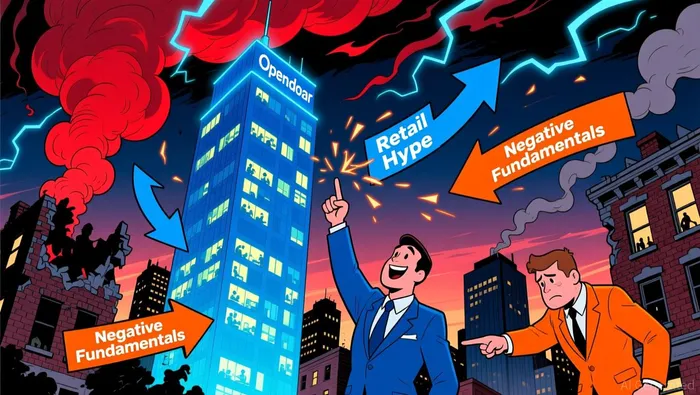 The speculative fervor contrasts sharply with Opendoor's operational challenges. The U.S. housing market, a critical tailwind for the company's iBuying model, has deteriorated, with record numbers of sellers outpacing buyers and weak job growth further dampening transaction volumes according to AOL. Opendoor's Q3 2025 results underscore this reality: revenue fell 33% year-over-year to $915 million, and the company reported a $90 million net loss according to Seeking Alpha. Inventory levels were halved compared to prior years, reflecting a risk-averse strategy amid market uncertainty according to Seeking Alpha.
Analysts remain skeptical about the company's ability to achieve sustainable profitability. Despite JPMorgan's bullish $8 price target according to Stock to Trade, the consensus view is cautious. Opendoor's margins remain negative, and its business model-reliant on buying and flipping homes-has been particularly vulnerable to the downturn according to Seeking Alpha. As one analyst noted, "The current valuation implies a level of optimism about future profitability that isn't supported by today's data" according to Simply Wall St.
Strategic Shifts and AI-Driven Transformation
Under CEO Kaz Nejatian, OpendoorOPEN-- is pivoting to a higher-velocity, tech-driven model to address these challenges. The company is leveraging AI to improve pricing accuracy, streamline inspections, and reduce holding costs according to Nasdaq. This shift includes a direct marketplace model to connect buyers and sellers, aiming to reduce reliance on balance sheet-driven home purchases according to Forbes.
Nejatian has also emphasized tighter spreads and operational efficiency, with a focus on high-demand markets according to Nasdaq. While these changes could enhance long-term viability, the near-term outlook remains uncertain. Opendoor's Q3 2025 results showed progress in scaling home acquisitions and improving unit economics, but profitability is still projected for late 2026 according to Investor Relations.
Balancing Act: Momentum vs. Fundamentals
The key question for investors is whether Opendoor's strategic shifts can bridge the gap between speculative hype and fundamental reality. On one hand, the company's AI-driven approach and marketplace experimentation position it to capitalize on a potential housing market recovery. On the other, the current valuation appears disconnected from near-term performance metrics.
JPMorgan's Overweight rating according to Stock to Trade and Nejatian's confidence in the company's path to profitability according to Investor Relations suggest optimism. However, the broader market's skepticism-evidenced by the $1.143 consensus price target according to Investor Relations-highlights the risks of overestimating the pace of transformation.
Conclusion
Opendoor's stock has become a case study in the tension between speculative momentum and valuation realism. While the company's strategic pivot to AI and a direct marketplace model offers a plausible long-term vision, the near-term fundamentals-including a struggling housing market and unprofitable operations-pose significant risks. For now, the stock appears to be a hybrid: part speculative play, part cautious bet on a housing rebound. Investors must weigh the allure of momentum against the sobering reality that fundamentals have yet to justify the current valuation.







Comentarios
Aún no hay comentarios