
OpenAI's Strategic Independence and the Future of AI-Driven Tech Stocks
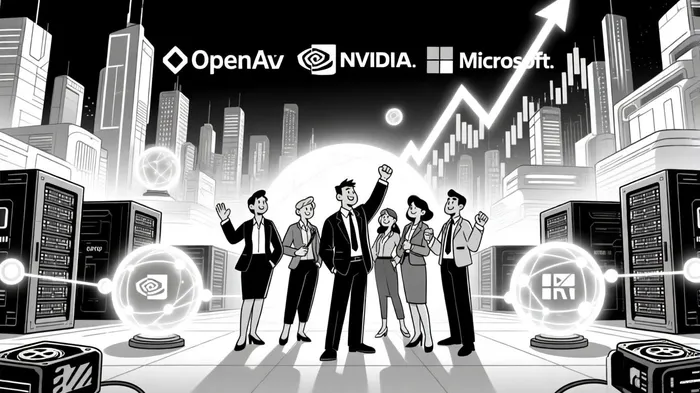
The AI landscape in 2025 is defined by a delicate balance of collaboration and competition among tech giants. OpenAI, once a Microsoft-centric entity, is now navigating a path toward strategic independence, reshaping the dynamics of AI-driven tech stocks. This shift, fueled by partnerships with NVIDIANVDA-- and BroadcomAVGO--, as well as internal restructuring efforts, presents both risks and opportunities for investors.
NVIDIA's $100 Billion Bet: A Catalyst for AI Infrastructure Growth
NVIDIA's recent $100 billion strategic partnership with OpenAI to deploy 10 gigawatts of AI data centers marks a pivotal moment in the industry[1]. This investment, tied to the deployment of millions of GPUs via the Vera Rubin platform, positions NVIDIA as a critical enabler of OpenAI's next-generation AI models. The first gigawatt of systems is slated for late 2026, with subsequent phases contingent on infrastructure scaling[3]. For investors, this partnership underscores NVIDIA's dominance in AI hardware, a sector projected to grow exponentially. The company's stock surged 4.4% following the announcement, reflecting market confidence in its role as the backbone of AI innovation[5]. However, risks linger if OpenAI's hardware independence—such as its custom chip project with Broadcom—reduces long-term demand for NVIDIA's products[6].
Microsoft's Dual Strategy: Collaboration and Self-Reliance
Microsoft's relationship with OpenAI has evolved from a one-sided dependency to a more balanced negotiation. While the Redmond giant remains OpenAI's primary cloud provider via Azure, it is simultaneously developing in-house AI models like MAI-1-preview and MAI-Voice-1 to mitigate reliance on OpenAI[2]. This dual strategy reflects Microsoft's broader ambition to dominate the AI-driven productivity market. Yet, OpenAI's push for independence—through a potential IPO and PBC restructuring—threatens to fragment their partnership[4]. Analysts note that Microsoft's stock has historically benefited from OpenAI's success, but its future growth may hinge on successfully scaling its own AI offerings[3].
Market Implications: Fragmentation or Consolidation?
OpenAI's infrastructure diversification, including a $11.6 billion Texas data center and collaborations with Oracle and SoftBank[2], signals a broader industry trend: the rise of custom silicon and self-sufficient AI ecosystems. Companies like Google, Amazon, and Meta are following suit, reducing dependency on third-party hardware providers. This shift could lead to a more fragmented AI market, where partnerships are transactional rather than symbiotic. For investors, this raises questions about the sustainability of NVIDIA's current valuation and Microsoft's ability to maintain its cloud AI dominance.
Investment Risks and Opportunities
The AI sector's volatility demands a nuanced approach. NVIDIA's near-term growth is well-supported by OpenAI's infrastructure needs, but long-term risks include commoditization of its hardware and OpenAI's hardware independence. Conversely, Microsoft's stock offers a more diversified bet, with Azure's AI revenue streams and its expanding commercial contracts[3]. However, its internal AI models are still in early stages, and a breakdown in the OpenAI partnership could disrupt its AI roadmap.
Conclusion
OpenAI's strategic independence is a double-edged sword for the AI ecosystem. While it drives innovation and infrastructure growth, it also introduces uncertainty into the partnerships that have defined the sector. For investors, the key lies in balancing exposure to NVIDIA's hardware dominance with Microsoft's cloud and AI integration. As the industry moves toward self-sufficient ecosystems, the winners will be those who adapt to the new paradigm of collaboration and competition.





Comentarios
Aún no hay comentarios