
OpenAI's Strategic Expansion of Stargate: A Blueprint for AI Infrastructure Resilience and Scalability
In the race to dominate the next frontier of artificial intelligence, infrastructure has emerged as the critical battleground. OpenAI's Stargate project, a $500 billion, 10-gigawatt initiative, is not merely about building data centers—it's about redefining the architecture of AI itself. By prioritizing both scalability and resilience, OpenAI, alongside OracleORCL-- and SoftBank, is laying the groundwork for a decentralized, secure, and economically transformative AI ecosystem. For investors, this represents a rare convergence of technological ambition, geopolitical strategy, and financial scale.
The Scalability Imperative: A Nation-Wide Compute Revolution
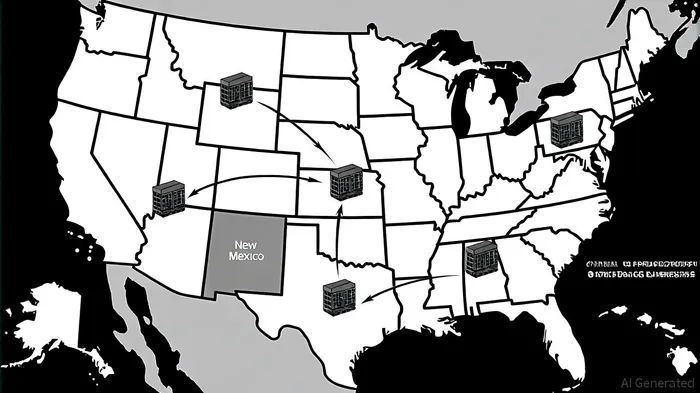
OpenAI's Stargate project has accelerated its infrastructure rollout, with five new U.S. data center sites announced in 2025. These include locations in Texas, New Mexico, Ohio, and an undisclosed Midwest site, bringing the total planned capacity to nearly 7 gigawatts and investment to over $400 billion—well ahead of its original 2025 target [1]. The partnership with Oracle and SoftBank is pivotal: Oracle's existing 1.2-gigawatt “Supercluster” in Abilene, Texas, is being expanded to nearly 2 gigawatts, equipped with up to 400,000 NvidiaNVDA-- GB200 AI chips [2]. This expansion alone is expected to create over 100,000 jobs across construction and operations roles [2].
The economic implications are staggering. OpenAI and Oracle have separately agreed to develop an additional 4.5 gigawatts of capacity, valued at $300 billion over five years [3]. This not only underscores the project's financial gravity but also its potential to reshape the U.S. labor market, with estimates suggesting over 25,000 onsite jobs and tens of thousands of indirect roles [1]. For investors, this is a clear signal of sustained capital deployment and long-term value creation.
Resilience by Design: Geographic Redundancy and Energy Innovation
Scalability alone is insufficient without infrastructure resilience. Stargate's geographic diversity—spanning Texas, Ohio, New Mexico, and the Midwest—ensures redundancy and disaster recovery capabilities. As stated by OpenAI CEO Sam Altman, this distributed model “reduces the risk of single points of failure” while enabling parallel model training across sites [4]. Oracle's role in deploying advanced GPU superclusters and zero-trust security architectures further bolsters this resilience [3].
Energy strategy is another cornerstone. OpenAI is leveraging a mix of renewable sources, including solar with battery storage and Small Modular Nuclear Reactors (SMRs), alongside carbon-capture-enhanced natural gas [6]. This hybrid approach addresses both the massive power demands of AI training and environmental concerns, positioning Stargate as a model for sustainable hyperscale computing.
Investment Implications: A New Era of AI Infrastructure
For investors, Stargate represents more than a tech play—it's a structural shift in how AI is built and governed. The project's emphasis on localized, sovereign data centers (via the “OpenAI for Countries” program) aligns with global trends toward data localization and regulatory compliance [5]. This could unlock new revenue streams in healthcare, education, and government sectors.
Moreover, the $30 billion annual data center agreement between OpenAI and Oracle [6] signals a long-term partnership that could stabilize returns amid the volatile AI hardware market. The inclusion of SoftBank, a global infrastructure giant, adds another layer of credibility and financial firepower.
Conclusion: A Strategic Bet on the Future
OpenAI's Stargate project is a masterclass in strategic infrastructure planning. By marrying scalability with resilience—through geographic diversity, energy innovation, and robust security—OpenAI is not just building data centers; it's constructing a framework for global AI leadership. For investors, this is a high-conviction opportunity to participate in a $500 billion bet on the future of technology.





Comentarios
Aún no hay comentarios