
OpenAI’s Strategic Acquisition of Statsig and Implications for AI-Powered SaaS Growth
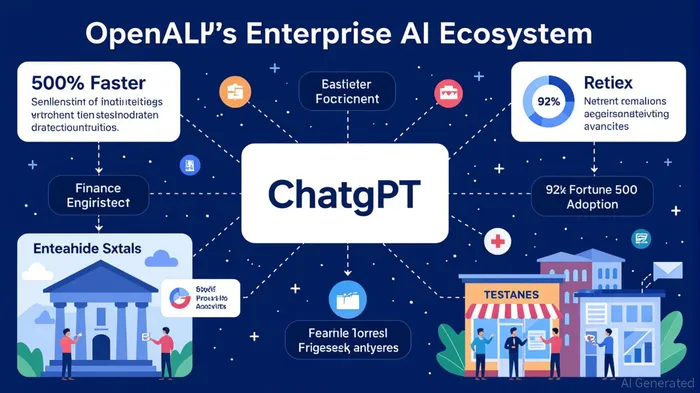
In September 2025, OpenAI announced a transformative $1.1 billion all-stock acquisition of Statsig, a leading product testing and experimentation platform [1]. This move, coupled with the appointment of Statsig founder Vijaye Raji as CTO of Applications, signals OpenAI’s strategic pivot toward enterprise-focused AI development. By embedding Statsig’s tools into its workflows, OpenAI is accelerating product iteration, enhancing safety protocols, and solidifying its dominance in the AI-as-a-service (AIaaS) market. For investors, this acquisition underscores a broader industry shift: the integration of advanced analytics and experimentation frameworks into AI-powered SaaS, enabling enterprises to scale AI adoption with unprecedented precision.
Talent Acquisition: Strengthening Leadership for Enterprise AI
The acquisition brings Raji into OpenAI’s Applications division, where he will oversee product engineering for ChatGPT, Codex, and infrastructure integrity [1]. His expertise in scaling consumer and enterprise products—evidenced by Statsig’s work with clients like AtlassianTEAM-- and Notion—aligns with OpenAI’s goal to operationalize AI innovations. This leadership reshuffling, with Fidji Simo (CEO of Applications) and Raji at the helm, reflects a deliberate focus on enterprise growth while allowing Sam Altman to concentrate on frontier research [4].
Raji’s role is critical in addressing enterprise demands for transparency and control. For instance, Statsig’s feature flagging and real-time decisioning tools now enable OpenAI to manage AI model rollouts with granular precision. This is particularly vital for high-stakes sectors like healthcare and finance, where iterative testing of AI behaviors (e.g., adjusting ChatGPT’s response thresholds for sensitive queries) reduces risk while maintaining user trust [1].
Product Integration: Accelerating Development and Safety
Statsig’s technology is already embedded in OpenAI’s workflows, streamlining experimentation with large language models (LLMs). For example, developers can now A/B test different model versions (e.g., “gpt-3.5-turbo” vs. “gpt-4”) and track metrics like response time, token usage, and user satisfaction via a Python-based integration [1]. This has reduced time-to-decision for experiments by up to seven days and enabled processing of over a billion events annually [2].
The impact on development speed is quantifiable. By leveraging Statsig’s CUPED variance reduction and sequential testing methods, OpenAI has improved the efficiency of its AI workflows, detecting smaller effects 50% faster than traditional methods [1]. For Codex, Statsig’s feature flagging allows controlled rollouts of code-generation capabilities, ensuring alignment with project-specific guidelines (e.g., AGENTS.md configurations) while mitigating risks of unpredictable behavior [3].
Enterprise Adoption and Competitive Positioning
OpenAI’s enterprise AI adoption has surged, with 92% of Fortune 500 companies utilizing its tools as of Q2 2025 [3]. This growth is driven by Statsig-enabled capabilities that address enterprise pain points:
- Transparency: Real-time analytics for agent-level performance monitoring.
- Scalability: Automated A/B testing across 25+ languages and 25,000-word context windows in ChatGPT.
- Safety: Enhanced guardrails for sensitive use cases, such as healthcare diagnostics or financial forecasting [2].
Financially, OpenAI’s 2025 revenue is projected at $3.4 billion, nearly double its 2023 figures, with enterprise agreements accounting for 56% of total revenue [3]. This positions OpenAI to challenge Anthropic, which holds a 32% market share in enterprise AI versus OpenAI’s 25% [4]. While Anthropic excels in tailored models and data retention policies, OpenAI’s integration of Statsig’s safety tools offers a unique value proposition: a vertically integrated framework for rapid, controlled AI iteration [1].
Strategic Implications for Investors
OpenAI’s acquisition of Statsig is not merely a toolset addition but a foundational investment in its AI stack. By reducing reliance on third-party experimentation platforms, OpenAI strengthens its control over the entire product lifecycle—from research to enterprise deployment. This vertical integration, combined with a $40 billion funding round and prior acquisitions like io for custom hardware, signals long-term dominance in the AIaaS market [1].
For investors, the key metrics to monitor include:
1. Enterprise Revenue Growth: Track the proportion of revenue from enterprise clients post-acquisition.
2. Development Efficiency: Measure reductions in experiment iteration times and deployment risks.
3. Market Share Shifts: Compare OpenAI’s enterprise adoption rates against Anthropic and Google’s Gemini.
Conclusion
OpenAI’s acquisition of Statsig represents a masterstroke in enterprise AI strategy. By combining Raji’s operational expertise with Statsig’s experimentation tools, OpenAI is not only accelerating product development but also addressing the critical needs of enterprise clients: scalability, safety, and transparency. As the AI market approaches $1.81 trillion by 2030, companies that prioritize infrastructure and productization—like OpenAI—are poised to lead the next phase of the generative AI revolution. For investors, this acquisition is a clear indicator of OpenAI’s commitment to dominating the enterprise AI landscape.
Source:
[1] OpenAI’s Strategic Acquisition of Statsig and Its Implications for AI-Driven Product Innovation [https://www.ainvest.com/news/openai-strategic-acquisition-statsig-implications-ai-driven-product-innovation-2509/]
[2] Statsig Blog | The Authoritative Source for Data-Driven Insights [https://www.statsig.com/perspectives/all]
[3] OpenAI Statistics 2025: Adoption, Integration & Innovation [https://sqmagazine.co.uk/openai-statistics/]
[4] OpenAI Appoints Statsig CEO Vijay Eranti as CTO of Applications After Strategic Acquisition: Impact on ChatGPT and Codex AI Product Development [https://blockchain.news/ainews/openai-appoints-statsig-ceo-vijay-eranti-as-cto-of-applications-after-strategic-acquisition-impact-on-chatgpt-and-codex-ai-product-development]







Comentarios
Aún no hay comentarios