
Open Game Protocol and the Future of Tokenized Gaming Ecosystems
The Web3 gaming industry is undergoing a paradigm shift, driven by cross-chain interoperability protocols that are dismantling the siloed nature of blockchain ecosystems. At the forefront of this transformation is the Open Game Protocol, a framework designed to enable seamless asset and data transfers across multiple blockchains. By addressing critical pain points such as fragmented liquidity, high transaction costs, and limited asset portability, the protocol is positioning itself as a cornerstone for mass adoption in tokenized gaming. This analysis explores how cross-chain interoperability, particularly through the CROSS Protocol, is catalyzing growth in Web3 gaming and reshaping the economic models underpinning the sector.
Cross-Chain Interoperability: The Technical Foundation
The Open Game Protocol leverages cross-chain messaging layers like LayerZero and Wormhole to achieve sub-2-second latency and reduce transfer costs by 80% compared to traditional bridges, according to a CROSS Protocol analysis. This infrastructure supports major blockchains such as EthereumETH--, SolanaSOL--, and Polygon, enabling developers to "mint once, circulate anywhere", as noted in the CROSS Protocol analysis. For instance, a high-value NFT can be created on Ethereum for security while gameplay occurs on a low-cost chain like Solana, optimizing performance without compromising asset integrity.
Dynamic state synchronization ensures real-time updates of asset attributes-such as weapon stats or character traits-across chains, while a trust-minimized verification design mitigates security risks, the CROSS Protocol analysis finds. The protocol also introduces evolvable NFTs, where in-game actions (e.g., defeating a boss) can upgrade an asset's properties on-chain, embedding universal tags to ensure compatibility across diverse game logics, the analysis adds. These innovations not only enhance user experience but also create a foundation for composable, player-owned economies.
Dual-Token Economy and Liquidity Networks
The CROSS Protocol's dual-token model further strengthens its economic framework. The CROSS token serves as a governance and gasGAS-- token, while the CRED token-dynamically minted via in-game tasks and pegged to USDC-provides stability for in-game transactions, the CROSS Protocol analysis reports. This design addresses volatility concerns in Web3 gaming, where speculative tokenomics have historically deterred mainstream users. By integrating with platforms like Magic Eden and the Epic Games Store, the protocol is also fostering cross-chain marketplaces, allowing players to trade assets across ecosystems without intermediaries.
Real-World Adoption and Case Studies
Cross-chain interoperability is already driving measurable user adoption. N3MUS, a Web3 gaming platform built on MoonbeamGLMR--, has attracted 17,000 wallets and 55,000 monthly active users by abstracting blockchain complexity through its N3MUS ID system, according to a Moonbeam case study. Similarly, Angry Dynomites Lab leveraged thirdweb's tools to create a cross-platform game with 20+ tradeable tokens, demonstrating how interoperability enables player-owned economies, according to an IBC report.
The BNBBNB-- Chain's gaming ecosystem further underscores this trend, with 565 projects and an average of 177,000 active users per platform as of 2024, according to a BNB Chain report. These platforms benefit from low gas fees and scalable infrastructure like Rollup-as-a-Service (RaaS), which cross-chain protocols amplify by enabling seamless asset transfers between EVM and non-EVM chains.
Market Projections and Industry Trends
Industry reports highlight a surge in cross-chain activity, with the total value locked (TVL) in interoperability protocols reaching $8 billion in 2024 (Grand View Research). The Ethereum-to-Arbitrum route alone processed $10.7 billion in volume, underscoring the demand for scalable, interoperable solutions, the CROSS Protocol analysis reports. Meanwhile, the broader blockchain gaming market is projected to grow from $13 billion in 2024 to $301.53 billion by 2030, driven by play-to-own models and decentralized asset ownership, according to Grand View Research.
Challenges and Risks
Despite its promise, cross-chain interoperability faces hurdles. Security exploits in infrastructure like LayerZeroZRO-- and WormholeW-- have averaged 0.7% historically, the IBC report finds, while regulatory uncertainties around dynamic NFTs and cross-border transactions remain unresolved, the CROSS Protocol analysis notes. Additionally, the need for standardized protocols to unify disparate blockchain ecosystems persists.
Conclusion: A Catalyst for Mass Adoption
The Open Game Protocol's cross-chain innovations are not merely technical advancements-they are foundational to the mass adoption of Web3 gaming. By enabling universal liquidity, reducing friction, and fostering sustainable economies, the protocol is bridging the gap between traditional and blockchain-based gaming. For investors, the convergence of interoperability, real-world adoption, and favorable market projections presents a compelling opportunity. However, success will depend on addressing security and regulatory challenges while continuing to innovate in asset portability and user experience. 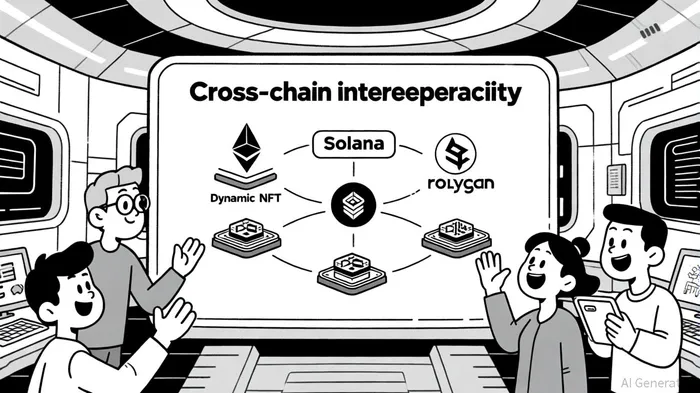







Comentarios
Aún no hay comentarios