
OPEC+'s Production Gambit and the U.S. Economic Slowdown: A Perfect Storm for Oil?
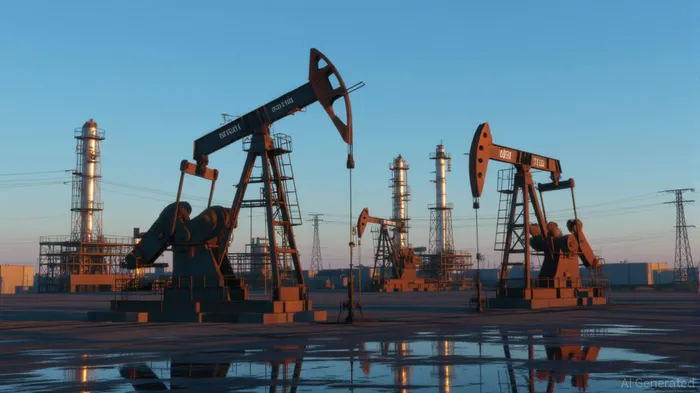
The global oil market in 2025 is caught in a precarious balancing act. OPEC+’s aggressive production adjustments, coupled with a U.S.-led economic slowdown, are creating a volatile environment where supply-side gambits clash with demand-side headwinds. For investors, the interplay between these forces raises a critical question: Is this the beginning of a structural downturn in oil markets, or a temporary correction?
OPEC+’s Strategic Shift: Market Share Over Price Stability
OPEC+’s September 2025 decision to increase output by 547,000 barrels per day marks a pivotal shift in its strategy. This move, part of a broader plan to unwind 2.2 million bpd in voluntary cuts, reflects a prioritization of market share over price stability [1]. The group’s rationale—citing a “very strong” Q3 demand surge and a desire to avoid oversupply—has instead triggered a bearish response. Brent crude prices plummeted to $68.18 per barrel immediately after the announcement, while WTI formed a “death cross” pattern, signaling technical concerns for crude and refined product futures [2].
This production gambit underscores OPEC+’s flexibility, with the group reserving the right to pause or reverse the phase-out based on evolving conditions [6]. However, the immediate consequence is a projected 1.5% global crude surplus by Q4 2025, according to the International Energy Agency (IEA) [4]. Such a surplus risks eroding the very market stability OPEC+ claims to uphold.
U.S. Economic Slowdown: A Drag on Global Demand
While OPEC+ focuses on supply-side dynamics, the U.S. economic slowdown is reshaping demand fundamentals. The U.S. Energy Information Administration (EIA) forecasts a sharp decline in Brent crude prices—from $71 in July 2025 to $58 by year-end—driven by subdued global demand and inventory builds [1]. This trend is amplified by trade tensions, with U.S. tariffs on key partners reducing container vessel activity and curbing oil consumption in sectors like shipping and trucking [1].
Global oil demand growth is now expected to remain below 1 million bpd in 2025 and 2026, the weakest since 2008 [1]. OECD countries, including the U.S., are leading this slowdown, with Asia’s consumption growth projected to average just 0.5 million bpd over the same period [1]. Refinery margins, already pressured by high utilization rates, are hovering near historical lows, further signaling weak demand [3].
Investor Responses: Hedging Against Uncertainty
Investors are recalibrating their commodity positioning in response to these dual pressures. Energy ETFs like the Energy Select Sector SPDR Fund (XLE) and the SPDR S&P Oil & Gas Exploration & Production ETF (XOP) have surged by 5–8% in Q3 2025, capitalizing on short-term volatility [2]. However, hedge funds are adopting a more cautious stance. A Bloomberg report highlights a strategic reversal: funds are shorting oil stocks while unwinding short positions in solar stocks, reflecting a long-term bet on renewables [4].
This shift aligns with the growing narrative of “peak oil demand”. The IEA and BPBP-- now project global oil consumption could peak by 2030, driven by electrification and efficiency gains [6]. For investors, this creates a zero-sum game: supply increases in one region may force price declines that suppress demand or production elsewhere.
The Perfect Storm?
The convergence of OPEC+’s production gambit and U.S. demand weakness is creating a perfect storm for oil markets. On one hand, OPEC+’s focus on market share risks oversupply and price erosion. On the other, the U.S. slowdown and global trade tensions are accelerating the transition to low-carbon energy.
For investors, the path forward requires hedging against both short-term volatility and long-term structural shifts. Energy equities may offer near-term gains amid OPEC+’s output hikes, but exposure to renewables and energy transition technologies could prove more resilient in the long run. As the IEA warns, “The oil market is no longer a game of supply alone—it is a race against demand’s transformation” [5].
Source:
[1] EIA forecasts world oil consumption growth to slow amid trade tensions, [https://www.eia.gov/todayinenergy/detail.php?id=65285]
[2] OPEC+ Output Hike and Oil Price Volatility, [https://www.ainvest.com/news/opec-output-hike-oil-price-volatility-strategic-implications-energy-equity-etf-allocations-2508/]
[3] Petroleum prices reacted to economic and geopolitical tensions in 2025, [https://www.eia.gov/todayinenergy/detail.php?id=65884]
[4] Navigating the Oil Market Crossroads: Strategic Positioning, [https://www.ainvest.com/news/navigating-oil-market-crossroads-strategic-positioning-geopolitical-supply-volatility-q3-2025-2509/]
[5] Oil Market Report - July 2025 – Analysis, [https://www.iea.org/reports/oil-market-report-july-2025]
[6] Will Peak Demand Roil Global Oil Markets?, [https://libertystreeteconomics.newyorkfed.org/2025/04/will-peak-demand-roil-global-oil-markets/]





Comentarios
Aún no hay comentarios