
OPEC+ Output Hikes and Short-Term Volatility in Crude Oil Markets: Strategic Hedging for Investors Amid Near-Term Correction Risks
The global crude oil market in 2025 has been shaped by a delicate balancing act between OPEC+ production adjustments, shifting demand dynamics, and geopolitical uncertainties. Recent decisions by the cartel to incrementally increase output have introduced significant volatility, testing the resilience of investors and producers alike. As OPEC+ unwinds its voluntary production cuts—a process expected to conclude by September 2026—market participants must navigate a landscape where bearish fundamentals, such as rising inventories and weak demand signals, clash with the potential for supply-side disruptions. For investors, the challenge lies in identifying strategic entry points and hedging mechanisms to mitigate near-term risks while capitalizing on long-term stability.
OPEC+ Output Adjustments and Market Fundamentals
In September 2025, OPEC+ agreed to raise crude production by 547,000 barrels per day (bpd), marking a gradual phase-out of the 2.2 million bpd voluntary cuts implemented in December 2024 [1]. This decision, framed as a response to a “steady global economic outlook” and “healthy market fundamentals,” reflects the cartel's intent to align supply with demand while maintaining flexibility to pause or reverse adjustments if conditions deteriorate [1]. However, the move has introduced bearish sentiment, particularly as global oil inventories—both onshore and in floating storage—have risen, signaling oversupply concerns [1].
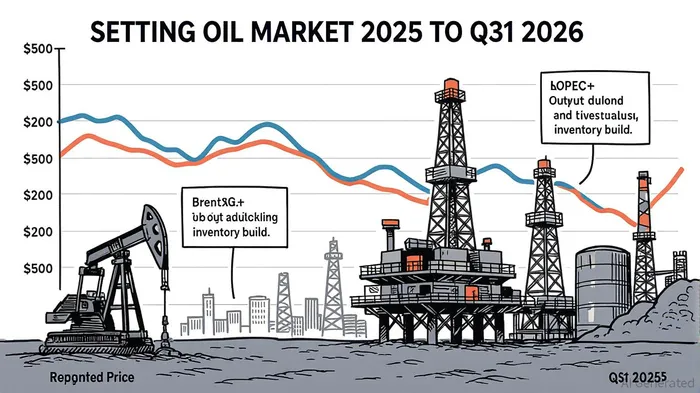
Compounding this, Saudi Arabia's recent decision to cut crude prices for Asian buyers by $1 per barrel has further pressured prices, underscoring weak demand from key markets [1]. Analysts project that Brent crude prices will average $59 per barrel in Q4 2025 and dip to around $50 in early 2026, driven by inventory builds and OPEC+ output hikes [6]. These projections highlight the urgency for investors to adopt proactive risk management strategies.
Hedging Strategies: Tools and Tactical Adaptation
To navigate this volatile environment, investors must leverage a combination of financial instruments and advanced modeling techniques. Futures contracts remain a cornerstone of hedging, allowing producers and importers to lock in prices and stabilize cash flows. For example, selling futures at predetermined prices can shield producers from falling market prices, while importing firms can use joint hedging strategies that account for both oil price and currency risks [5].
Options, particularly put options, offer asymmetric protection. By purchasing puts, investors can secure a minimum sale price, effectively insuring against sharp declines. Costless collars—combining long puts and short calls—provide a budget-friendly alternative, capping downside risk while retaining upside potential [6]. These tools are especially valuable in a market where technical indicators suggest a bearish bias, with Brent crude's support levels near $65 and resistance at $66.80 [4].
Advanced models, such as time-varying parameter vector autoregressive (TVP-VAR) and wavelet-based multivariate GARCH (MGARCH), are increasingly critical for capturing the nonlinear dynamics of oil price volatility [2]. These methodologies incorporate higher-order moments like skewness and kurtosis, enabling investors to anticipate tail risks and adjust hedge ratios dynamically. For instance, Markov Switching GARCH (MS-GARCH) models allow for adaptive hedging strategies that respond to shifting market states, such as periods of geopolitical tension or supply shocks [1].
Historical Lessons and Strategic Recommendations
Historical precedents underscore the importance of diversification and flexibility. During the 2022 Russia-Ukraine invasion, investors who allocated to gold ETFs and infrastructure funds—assets with low correlation to energy equities—successfully buffered their portfolios against oil price corrections [2]. Similarly, in 2025, energy investors have turned to midstream operators, which offer stable returns irrespective of commodity price swings [1].
For near-term strategies, a dual approach is recommended:
1. Short-Term Hedging: Use put options or inverse ETFs to hedge against price drops triggered by OPEC+ output hikes.
2. Long-Term Positioning: Invest in infrastructure or gold ETFs to diversify exposure and mitigate systemic risks.
Additionally, airlines and other oil-sensitive sectors can benefit from index-based hedging, which provides a buffer against supply-demand imbalances [3]. Producers, meanwhile, should prioritize dynamic hedge ratios that adjust to evolving OPEC+ policies and macroeconomic conditions [5].
Conclusion
The interplay of OPEC+ output hikes, inventory dynamics, and geopolitical risks has created a volatile yet navigable landscape for crude oil investors. While bearish fundamentals suggest near-term price corrections, strategic hedging—coupled with advanced modeling and diversified portfolios—can mitigate risks and position investors for long-term resilience. As OPEC+ continues to fine-tune its production strategy, adaptability will remain the key to success in this high-stakes market.







Comentarios
Aún no hay comentarios