
OPEC+'s Output Hike and U.S. Tariffs: Navigating Oil Market Volatility
The oil market faces a critical juncture as OPEC+ accelerates production cuts unwinding while U.S. tariffs amplify demand-side risks. This interplay of supply and demand dynamics will determine near-term price direction and create opportunities for tactical investors. Here's how to parse the volatility and position for what's next.
The Supply Side: OPEC+'s Calculated Gamble
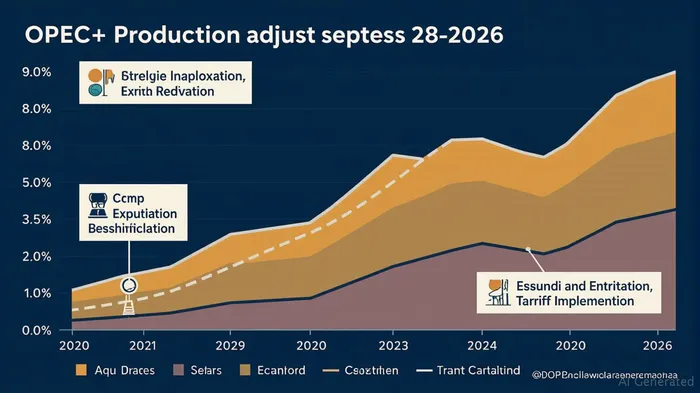
OPEC+'s decision to boost output by 548,000 barrels per day (bpd) in August 2025—surpassing expectations—reflects its strategy to balance immediate demand (summer driving season, geopolitical tensions in the Strait of Hormuz) with long-term market share goals. The group aims to fully restore 2.2 million bpd of cuts by late 2025, a year earlier than planned. This move underscores confidence in global liquidity and a desire to counter U.S. shale's resurgence.
But risks loom. The International Energy Agency (IEA) warns of a potential oversupply in Q4 2025, with global oil inventories already tightening. OPEC+'s flexibility clause—allowing monthly adjustments—means the August 3 meeting could pause or reverse the hikes if fundamentals sour. Investors should monitor compliance with production targets (e.g., Saudi Arabia's adherence) and geopolitical developments (e.g., Iran nuclear talks).
The Demand Side: U.S. Tariffs and Global Supply Chain Chaos
U.S. tariffs on Canadian and Mexican crude—10% and 25%, respectively—are squeezing refiners' margins, particularly in the Midwest, where 75% of crude feedstock is Canadian. While Gulf Coast refiners can pivot to cheaper Middle Eastern or Venezuelan crude, Midwest operators (e.g., Marathon PetroleumMPC--, Valero) face limited alternatives. The Q2 2025 CIPS survey highlights a record 5.03/7 concern score over supply disruptions, with geopolitical risks and trade wars cited by 66% of respondents.
The broader impact is chilling. J.P. Morgan estimates U.S. tariffs could reduce global GDP by 1% and boost PCE inflation by 1–1.5%, squeezing consumer spending and oil demand. A “trade war” scenario could slash Brent prices to $50/bbl by (per Wood Mackenzie), while a “trade truce” might stabilize at $70/bbl. Investors must weigh the likelihood of tariff rollbacks against geopolitical escalation.
Forecasting Near-Term Price Movements
- Short-term (Q3 2025): Prices could dip to $70–$75/bbl as OPEC+ supply floods the market, but Middle East tensions (e.g., Iran/Israel conflict) and U.S. strategic reserves releases could stabilize the downside.
- Medium-term (Q4 2025): Oversupply risks and global recession fears (U.S. GDP growth now 0.6% lower) may push prices toward $60/bbl unless OPEC+ halts hikes or demand surprises to the upside.
Tactical Investment Recommendations
- Oil Producers: Buy exposure to OPEC+ members (e.g., Saudi Aramco, state-owned firms) if prices dip below $70/bbl, betting on OPEC+ curtailment. However, avoid pure-play U.S. shale (e.g., Pioneer Natural Resources) due to tariff-driven cost pressures.
- Refiners: Short Midwest-focused refiners (MPC, VLO) until trade tensions ease. Gulf Coast peers (Phillips 66) may outperform if they pivot to cheaper feedstock.
- Hedging: Use put options on oil ETFs (USO) to protect against a $50/bbl collapse.
- Tariff Plays: Consider long positions in companies insulated from tariffs (e.g., U.S. domestic drillers like EOG Resources) or beneficiaries of trade diversion (e.g., Canadian National Railway).
Final Take
The oil market is a high-wire act between OPEC+'s supply discipline and U.S. policy-induced demand destruction. Investors should prioritize flexibility:
- Aggressive stance: Buy OPEC-linked stocks at $60–$65/bbl.
- Cautious stance: Stay neutral until OPEC's August meeting clarifies production intent and U.S.-China trade talks yield progress.
The next few months will test whether OPEC+ can reclaim market share without triggering a global price collapse—or whether tariffs and trade wars will redefine the oil economy. Stay vigilant.





Comentarios
Aún no hay comentarios