
OPEC+ Output Hike and Global Energy Market Rebalancing: Strategic Positioning for Energy Investors
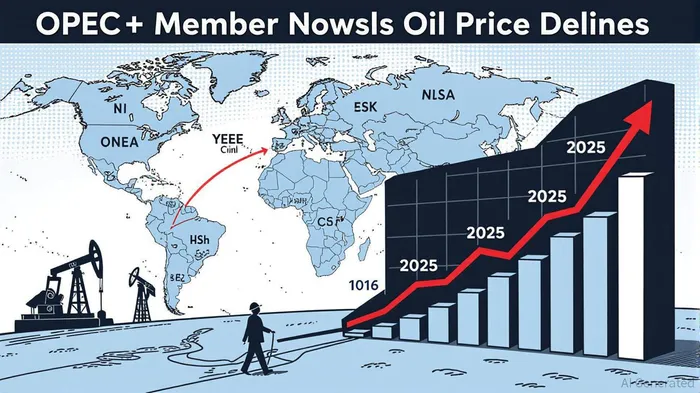
The global energy landscape is undergoing a seismic shift as OPEC+ accelerates its unwinding of production cuts, injecting 137,000 barrels per day (bpd) into the market in October 2025. This move, part of a broader strategy to restore 1.66 million bpd of previously curtailed output, reflects a calculated pivot from price stability to market share dominance. For energy investors, this rebalancing moment demands a nuanced understanding of geopolitical dynamics, supply-demand imbalances, and the accelerating energy transition.
Geopolitical Calculations and Strategic Shifts
OPEC+'s decision to increase output is not merely a response to market fundamentals but a strategic recalibration driven by geopolitical pressures. The group's eight core contributors—Saudi Arabia, Russia, Iraq, UAE, Kuwait, Kazakhstan, Algeria, and Oman—are prioritizing market share over fiscal discipline, a departure from their earlier focus on price stabilization. This shift is fueled by three key factors:
1. U.S. Pressure: President Donald Trump's vocal advocacy for lower energy prices has forced OPEC+ to align with U.S. inflationary goals, even at the expense of short-term revenue.
2. Internal Tensions: Non-compliant members like Iraq and Kazakhstan have exceeded quotas, eroding the group's cohesion. The UAE's 300,000 bpd surge in August 2025 underscores the growing divide between high-spare-capacity producers and those struggling to meet targets.
3. Non-OPEC Competition: U.S. shale, Brazilian offshore projects, and Canadian oil sands have added over 1 million bpd to global supply in 2025, forcing OPEC+ to act preemptively to retain influence.
Short-Term Impacts: Oil Prices Under Pressure
The immediate fallout from the October 2025 hike is a further compression in oil prices, already trading at $68 per barrel. Analysts project a continued decline, with the EIA forecasting an average of $67/bbl in 2025 and J.P. Morgan predicting $58/bbl by 2026. Key drivers include:
- Supply Glut: Global oil inventories are rising as OPEC+ and non-OPEC producers outpace demand. By year-end 2025, a 3 million bpd surplus is expected, driven by weak demand in China and Europe.
- Demand Weakness: The IEA forecasts oil demand growth of just 680,000 bpd in 2025, far below pre-pandemic levels. China's shift to electric vehicles (EVs) and liquefied natural gas (LNG) is a critical factor.
- OPEC+ Flexibility: The group's ability to pause or reverse production increases ensures it remains a swing producer, but this flexibility also introduces volatility.
Long-Term Implications: The Energy Transition Accelerates
While OPEC+ focuses on short-term market share, the long-term trajectory of the energy transition is reshaping the industry. Lower oil prices may temporarily slow renewable energy investment, but structural trends—such as AI-driven electricity demand and decarbonization mandates—ensure the transition's momentum. Key developments include:
- Renewable Investment Surge: Global clean energy investment is projected to reach $2.2 trillion in 2025, nearly double fossil fuel spending. Solar PV alone will attract $450 billion, driven by cost declines and policy support.
- Electrification of Demand: The rise of EVs, data centers, and industrial electrification is creating a new energy paradigm. By 2026, electricity demand is expected to outpace oil consumption in key markets.
- Strategic Diversification: Major oil companies are pivoting to low-carbon projects, while national oil companies are balancing fossil fuel output with green hydrogen and carbon capture investments.
Strategic Positioning for Energy Investors
For investors navigating this rebalancing moment, the following strategies offer actionable insights:
- Prioritize Resilient Business Models
- Midstream Infrastructure: Companies like Kinder MorganKMI-- (KMI) and EnbridgeENB-- (ENB) offer stable cash flows insulated from commodity price swings.
- Integrated Energy Firms: ChevronCVX-- (CVX) and TotalEnergiesTTE-- (TTE) combine upstream and downstream operations, providing diversification and cost efficiency.
Low-Breakeven Producers: Saudi Aramco (2080.SE) and Abu Dhabi National Oil Co. (ADNOC) benefit from OPEC+'s market-share strategy due to their low production costs.
Hedge Against Price Volatility
- Use derivatives to lock in prices for high-cost producers.
Allocate to energy ETFs like the Invesco Solar ETF (TAN) to balance exposure to renewables and traditional energy.
Embrace the Energy Transition
- Invest in grid infrastructure (e.g., NextEra Energy, NEER) and storage solutions (e.g., TeslaTSLA--, TSLA) to capitalize on electrification trends.
Monitor natural gas as a transitional fuel, with companies like Cheniere EnergyLNG-- (LNG) benefiting from LNG demand in Asia.
Geopolitical Risk Mitigation
- Diversify portfolios across regions to hedge against conflicts (e.g., Israel-Iran tensions) and sanctions.
- Track U.S. shale output and OPEC+ compliance rates as key indicators of market stability.
Conclusion
OPEC+'s October 2025 output hike marks a pivotal moment in the global energy transition. While short-term oil prices face downward pressure, the long-term shift toward electrification and renewables is irreversible. Investors who position themselves at the intersection of traditional energy resilience and clean energy innovation will be best equipped to navigate this rebalancing. The next 12 months will test the adaptability of energy portfolios, but those who embrace strategic diversification and technological foresight will emerge stronger in the evolving energy landscape.





Comentarios
Aún no hay comentarios