
OPEC+'s Market Share Strategy and Its Implications for Oil Prices and Energy Sector Valuations
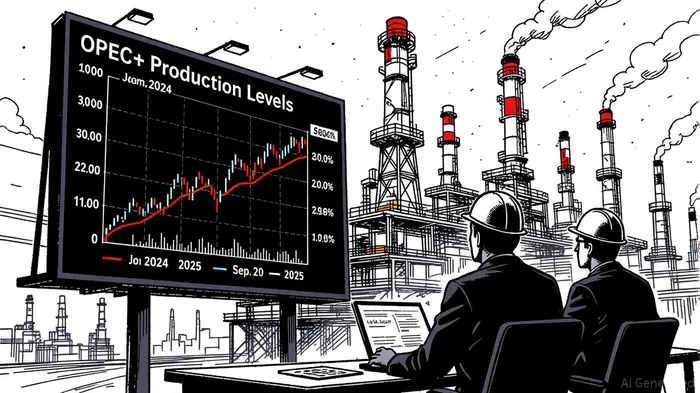
OPEC+’s strategic pivot toward prioritizing market share over price stability in 2025 has sent ripples through global oil markets, creating both risks and opportunities for energy investors. The group’s decision to unwind 1.66 million barrels per day (bpd) of voluntary production cuts—implemented since April 2023—signals a recalibration of its approach amid shifting global demand dynamics and geopolitical pressures. According to a report by Bloomberg, this move, set to be finalized at the September 7, 2025, meeting, could exacerbate an anticipated supply surplus in Q4 2025, potentially pushing prices lower [1].
The Production Surge and Market Dynamics
OPEC+ has already increased output by 547,000 bpd in September 2025 compared to August levels, part of a broader strategy to phase out 2.2 million bpd of cuts since April 2025 [3]. This aggressive unwinding reflects a shift from price stabilization to market share competition, driven by concerns over U.S. pressure on India to curb Russian oil imports and the lingering effects of the Russia-Ukraine conflict on global supply chains [3]. However, analysts caution that this strategy carries risks. A Reuters analysis notes that while OPEC+ retains flexibility to pause or reverse production increases, the current trajectory could lead to a supply glut, particularly if global demand growth slows due to trade tensions or economic downturns [5].
The market has already priced in some of these risks. U.S. benchmark oil prices fell more than 3% in early September 2025 as investors anticipated further production hikes [1]. Goldman SachsGS-- has cut its Q3 2025 Brent crude forecast to $70 per barrel from $85, citing inventory glut concerns despite recent drawdowns [4].
Investor Sentiment and Sector Valuations
The energy sector’s valuation metrics, such as the S&P 500 energy index’s 3.92% year-to-date gain by June 2025, suggest resilience despite volatility [2]. However, investor sentiment remains cautiously bearish. A Deloitte report highlights that while the oil and gas industry distributed $213 billion in dividends and $136 billion in buybacks between January 2024 and mid-November 2024, capital expenditures have surged by 53% over four years, reflecting a focus on high-return projects [2].
For individual investors, the key lies in identifying companies with structural advantages. Crescent EnergyCRGY--, for instance, has adopted a hedging strategy to mitigate price volatility, ensuring stable free cash flow and consistent dividends [5]. Similarly, firms like FlowcoFLOC-- and Hess MidstreamHESM--, which focus on production optimization and transportation infrastructure, offer less direct exposure to commodity price swings [5]. These companies exemplify opportunities in a sector where market share competition may erode margins for pure-play producers.
Geopolitical and Economic Headwinds
OPEC+’s strategy is further complicated by external factors. The U.S. has imposed tariffs of 10% to 50% on imports from multiple countries, creating trade uncertainty and dampening global demand expectations [4]. Meanwhile, China’s strategic stockpiling of 82 million barrels in Q2 2025 has removed oil from circulation, tightening markets despite OPEC+’s output increases [1].
The U.S. One Big Beautiful Bill, which promotes domestic shale production while rolling back renewable energy incentives, adds another layer of complexity. While this could boost U.S. output, it may also force OPEC+ to adjust its strategy to maintain market balance [4].
Risks and Opportunities for Investors
The primary risk for oil investors lies in the potential for a prolonged price slump. If OPEC+’s production increases outpace demand growth, oil prices could face downward pressure through 2026 [2]. However, the sector’s flexibility—such as OPEC+’s ability to pause output hikes—provides a buffer against extreme volatility [5].
Opportunities exist for investors who can differentiate between cyclical and structural trends. Companies with strong balance sheets, diversified revenue streams, or exposure to infrastructure (e.g., midstream operators) are better positioned to weather price fluctuations. Conversely, high-cost producers with limited hedging may struggle in a lower-price environment.
Conclusion
OPEC+’s market share strategy in 2025 underscores the delicate balance between regaining lost ground and avoiding a price war. While the group’s production increases pose short-term risks to oil prices, they also create opportunities for investors to capitalize on resilient energy stocks. As the September 7 meeting approaches, the market will closely watch whether OPEC+ can navigate geopolitical headwinds and maintain a delicate equilibrium between supply and demand.
Source:
[1]
Would Another OPEC+ Production Surge Really Crash Oil Prices?
[2]
2025 Oil and Gas Industry Outlook
[3]
OPEC+ makes another large oil output hike in market share push
[4]
Understanding Crude Oil Prices Today: 2025 Market Analysis
[5]
We See Opportunities Despite Falling Oil Prices







Comentarios
Aún no hay comentarios