
OPEC+'s Aggressive Output Hikes and Market Oversupply Risks: Strategic Positioning for Energy Investors in a Volatile Landscape
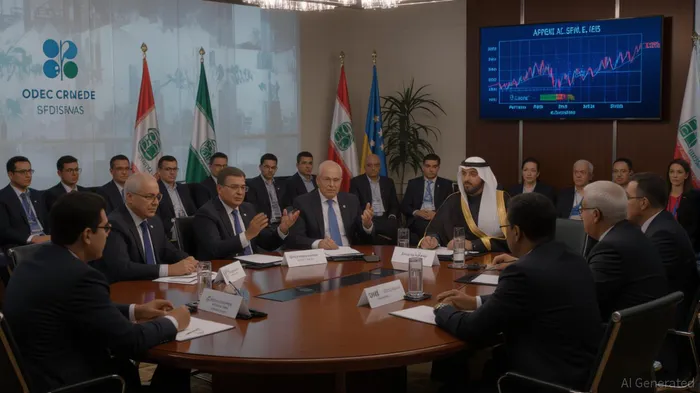
The global oil market in 2025 is navigating a precarious equilibrium, shaped by OPEC+'s calculated production hikes, geopolitical frictions, and the lingering shadow of the energy transition. For energy investors, the interplay of these forces demands a nuanced approach to risk management and strategic positioning.
OPEC+'s Calculated Gambit: Restoring Market Share Amid Fragile Fundamentals
OPEC+ has embarked on a phased strategy to restore 2.2 million barrels per day (b/d) of production by September 2026, with incremental increases of 548,000 b/d in August 2025 alone. This move reflects a dual objective: countering non-OPEC+ supply gains (notably from U.S. shale and Brazilian offshore projects) and addressing low global oil inventories. However, the group's flexibility to pause or reverse these hikes underscores the fragility of its strategy. The August 2025 production adjustment, for instance, was justified by “healthy economic conditions,” yet it has already triggered a 1.5% projected surplus in Q4 2025, according to the International Energy Agency (IEA).
The geopolitical dimension adds complexity. OPEC+'s internal dynamics—where high-cost producers like Iraq and Algeria struggle with falling prices, while Saudi Arabia and the UAE pivot toward green hydrogen—highlight the group's uneven resilience. Meanwhile, the U.S.-India-Russia trade conflict, with India defying U.S. pressure to curb Russian oil imports, has created a parallel supply chain that OPEC+ cannot fully control.
Market Reactions: A Bearish Trend Amid Dollar Weakness and Supply Glut Fears
Oil prices have responded to OPEC+'s actions with a clear downward trajectory. Brent crude closed at $69.67 in late August 2025, down from $81 in 2024, while U.S. crude production, though modestly rising, remains near record highs. The market's bearish sentiment is compounded by the IEA's warning of a 1 million b/d inventory build and a projected 1.5% surplus by year-end.
Investors must also contend with the U.S. Energy Information Administration's (EIA) forecast of a $58/bbl average for Brent in 2026, driven by non-OPEC+ supply growth and slowing demand. This trajectory suggests that OPEC+'s market-share strategy may come at the cost of price stability, a trade-off that could test the group's cohesion in 2026.
Strategic Positioning: Hedging, Diversification, and Transition Opportunities
For energy investors, the path forward requires balancing short-term hedging with long-term foresight. Here's how to navigate the current landscape:
Short-Term Hedging: Futures and Options as Defensive Tools
With oil prices vulnerable to OPEC+ policy shifts and geopolitical shocks, investors should use futures and options to lock in exposure. For example, short-dated Brent crude options can mitigate downside risk if the IEA's surplus projections materialize. Similarly, U.S. producers facing production declines (e.g., due to low rig counts) could benefit from hedging against further price erosion.Mid-Term Diversification: Monitoring OPEC+ Compliance and Geopolitical Leverage Points
OPEC+'s September 2025 ministerial meeting will be critical. If the group pauses its production hikes, prices could rebound. Conversely, continued overproduction may force a price war. Investors should also track U.S.-India-Russia trade developments, as retaliatory measures could disrupt supply chains and push prices toward $100/bbl.Long-Term Transition Play: Green Hydrogen and Decarbonization Incentives
OPEC+'s pivot toward green hydrogen and the EU's Carbon Border Adjustment Mechanism (CBAM) signal a structural shift. Investors should allocate capital to companies bridging traditional and transition energy, such as Saudi Aramco's hydrogen ventures or UAE-based renewables firms. The energy transition is no longer a distant horizon—it is a present-day opportunity.
Conclusion: Navigating Uncertainty with Agility and Foresight
The oil market in 2025 is a theater of competing forces: OPEC+'s market-share ambitions, U.S. production resilience, and the accelerating energy transition. For investors, the key lies in agility—hedging against short-term volatility while positioning for long-term gains in decarbonization.
As OPEC+'s production hikes continue to test market fundamentals, the ability to adapt to shifting supply dynamics and geopolitical risks will separate successful investors from the rest. The path forward is uncertain, but for those who recognize the interdependence of market forces and strategic foresight, the opportunities are substantial.







Comentarios
Aún no hay comentarios