
ONDO Token: A Case of DeFi Undervaluation Amidst Explosive Fundamentals
The DeFi market has long been plagued by pricing inefficiencies, where tokens often trade at valuations that bear little resemblance to their underlying fundamentals. The ONDOONDO-- token, native to Ondo Finance, exemplifies this dislocation. Despite a Total Value Locked (TVL) of $1.93 billion and a 400% surge in daily active addresses in 2025, ONDO's market cap of $1.22 billion as of December 29, 2025, remains significantly lower than its intrinsic value metrics. This article argues that structural misalignments in DeFi token pricing-rooted in speculative narratives, opaque tokenomics, and underappreciated utility-are causing the market to undervalue ONDO, even as the platform's real-world asset (RWA) infrastructure and institutional-grade products gain traction.
The Intrinsic Value Case for ONDO
Ondo Finance has positioned itself as a leader in tokenized RWA, with products like USDY (a yield-generating stablecoin) and OUSG (a U.S. Treasury-backed fund) collectively achieving a $1 billion market cap. These assets are backed by short-term U.S. Treasuries and bank deposits, generating revenue through management fees and yield distribution. For instance, USDY retains a 0.5 percentage point fee on its base yield while distributing the remainder to holders. Meanwhile, OUSG, which targets institutional investors, began charging a 0.15% management fee in July 2025. These revenue streams are not just theoretical-they are already contributing to Ondo's ecosystem, with protocol revenue growing in tandem with TVL.
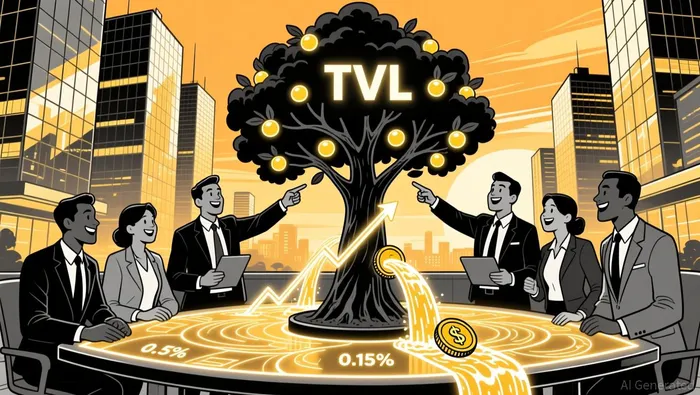
The platform's TVL surged to $1.93 billion in late 2025, driven by the launch of tokenized U.S. stocks and ETFs on SolanaSOL--. This expansion has attracted institutional partners like Fidelity and JPMorgan, with $2 billion in trading volume and $370 million in TVL for tokenized equities. Yet, despite these metrics, ONDO's price languishes at $0.3769, far below its intrinsic value. Academic analyses highlight a recurring theme: DeFi tokens often trade at discounts to their TVL due to a lack of direct value capture mechanisms. ONDO, which serves primarily as a governance token, lacks the earning potential of its RWA counterparts, creating a misalignment between its utility and market price.
On-Chain Adoption vs. Market Sentiment
Ondo's on-chain adoption metrics tell a story of explosive growth. Daily active addresses increased by 400% in early 2025, and the platform's TVL grew by 38.9% in Q4 2025, reaching $1.7 billion. Transaction volume for tokenized assets like OUSG and USDY has also spiked, with $53 million in 24-hour trading volume recorded in early January 2026. These figures suggest robust user engagement and institutional confidence, yet ONDO's price remains volatile, fluctuating between $0.35 and $0.45 in late 2025.
The disconnect is further exacerbated by structural supply dynamics. A major token unlock of 1.94 billion ONDO tokens in January 2026-57% of the circulating supply-introduced liquidity but triggered short-term selling pressure, pushing the price down from its mid-2024 high of $2.14 to $0.746 by mid-2025. While this event poses near-term risks, the majority of unlocked tokens are earmarked for long-term ecosystem growth, including staking rewards and product development. Analysts project that ONDO could reach $1.50 if the platform's market cap surpasses $5 billion, with potential for $3 if it exceeds $10 billion. These targets hinge on the assumption that the market will eventually recognize the token's role in a rapidly expanding RWA sector.
Structural Misalignments in DeFi Pricing
The broader DeFi market in 2025 has been marked by inefficiencies between intrinsic value and on-chain adoption. Many tokens are priced based on speculative narratives rather than verifiable usage or transparent governance. For example, stablecoins now dominate the digital economy with a $310 billion market cap, yet their pricing often reflects liquidity demand rather than underlying asset quality. Similarly, RWA tokenization has surged, with tokenized private credit reaching $14 billion in mid-2025, but many tokens in this space trade at low volumes and long holding periods, underscoring a liquidity mismatch.
ONDO's situation mirrors these broader trends. While its TVL and user growth metrics are robust, the token's price remains disconnected from these fundamentals. This is partly due to its governance-centric utility, which lacks direct yield generation mechanisms. In contrast, Ondo's tokenized assets like USDY and OUSG offer tangible returns, creating a disparity in how value is distributed within the ecosystem. Academic studies suggest that such misalignments are common in DeFi, where tokens with strong utility but limited earning potential often trade at discounts to their TVL.
The Path to Repricing
For ONDO to achieve fair valuation, the market must reconcile its intrinsic value with its governance utility. Several factors could drive this repricing:
1. Regulatory Clarity: Ondo's acquisition of SEC-registered licenses and partnerships with traditional institutions like BlackRock could enhance institutional adoption.
2. Utility Expansion: The platform's roadmap to expand tokenized assets beyond stablecoins and treasuries-into equities, ETFs, and cross-chain interoperability- could unlock new revenue streams.
3. Token Burn Mechanisms: While Ondo's tokenomics include burn mechanisms, increased adoption of USDY and OUSG could drive demand for ONDO through staking and governance participation.
Conclusion
The ONDO token is a prime example of DeFi's pricing inefficiencies. Its market cap fails to reflect the platform's $1.93 billion TVL, explosive user growth, and institutional-grade RWA products. While short-term challenges like token unlocks and governance limitations persist, the long-term fundamentals are compelling. As the RWA sector matures and DeFi moves toward institutional-grade infrastructure, ONDO's role as a governance token in a $10+ billion market could justify a significant re-rating. For investors, the key takeaway is clear: the market is undervaluing ONDO's structural strengths, and patience may be rewarded as the ecosystem scales.






Comentarios
Aún no hay comentarios