
Omada Health's Path to Profitability: A Breakout Story in Chronic Disease Management
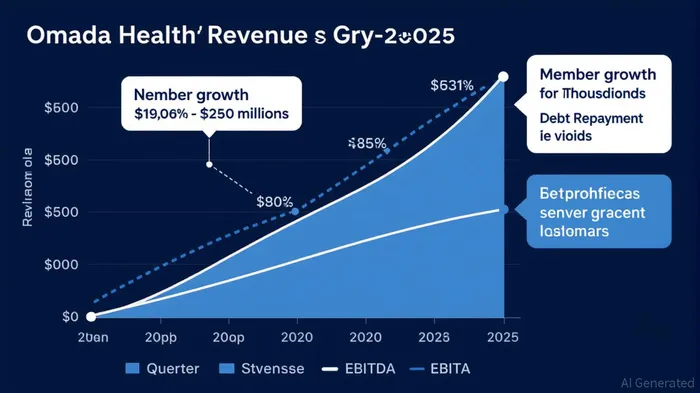
Omada Health's journey from a high-burn digital health startup to a company on the cusp of profitability has become one of the most compelling stories in chronic disease management. The firm's second-quarter 2025 results underscored a dramatic turnaround, with revenue surging 49% year-over-year to $61 million and adjusted EBITDA losses narrowing to just $0.2 million from $6.8 million in the prior-year period [1]. This progress, coupled with a successful $150 million IPO in June 2025 and a post-debut valuation of $1.28 billion [2], positions OmadaOMDA-- as a standout in a sector grappling with scaling challenges.
Sustainable Growth: Scaling Members and Revenue
Omada's ability to grow its member base by 52% year-over-year to 752,000 in Q2 2025 [1] reflects the increasing demand for digital solutions in managing chronic conditions like diabetes and hypertension. The company's focus on high-margin SaaS-like services—accounting for 93% of revenue—has driven a gross margin improvement to 66% in Q2 2025, up from 61% in FY2024 [3]. This shift away from hardware (which comprises only 7% of revenue) has been critical in enhancing profitability.
The company's strategic pivot to GLP-1s and AI-driven tools like OmadaSpark further strengthens its value proposition. These innovations, combined with optimized marketing campaigns, have boosted outreach productivity and member retention [4]. With 2,000+ employer and health plan partners [2], Omada is well-positioned to capitalize on the $5.2 billion U.S. patient engagement solutions market [5], where its multi-condition platform offers a unique edge.
Operational Leverage: Cost Discipline and Debt Reduction
Omada's path to profitability hinges on its ability to balance growth with cost control. The company has implemented significant SG&A reductions, transitioning from a -45% operating margin in 2023 to -7% in 2024 [6]. This trend accelerated in 2025, with management emphasizing “rightsizing” SG&A expenses in the second half of the year [4].
A landmark achievement was the early repayment of $31.4 million in debt, eliminating future interest expenses and covenant constraints [1]. This financial flexibility allows Omada to reinvest in growth initiatives, including potential acquisitions of complementary businesses [2]. The company's FY2025 guidance—$235–241 million in revenue and adjusted EBITDA losses of $5–9 million—signals a clear trajectory toward breakeven, assuming current trends persist [1].
EBITDA Recovery and Market Validation
The narrowing EBITDA losses—from $6.8 million in Q2 2024 to $0.2 million in Q2 2025—demonstrate Omada's operational progress. While the company still faces a projected $5–9 million EBITDA loss for FY2025, this represents a 90% reduction from 2023 levels [1]. The IPO, which priced at $19 per share and opened 21% higher [2], provided a liquidity boost to accelerate this recovery.
Investor confidence is further bolstered by Omada's credit profile. Default probability metrics stabilized to 1.287 by June 2025 from a peak of 2.291 in 2022 [7], reflecting improved financial discipline and market positioning. Analysts note that Omada's SaaS-like margin structure and focus on chronic care—a $1.2 trillion global market—position it to outperform peers in the volatile digital health sector [5].
Challenges and the Road Ahead
Despite these strides, risks remain. The company's reliance on venture funding and public market capital highlights its need to maintain growth while achieving profitability. Customer acquisition costs, though not explicitly disclosed, are a critical metric to monitor, as optimizing these will determine long-term sustainability [3]. Additionally, competition from emerging digital health players and traditional healthcare providers could pressure margins.
However, Omada's first-mover advantage in chronic condition management, combined with its AI and GLP-1 integrations, creates a moat. The firm's ability to scale its virtual care platform while maintaining a 66% gross margin [1] suggests it is navigating these challenges effectively.
Conclusion
Omada Health's transformation from a high-growth, unprofitable startup to a company with a clear path to breakeven is a testament to its strategic agility. With revenue growth outpacing losses, a deleveraged balance sheet, and a strong market position, the firm is poised to benefit from the broader shift toward digital solutions in chronic care. For investors, the key question is whether Omada can sustain its operational discipline while scaling—a challenge it appears well-equipped to meet.





Comentarios
Aún no hay comentarios