
Olin Corporation's Q3 2025 Earnings Outlook and Strategic Positioning: Leveraging Cyclical Recovery in Chemical and Defense Sectors
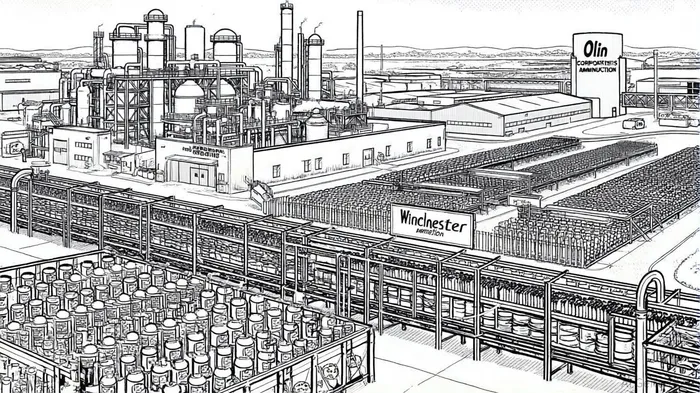
Olin Corporation (NYSE: OLN) is poised to capitalize on the cyclical recovery in both the chemical and defense sectors as it prepares to release its Q3 2025 earnings on October 23, 2025. With a diversified portfolio spanning chlor-alkali products, epoxy resins, and small-caliber ammunition under its Winchester brand, Olin's strategic positioning aligns with macroeconomic tailwinds in industrial demand and defense modernization. This analysis examines how the company's operational resilience, debt reduction, and sector-specific investments position it to outperform in a recovering market.
Chemical Industry Recovery: A Tailwind for Olin's Core Businesses
The global chemical industry is entering a modest recovery phase in 2025, with projected output growth of 1.9% driven by easing monetary policy and increased capital investment [1]. Olin's Chlor Alkali Products & Vinyls segment, which accounted for 55.71% of total revenues in Q2 2025 ($979.50 million), is well-positioned to benefit from this trend [4]. The segment's key products—chlorine, sodium hydroxide, and polyvinyl chloride—are critical inputs for construction, water treatment, and manufacturing, all of which are rebounding as industrial activity normalizes.
However, the sector remains challenged by overbuilt capacity and maturing markets. To address this, OlinOLN-- has prioritized cost efficiency through asset rationalization and workforce adjustments [1]. For instance, the company reduced its debt to nearly zero in Q3 2025, enhancing financial flexibility and allowing reinvestment in high-growth areas [2]. Analysts project that Olin's EBITDA will rise by 40% year-over-year to $11.6 billion in Q3 2025, despite a 10% decline in total income to $73 billion, underscoring operational resilience [2].
Defense Sector Growth: Winchester's Strategic Alignment
The defense sector is experiencing a robust cyclical recovery, fueled by geopolitical tensions and a global defense spending supercycle. European nations, including Germany, are leading the charge, with defense budgets growing at an annual rate of 6.8% from 2024 to 2035 [2]. Olin's Winchester division, a key contributor to its revenue, has demonstrated strong alignment with this trend. In Q2 2025, the segment saw a 10.2% revenue increase, driven by higher military sales and project-related revenues [1].
Winchester's performance is further bolstered by significant government contracts. For example, the division secured a $97 million payment from the U.S. Department of Defense in January 2025 for upgrading a 5.56mm SCAMP primer safe pack unloader system [4]. Additionally, the segment's contract backlog surged to $1.4 billion as of January 31, 2025, up from $914 million, reflecting sustained demand for military ammunition [5]. These developments highlight Winchester's ability to capitalize on defense modernization programs, particularly in land systems and artillery, where Europe alone is projected to spend over $50 billion through the early 2030s [2].
Strategic Investments in Renewable Energy and Nuclear Innovation
Beyond its core operations, Olin is positioning itself for long-term growth through strategic investments in renewable energy and nuclear technology. The company plans to allocate 35 billion euros by 2035, focusing on two small modular reactor (SMR) nuclear plants and offshore wind projects [2]. This pivot aligns with global decarbonization goals and positions Olin to benefit from the energy transition, particularly in Europe, where nuclear energy is gaining renewed interest as a low-carbon power source.
These investments also complement Olin's chemical segment, which is under pressure to adopt sustainable practices. By leveraging its expertise in industrial chemicals, Olin can support the production of materials needed for renewable energy infrastructure, such as epoxy resins for wind turbines [4]. This dual focus on traditional and emerging markets strengthens the company's competitive moat.
Earnings Outlook and Market Reaction
Analysts project Olin's Q3 2025 earnings per share (EPS) to reach $0.35, exceeding the Q2 2025 result of $0.05 [3]. While revenue is expected to dip slightly to $1.74 billion from $1.76 billion in Q2 2025, the EBITDA growth of 40% indicates improving profitability [2]. The stock has historically shown volatility around earnings releases, with a 5.09% one-day gain in Q2 2025 followed by a 12.48% five-day decline [4]. However, recent positive revisions in revenue forecasts—up 3.02% over three months—suggest growing confidence in the company's ability to navigate sector challenges [4].
Historical backtesting of OLN's performance around earnings releases from 2022 to 2025 reveals mixed signals for a simple buy-and-hold strategy. While the stock showed a modest average excess return of +0.51% on the day after earnings (Day +1) with a 55% win rate, these results were not statistically significant. More notably, cumulative returns turned negative by Day +14, declining to -2.9% by Day +26 and -4.9% by Day +30. This suggests that holding OLNOLN-- for extended periods post-earnings has historically underperformed relative to a market-neutral benchmark. Investors may need to incorporate additional filters—such as the magnitude of earnings surprises or guidance tone—to refine timing strategies [4].
Conclusion: A Compelling Case for Long-Term Investors
Olin Corporation's strategic positioning in the chemical and defense sectors, combined with its debt reduction and renewable energy investments, creates a compelling case for investors. The company's ability to leverage cyclical recovery in industrial demand and defense modernization, while addressing sustainability challenges, positions it to deliver resilient earnings and long-term value. As the Q3 2025 earnings report approaches, market participants will be watching closely for signs of continued momentum in both its core and emerging businesses.





Comentarios
Aún no hay comentarios