
Is Oklo Stock a High-Risk Speculative Bet or a Strategic Play on the Future of Nuclear Energy?
The nuclear energy sector is undergoing a renaissance, driven by global decarbonization goals and the urgent need for reliable, scalable clean energy. At the forefront of this transformation is Oklo Inc.OKLO-- (NYSE: OKLO), a company pioneering advanced fission technology. However, its soaring valuation-$13 billion as of December 2025-raises critical questions: Is OkloOKLO-- a speculative gamble, or does it represent a calculated bet on the future of energy? This analysis evaluates Oklo's long-term growth potential against its current financial and valuation risks, drawing on recent data and industry trends.
Oklo's Technological Edge and Strategic Positioning
Oklo's core innovation, the Aurora Powerhouse, is a compact, advanced fission reactor designed to deliver clean energy with enhanced safety and efficiency compared to traditional nuclear plants according to analysis. The company's secured supply of High-Assay Low-Enriched Uranium (HALEU)-5 metric tons from the U.S. Department of Energy-gives it a critical advantage over peers, ensuring fuel availability for its first commercial facility based on Q2 2025 data. This strategic move reduces supply chain risks and aligns with U.S. policy priorities to bolster domestic nuclear capabilities.
Oklo's nuclear fuel recycling initiative further differentiates it. By converting used nuclear fuel into usable energy, the company addresses one of the industry's most persistent challenges: waste management according to analysis. This capability positions Oklo as a key player in the circular economy of nuclear energy, a growing focus for regulators and investors.
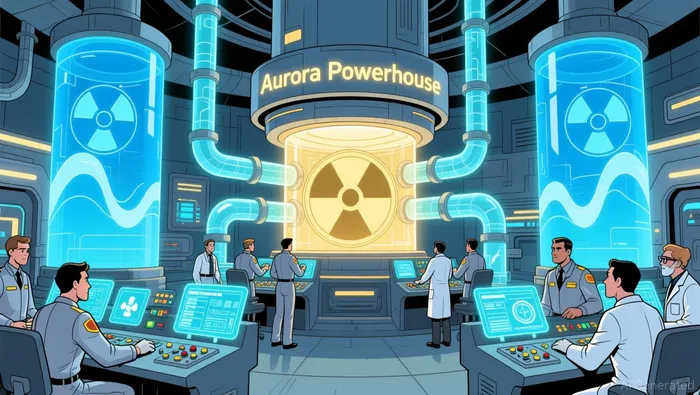 Regulatory progress is another strong suit. Oklo recently completed Phase I of the Nuclear Regulatory Commission's (NRC) readiness assessment for its Aurora-INL combined license application, with no major gaps identified according to company reports. The company is on track to submit its license application in early Q4 2025 and begin construction at Idaho National Laboratory (INL) in Q3 2025, targeting commercial operations by late 2027. These milestones, supported by partnerships with Kiewit (construction) and Vertiv (cooling solutions), underscore its operational credibility.
Valuation Risks: A Pre-Revenue, High-Cost Play
Despite these strengths, Oklo's financials paint a cautionary picture. As of Q2 2025, the company reported an operating loss of $28 million, with losses widening year-over-year according to market data. Its balance sheet, however, remains robust: $683 million in cash and marketable securities as of June 30, 2025, provides a multi-year runway according to financial reports. Yet, this liquidity comes at a cost. Oklo has raised capital through at-the-market (ATM) equity sales, leading to significant shareholder dilution. For instance, its November 2025 market cap of $13 billion reflects a 423% surge since 2024, but this growth has been fueled by continuous equity issuance, eroding value for existing investors according to financial analysis.
Valuation metrics exacerbate concerns. Oklo trades at a Price-to-Book (PB) ratio of 10.8x, far exceeding the peer average of 1.8x and the U.S. Electric Utilities industry average of 1.9x according to valuation data. This premium reflects investor optimism about its long-term potential but also highlights the speculative nature of the investment. The company's negative earnings per share (-$0.58) and ROE of -10.42% further underscore its unprofitable status according to financial statistics. While analysts project a 30% upside to $108.33 per share, such optimism hinges on Oklo's ability to commercialize its technology and generate revenue-a distant milestone.
Industry Context: Growth vs. Competition
The advanced nuclear energy market is projected to grow substantially, with small modular reactors (SMRs) and emerging technologies like molten salt reactors (MSRs) leading the charge. The global advanced nuclear market is forecasted to reach $392.7 billion by 2035, driven by AI-driven energy demand and decarbonization mandates. Oklo's focus on SMRs aligns with this trend, but it faces stiff competition.
NuScale Power, a leader in SMR development, recently secured a $227.7 million funding boost and is targeting commercial operations in Poland by 2029 according to investment reports. While NuScale's valuation is opaque, its recent quarterly net loss of $532 million and $753.8 million cash reserves highlight the sector's capital-intensive nature according to financial results. Terrestrial Energy, another peer, remains pre-revenue and lacks a clear commercialization timeline, making it a riskier proposition than Oklo according to market analysis.
Oklo's valuation, however, dwarfs these competitors. With a market cap of $13 billion, it is valued at over 10x the $1.2 billion cash balance on its balance sheet according to financial data. This disconnect suggests that investors are pricing in a dominant market share and rapid scalability, which may or may not materialize.
Long-Term Potential: A Bet on Energy Transition
Oklo's strategic partnerships and technological differentiation position it to benefit from the energy transition. Its 14 GW customer pipeline across data centers, utilities, and industrial sectors reflects growing demand for reliable, low-carbon power according to market analysis. The Aurora-INL project, supported by the DOE's Reactor Pilot Program, could serve as a blueprint for future deployments, reducing licensing costs and regulatory hurdles for subsequent projects.
Moreover, Oklo's collaboration with Lightbridge Corporation to co-locate fuel fabrication facilities aligns with federal efforts to strengthen domestic nuclear supply chains according to company announcements. These initiatives could create a flywheel effect: lower costs, faster deployment, and increased profitability.
Conclusion: High-Risk, High-Reward Dynamics
Oklo stock embodies the classic tension between innovation and valuation. Its technological advancements and regulatory progress justify optimism, particularly in a sector poised for long-term growth. However, its current valuation-driven by speculative fervor rather than profitability-introduces significant risks.
For investors, Oklo represents a high-risk, high-reward play. The company's success hinges on executing its commercialization timeline, managing dilution, and capturing a meaningful share of the advanced nuclear market. Conservative investors may find the valuation too stretched, while those with a long-term horizon and tolerance for volatility could view it as a strategic bet on the future of clean energy.
In the end, Oklo's story is not just about nuclear reactors-it's about the broader energy transition. Whether it becomes a cornerstone of this shift or a cautionary tale will depend on its ability to bridge the gap between promise and performance.







Comentarios
Aún no hay comentarios