
Oklo Versus Bitcoin: A High-Stakes Investment Duel in the AI Era
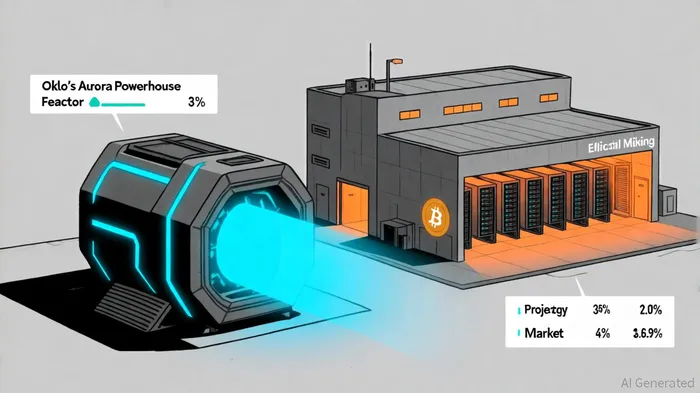
The artificial intelligence (AI) revolution is reshaping global energy demand, creating a high-stakes arena where energy-tech innovators and digital asset pioneers vie for dominance. At the center of this contest are two contrasting contenders: Oklo, a nuclear energy startup betting on small modular reactors (SMRs) to power the AI era, and Bitcoin, the decentralized digital asset redefining value storage and capital efficiency. This analysis examines their competing value propositions through the lenses of capital efficiency and long-term value creation, contextualized by AI-driven energy trends and blockchain innovation.
Oklo: Nuclear Power for the AI Age
Oklo's business model is built on a “build-own-operate” strategy, leveraging fast neutron reactors to generate scalable, low-carbon energy for data centers, industrial facilities, and military bases[1]. Its Aurora Powerhouse reactor, capable of producing 15–75 megawatts, is designed to address the surging electricity needs of AI, which is projected to consume 11.7% of U.S. power demand by 2030[2]. The company's partnerships with hyperscalers like Switch—securing 14 gigawatts of potential capacity—underscore its alignment with AI's energy bottleneck[3].
Oklo's capital efficiency hinges on fuel recycling and long-term power purchase agreements (PPAs). Unlike conventional reactors, which extract less than 1% of uranium's energy, Oklo's fast reactors recover over 90%, slashing fuel costs and creating revenue streams from spent fuel storage and radioisotope production[1]. However, the company's $682.97 million cash reserves face pressure from a $65–80 million annual burn rate, raising questions about its ability to navigate a decade-long regulatory approval process[4].
Critically, Oklo's valuation—$19.36 billion despite no commercial revenue—reflects speculative optimism rather than proven utility. Its price-to-book ratio of 27.80[4] contrasts sharply with Bitcoin's valuation, which is anchored in its role as a store of value and institutional adoption.
Bitcoin: Capital Efficiency in the Digital Asset Space
Bitcoin's value proposition lies in its scarcity (21 million supply cap) and utility as a hedge against inflation and traditional market volatility[5]. The 2024 halving event, which reduced mining rewards, accelerated Bitcoin's transition from speculative asset to institutional reserve. Public companies like MicroStrategy now treat BitcoinBTC-- as a primary treasury asset, mirroring the capital structure of REITs or MLPs[5].
Capital efficiency for Bitcoin extends beyond its price action. Innovations like DeFi protocols and smart contracts now enable yield generation without sacrificing custody, addressing liquidity constraints that once limited its utility[6]. Meanwhile, Bitcoin miners are repurposing infrastructure to support AI workloads, creating a symbiotic relationship: surplus power from AI data centers can be redirected to mining during low-demand periods[7]. This dual-use model enhances energy efficiency and aligns with sustainability goals, as miners increasingly adopt renewable energy sources[8].
Bitcoin's valuation frameworks—Metcalfe's Law, Stock-to-Flow (S2F), and the Power Law—highlight its logarithmic growth potential as adoption expands[5]. Unlike OkloOKLO--, Bitcoin's value is not tied to a single use case but spans global markets for value storage, from gold to sovereign debt[6].
Comparative Analysis: Capital Efficiency and Long-Term Value
| Metric | Oklo | Bitcoin |
|---|---|---|
| Revenue Model | Long-term PPAs for energy sales | Store of value + yield generation |
| Capital Efficiency | High upfront costs, long regulatory lag | Low marginal cost, network-driven growth |
| Scalability | Geographically constrained (reactor sites) | Borderless, programmable infrastructure |
| Risk Profile | Regulatory, technical, and liquidity risks | Macroeconomic and adoption risks |
Oklo's long-term value depends on its ability to commercialize SMRs and secure regulatory approvals—a process that could take until the 2030s[1]. Its success is also contingent on AI's sustained energy demand, which could shift if renewable energy costs decline or AI efficiency improves.
Bitcoin, meanwhile, benefits from a self-reinforcing network effect. Its capital efficiency is amplified by institutional adoption, ETF approvals, and ESG-aligned energy transitions[8]. While its price growth (491% during the AI boom) lags Oklo's 1,290% surge[9], Bitcoin's valuation is underpinned by proven utility and global liquidity.
Conclusion: Divergent Paths in the AI Era
Oklo and Bitcoin represent two distinct approaches to capital efficiency and value creation in the AI-driven energy landscape. Oklo's SMRs offer a tangible solution to the energy infrastructure bottleneck but face high barriers to entry. Bitcoin, by contrast, leverages decentralized networks and institutional adoption to redefine capital as a programmable, borderless asset.
For investors, the choice hinges on risk tolerance and time horizon. Oklo appeals to those betting on a nuclear renaissance to power AI's next phase, while Bitcoin offers a hedge against systemic risks and a stake in the digital asset revolution. As AI's energy demands escalate, both assets will play pivotal roles—but their trajectories will diverge based on execution, regulation, and technological evolution.





Comentarios
Aún no hay comentarios