
Oil's Volatile Crossroads: Navigating Sanctions, OPEC+ and China's Shift
The oil market finds itself at a precarious crossroads as geopolitical tensions, OPEC+ policy shifts, and China's demand dynamics collide. With President Trump's 50-day ultimatum to Russia on sanctions hanging over markets until September 3, and OPEC+ accelerating production while grappling with compliance issues, short-term volatility is inevitable. Meanwhile, China's refining activity underscores a structural slowdown in oil demand growth, pointing to long-term oversupply risks. For investors, this volatile landscape demands a nuanced approach to energy equities and futures, leveraging backwardation trends and GoldmanGS-- Sachs' revised price forecasts to navigate the turbulence.
The Trump Deadline: A Sword of Damocles Over Russian Exports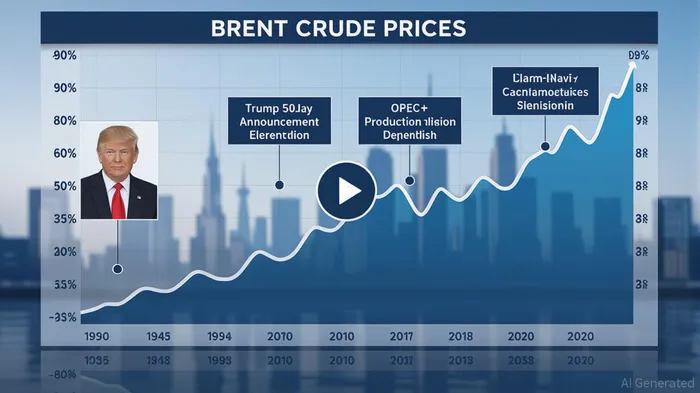
Trump's threat to impose a 100% tariff on Russian exports and secondary sanctions on countries trading with Russia has injected uncertainty into an already fragile market. The sanctions, if implemented, could block nearly half of Russia's crude exports, depriving its economy of $75 billion in annual revenue. However, enforcement remains questionable. The U.S. has a history of shifting deadlines, and China and India—purchasing 90% of Russia's crude—are unlikely to comply without U.S. incentives.
This uncertainty has kept prices volatile. Analysts estimate Brent crude could spike to $85 if sanctions bite, but the more likely scenario is a prolonged period of low prices as delays and exemptions erode their impact. For now, the market appears to be pricing in a delayed or diluted outcome, with Brent trading around $65—a midpoint between geopolitical fear and OPEC+'s supply overhang.
OPEC+ Compliance Debates: A War of Words Over Market Share
The group's recent decision to accelerate production hikes—to 411,000 barrels per day (b/d) monthly—exposes internal tensions. While Saudi Arabia and Russia push for market share gains, compliance issues loom. Iraq and Kazakhstan have openly flouted quotas, with the latter citing obligations to ChevronCVX--. Actual supply increases have lagged announced targets by up to 20%, raising doubts about OPEC+'s ability to sustain output growth.
The group's strategy hinges on reclaiming market share while tolerating lower prices. This could strain high-cost producers, including U.S. shale firms and some OPEC+ members. For investors, this creates a bifurcated opportunity:
- Short-term traders might exploit volatility via options, betting on swings caused by compliance leaks or geopolitical flare-ups.
- Long-term investors should focus on producers with low breakeven costs, such as Saudi Aramco or ExxonMobil, which can endure prolonged low prices.
China's Refining Activity: A Demand Plateau in the Making
China's refining sector is undergoing a structural shift. Transportation fuel demand—once the engine of oil growth—is stagnating as electric vehicles (EVs) and LNG trucking displace diesel. EVs now account for nearly half of China's car sales, reducing gasoline demand by an estimated 1 million b/d. Meanwhile, diesel consumption has fallen 17% since 2023, with light-duty electric truck sales up 25% year-on-year.
Petrochemicals provide a partial offset, with feedstock demand rising 5% in 2024. However, this growth cannot compensate for the transportation slump. The IEA forecasts China's oil demand will peak in 2025, with contributions to global demand growth falling below 20%.
Goldman Sachs' Price Forecasts: A Bearish Outlook Anchored in Oversupply
Goldman's revised forecasts underscore the growing oversupply risk. The bank now expects Brent to average $60 in 2025 and $56 by 2026—a $2 cut from prior estimates—due to OPEC+'s aggressive production and China's demand slowdown. Non-OPEC supply (including U.S. shale) is projected to add 1.7 million b/d in 2025, further pressuring prices.
Backwardation—the market structure where near-term prices exceed future prices—has faded as contango (the opposite) emerges, signaling oversupply. This suggests investors should:
1. Short crude oil futures, particularly front-month contracts, to bet on the contango deepening.
2. Avoid equities with high production costs, such as Canadian oil sands or U.S. shale firms.
3. Favor energy services firms, like SchlumbergerSLB-- or Baker HughesBKR--, which benefit from exploration activity regardless of price.
Conclusion: Position for Oversupply, Hedge Against Volatility
The oil market is caught between geopolitical fireworks and structural headwinds. While Trump's sanctions could spark short-term spikes, the long-term trajectory favors oversupply driven by OPEC+'s output ambitions and China's demand plateau. Investors should prioritize downside protection through short positions or volatility-linked instruments while seeking shelter in low-cost producers and services firms. As Goldman's forecasts make clear, this is a buyer's market—if you can stomach the swings.





Comentarios
Aún no hay comentarios