
Oil's Strategic Crossroads: Balancing Geopolitical Risks and Supply-Demand Dynamics
The global oil market is at a pivotal juncture, with OPEC+'s accelerated production hikes and U.S. tariff policies acting as twin catalysts for near-term volatility and long-term demand uncertainty. As OPEC+ shifts its focus from price stability to market share, and Washington's trade policies disrupt global supply chains, investors face a complex landscape of risks and opportunities. This article dissects the interplay of these forces and offers actionable insights for navigating the energy sector.
OPEC+'s Strategic Shift: From Price to Volume
OPEC+'s decision to accelerate production increases in 2025 marks a decisive pivot toward prioritizing market share over price stability. In August 2024, the alliance announced a 548,000 barrels per day (bpd) hike, exceeding expectations and signaling a departure from its historically cautious approach. By July 2025, cumulative increases had reached over 1 million bpd, with a further 548,000 bpd rise planned for August—a move described as an “oversized output hike” by analysts.
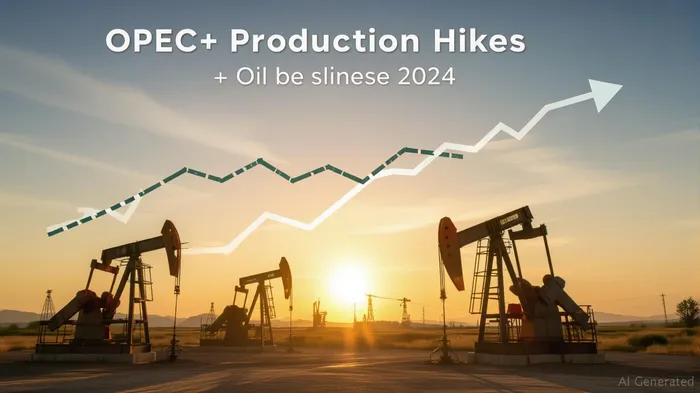
This strategy aims to counter the rise of U.S. shale producers, who require prices above $65–$70/bbl to justify new investments. OPEC+'s actions have already strained U.S. shale, with active rig counts falling for 10 consecutive weeks as of June 2025. However, compliance risks persist: Kazakhstan's overproduction and Russia's sanctions-driven export constraints threaten to undermine the alliance's cohesion.
U.S. Tariffs: A Double-Edged Sword for Demand
U.S. tariff policies, particularly those targeting energy imports and manufacturing goods, are reshaping global demand dynamics. By raising costs for imports, these tariffs risk slowing economic growth in trade-dependent regions like Asia, where oil demand growth is concentrated. For example, India's opposition to U.S. punitive measures on Russian oil has forced it to seek alternative suppliers, creating market fragmentation.
Meanwhile, U.S. shale producers face a paradox: while OPEC+'s output increases suppress prices, tariffs on domestic goods could reduce the economic activity that fuels oil consumption. This creates a “demand ceiling” that could limit the sector's recovery.
Geopolitical Risks: A Volatility Amplifier
Even as OPEC+ seeks to stabilize supply, geopolitical tensions threaten to upend prices. The Iran-Israel conflict in June 2025 briefly pushed Brent over $80/bbl, as fears of disruptions in the Strait of Hormuz—through which 20% of global oil flows—spiked. Such events underscore the fragility of price stability, with OPEC+'s production increases offering little comfort in the face of sudden supply shocks.
Near-Term Volatility vs. Long-Term Uncertainty
Near-Term: Investors should brace for continued price swings. OPEC+'s next meeting on August 3, 2025, will determine if the 548,000 bpd August hike persists or reverses. Meanwhile, geopolitical flare-ups, such as renewed Middle East conflict or Russian export disruptions, could trigger rallies.
Long-Term: The energy transition and demand trends loom large. While renewables may meet 50% of global electricity demand by 2030, oil's dominance in transportation and petrochemicals ensures lingering demand. However, U.S. tariffs could slow emerging market growth, reducing the pace of demand expansion.
Investment Implications
- Hedge Against Volatility: Use oil futures options to protect against price spikes from geopolitical risks or supply disruptions.
- Focus on Resilient Producers: Prioritize OPEC members with low breakeven costs (e.g., Saudi Arabia) and U.S. shale firms with strong balance sheets (e.g., EOG or APA).
- Avoid Pure Plays: Diversify into integrated majors like ExxonMobil (XOM) or TotalEnergies (TTE), which benefit from refining margins and renewable investments.
- Monitor Key Metrics: Track Brent prices, U.S. rig counts, and Middle East tensions for tactical adjustments.
Conclusion
Oil's strategic crossroads demands a nuanced approach. OPEC+'s production gambit and U.S. trade policies are reshaping supply-demand fundamentals, while geopolitical risks amplify uncertainty. Investors who balance short-term hedging with long-term exposure to resilient operators will be best positioned to navigate this complex landscape.
Stay informed, stay flexible—and keep one eye on Hormuz.





Comentarios
Aún no hay comentarios