
Oil's Plunge: A Perfect Storm or a Buying Opportunity?
The oil market is in freefall—plummeting to its worst monthly performance in three years. By mid-April, Brent crude had lost 14% of its value, dipping below $60 per barrel, while WTI crude hit four-year lows near $60/bbl. This isn’t just a correction—it’s a full-blown crisis fueled by trade wars, OPEC+ chaos, and fears of a global slowdown. Let’s break down what’s happening and whether this is a sell-off to fear or a buying opportunity to embrace.
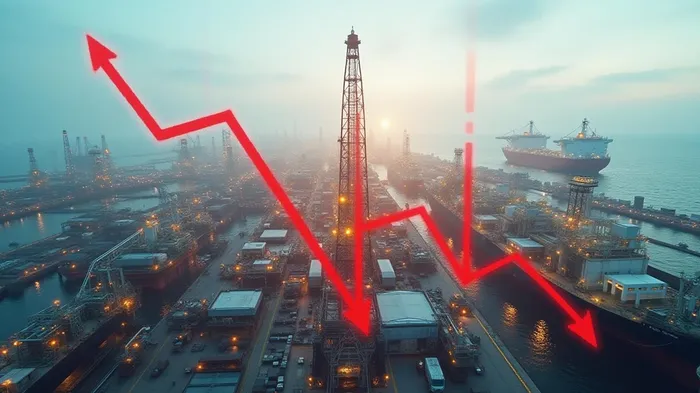
The Perfect Storm: Why Oil Is Collapsing
Trade Tariffs Igniting the Fire
The U.S. and China have lit a fuse with their escalating tariffs, even if energy is exempt. The mere threat of a trade war is spooking investors, slashing demand forecasts. The IEA slashed its 2025 oil demand growth estimate by 400,000 barrels per day (b/d), and Goldman Sachs warns of prices hitting $50/bbl by year-end if a recession hits.OPEC+’s Broken Promises
OPEC+ members like Saudi Arabia and Russia promised to cut production, but non-compliance is rampant. Kazakhstan, Iraq, and the UAE are overproducing by hundreds of thousands of barrels per day, flooding the market. Meanwhile, OPEC+’s plan to unwind production cuts in May adds to oversupply fears.The Demand Dilemma
The world’s two biggest oil consumers—the U.S. and China—are both stuck in a demand rut. The U.S. is battling inflation and a potential housing crash, while China’s post-pandemic rebound is weaker than expected.
Historical Context: How Bad Is This, Really?
The April 2025 drop is worse than 2023’s infamous September–December crash, when Brent fell 24.5% from $98/bbl to $74/bbl. But this time, the pain is sharper. In early April, prices plummeted $15/bbl in just five days, hitting lows not seen since 2019. Compare that to 2022, when prices averaged $101/bbl, or the 2020 crash to $11/bbl—this isn’t Armageddon, but it’s a serious reckoning.
Analysts Are Split, But the Data Speaks
- Bullish Case: The U.S. Energy Information Administration (EIA) sees prices rebounding to $70/bbl by year-end, citing OPEC+’s eventual discipline and a U.S. shale industry that’s hesitant to invest at current prices.
- Bearish Case: Goldman Sachs, ever the pessimist, predicts $50/bbl if trade wars trigger a recession. Meanwhile, Morningstar DBRS cut its 2025 WTI forecast to $60/bbl, a $5 drop from earlier estimates.
Investing Through the Chaos: What to Do Now
- Short-Term Traders: If you’re nimble, sell volatility or short oil ETFs like USO or SCO. But be cautious—oil can rebound fast if OPEC+ finally gets its act together.
- Long-Term Investors: Look for dividend-paying oil stocks trading at discounts. Names like Chevron (CVX) or ExxonMobil (XOM) have strong balance sheets and could thrive if prices stabilize.
- Hedge with Alternatives: Natural gas ETFs (UNG) or gold (GLD) can act as hedges against economic uncertainty.
Conclusion: The Bottom Line
Oil’s April 2025 crash is the worst monthly decline in three years, but it’s not all doom and gloom. The market is pricing in worst-case scenarios, which often creates buying opportunities. Investors who can stomach volatility might find value in select oil stocks or ETFs that hedge against further declines. However, if trade wars escalate or OPEC+ fails to unite, $50/bbl isn’t a pipe dream—it’s a real risk.
The takeaway? Stay nimble, do your homework, and don’t bet the farm on a rebound. The oil market is a storm—navigate it with caution, but don’t miss the chance to profit from the chaos.
Final Thought: In 2020, oil hit $11/bbl. Today, it’s $60/bbl. The cycle always turns—this time might be no different. But don’t count on it until OPEC+ stops leaking like a sieve.





Comentarios
Aún no hay comentarios