
Oil Market Volatility: Navigating Oversupply and Geopolitical Uncertainty in 2026
The global oil market in 2026 is poised for a delicate balancing act, with , geopolitical tensions, and evolving creating a volatile landscape for investors. As demand growth slows and OPEC+ adjusts its production strategy, energy commodity positioning requires a nuanced approach to mitigate risks while capitalizing on emerging opportunities.
Supply-Demand Dynamics: A Tug-of-War Between Projections
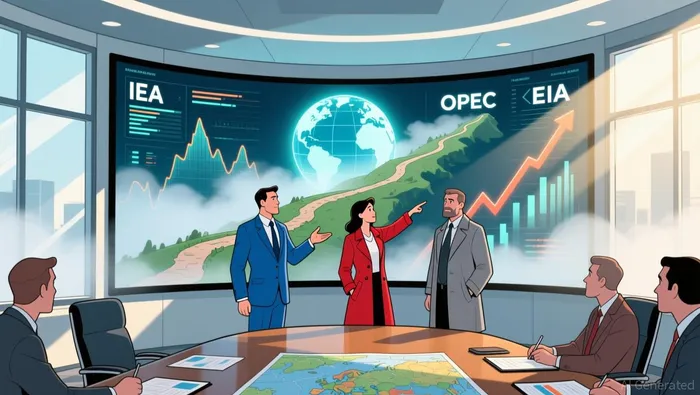
The divergence between the International Energy Agency (IEA) and OPEC forecasts underscores the uncertainty in 2026. The IEA in 2026, . This gap reflects broader concerns about emerging market consumption, which could amplify market volatility. Meanwhile, in Q4 2025, with this imbalance persisting into 2026 as non-OPEC supply growth outpaces demand.
OPEC+ has responded to these dynamics by pausing production increases through Q1 2026, aiming to stabilize markets amid seasonal demand lulls. However, the group's November 2025 output due to operational constraints in key members like Iraq and Nigeria. These shortfalls highlight the fragility of OPEC+'s coordinated strategy, as geopolitical and technical challenges complicate its ability to meet production goals.
Geopolitical Risks: A Wildcard in Oil Pricing
The Russia-Ukraine war remains a critical wildcard. Stalled peace talks have kept sanctions on Russian oil in place, limiting its ability to flood the market and maintaining a geopolitical risk premium in oil prices. Analysts warn that a potential ceasefire could trigger a surge in Russian exports, . Conversely, continued hostilities-particularly intensified Ukrainian strikes on Russian energy infrastructure-could disrupt supply chains and temporarily prop up prices.
Beyond Ukraine, tensions in the Red Sea, where on shipping persist, and U.S. sanctions on Venezuela further fragment global oil flows. These disruptions add a layer of uncertainty, with markets bracing for potential price spikes or corrections depending on de-escalation efforts.
Strategic Investment Approaches: Diversification and Hedging
Given these uncertainties, investors are advised to adopt that hedge against oversupply and geopolitical shocks. One approach is to shift toward midstream energy infrastructure, which offers less sensitive to commodity price swings. Energy infrastructure ETFs like the Alerian MLP ETF (AMLP) provide exposure to this sector, offering defensive characteristics in a volatile market according to analysis.
For those seeking growth, the presents long-term potential, driven by demand for in the tech and industrial sectors. The Range Nuclear Renaissance Index ETF (NUKZ) offers access to companies involved in advanced reactor development and nuclear services according to research.
Commodity diversification is equally critical. are positioned for structural demand growth, essential for the . Gold, meanwhile, remains a strategic asset amid geopolitical risks, with central bank demand likely to bolster its appeal according to .
Hedging techniques such as spread trading and options can also mitigate volatility. These tools allow investors to profit from price swings while limiting downside risk, particularly in a market where could trigger sharp corrections.
Conclusion: Preparing for a Fragmented Market
The 2026 oil market will be defined by its fragility-oversupply pressures, geopolitical tensions, and divergent demand forecasts creating a landscape where agility is key. Investors must prioritize diversification, hedging, and sector rotation to navigate these challenges. By balancing exposure to resilient infrastructure, strategic metals, and geopolitical hedges, energy portfolios can weather the uncertainties ahead while positioning for long-term growth.







Comentarios
Aún no hay comentarios