
Oil Market Volatility: Geopolitical Risk vs. Structural Oversupply in 2026
The global oil market in 2026 is poised to navigate a precarious tightrope between structural oversupply and geopolitical volatility. While the International Energy Agency (IEA) and U.S. Energy Information Administration (EIA) project a surplus of 3.84 million barrels per day by year-end, geopolitical tensions-from the Red Sea to Russia-threaten to disrupt this fragile equilibrium. For investors, the challenge lies in identifying energy equities and strategies that can thrive in a landscape where supply gluts and geopolitical shocks are equally potent forces.
Structural Oversupply: The Dominant Narrative
The 2026 oil market is defined by a persistent surplus, driven by non-OPEC+ production growth in the U.S., Brazil, Guyana, and Canada. The EIA forecasts that global oil inventories will continue to build, with prices averaging below $60 per barrel for West Texas Intermediate (WTI) and potentially dipping to $50 by year-end. This oversupply is compounded by weak demand growth, particularly in China and the European Union, where economic headwinds and energy transition policies are dampening consumption.
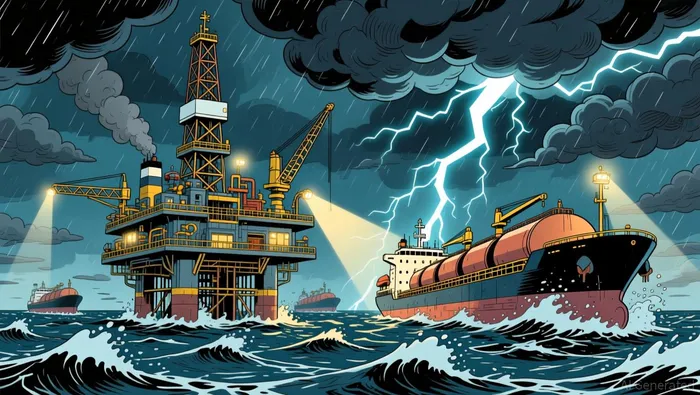 OPEC+, meanwhile, is expected to pause further production increases in early 2026 as it grapples with the surplus. However, the group's diminished spare capacity limits its ability to respond to sudden supply shocks, leaving the market vulnerable to price swings. As ING Research notes, a surplus exceeding 2 million bpd could push ICE Brent to an average of $57 per barrel in 2026, a level that tests the resilience of oil producers and investors alike.
Geopolitical Risks: The Wildcard Factor
Despite the structural bear case, geopolitical risks remain a critical variable. Houthi attacks in the Red Sea have disrupted shipping lanes, raising transportation costs and indirectly affecting crude prices. Meanwhile, the Russia-Ukraine war continues to reshape global trade flows, with Russian oil finding alternative markets in Asia despite Western sanctions as reported in market analysis. U.S. winter weather and Venezuela's production uncertainties further add to the volatility.
Macquarie Group cautions that these risks could slow the rate of price decline, creating short-term upside potential for oil equities. For instance, if sanctions on Russian oil prove more effective than anticipated, prices could rebound. Conversely, peace talks leading to sanctions relief might push Brent to the low $50s. This duality underscores the need for investment strategies that balance exposure to structural trends with hedging against geopolitical shocks.
Strategic Positioning in Energy Equities
For investors, the key lies in identifying companies and sectors that can navigate both oversupply and volatility.
Capital Discipline and Cost Efficiency
Energy firms with the lowest breakeven costs and disciplined capital allocation are best positioned to survive a prolonged bear market. Diamondback EnergyFANG--, for example, has prioritized reducing its oil price breakeven and reinvestment rate to maximize free cash flow, supporting dividends and buybacks. Similarly, consolidation trends-exemplified by ExxonMobil and Chevron's acquisitions-enhance scale and operational efficiency.Midstream and Infrastructure Plays
Midstream energy infrastructure offers a defensive angle, as these operators are less sensitive to commodity price fluctuations and provide stable cash flows according to industry analysis. The Alerian MLP ETF (AMLP) and Range Nuclear Renaissance Index ETF (NUKZ) are tailored to capitalize on this dynamic, with the latter focusing on nuclear energy's role in meeting AI-driven demand surges as reported in market research.LNG and Diversification
U.S. liquefied natural gas (LNG) exporters are well-positioned to benefit from rising global demand, particularly in industrial and datacenter sectors. However, investors must weigh the risks of oversupply in natural gas markets, where EIA projects Henry Hub prices to rise to $4.00/MMBtu in 2026.
Conclusion: Balancing the Equation
The 2026 oil market is a study in contradictions: a structural surplus coexists with geopolitical volatility, and long-term demand growth clashes with near-term price weakness. For energy equities, success hinges on adaptability-whether through cost discipline, infrastructure resilience, or strategic diversification. As Deloitte advises, companies must strengthen supply chains against tariff-driven costs and invest in technologies like AI to enhance efficiency. Investors, in turn, should adopt a nuanced approach, hedging against geopolitical risks while capitalizing on the structural opportunities in a market that remains as unpredictable as it is pivotal.





Comentarios
Aún no hay comentarios