
Oil Market Mechanics: Assessing the Geopolitical Risk vs. Structural Oversupply
The geopolitical shock of January 3, 2026, was the capture of Venezuelan President Nicolás Maduro in a U.S.-led military operation codenamed . The official narrative, as stated by U.S. officials, framed the action as a law enforcement operation against "narco-terrorism," with Maduro and his wife indicted on charges of cocaine-trafficking conspiracy. Yet, the evidence points to a more direct motive: control of Venezuela's vast resources. President Trump's immediate comments, including his claim that the U.S. would "run the country" and that Venezuela's oil reserves would cover the costs of the operation, suggest the primary objective is access to the nation's .
The immediate market reaction, however, was muted, reflecting a sober assessment of the global oil landscape. Analysts project only a marginally higher Brent crude price, . This tepid response is due to the market's overwhelming reality: a record oversupply. . In this context, the capture of Maduro, while a seismic political event, is seen as a manageable disruption.
The operational details underscore the market's limited concern. Key Venezuelan oil infrastructure, including the Jose port and Amuay refinery, remains intact and operational. More critically, Venezuela's current production is a fraction of its potential, averaging about . The U.S. has already imposed severe sanctions that have crippled the sector, . Any near-term increase in Venezuelan supply is therefore a distant prospect, hampered by broken infrastructure and a legacy of nationalization that has deterred major investment.
The bottom line is that this intervention is a high-risk geopolitical gamble with a muted immediate impact on oil prices. The market is pricing in the intervention as a political event, not an energy supply shock. The real test will be whether the U.S. can successfully rebuild Venezuela's oil sector-a complex and costly endeavor-and whether the global market can absorb any incremental supply from a country whose oil is both heavy and environmentally burdensome. For now, the record oversupply acts as a powerful brake on any significant price move.
Structural Oil Market Fundamentals: The Oversupply Reality
The geopolitical drama in Venezuela is a structural non-event for the near-term oil market. The country's vast reserves are a long-term potential, not a current supply driver. Venezuela's current production is about a million barrels a day, . This output now accounts for less than 1% of global oil output. The global market is already flooded, with forecasts pointing to a record . In this context, the capture of President Maduro and promises of U.S. corporate investment are noise against the dominant reality of oversupply.
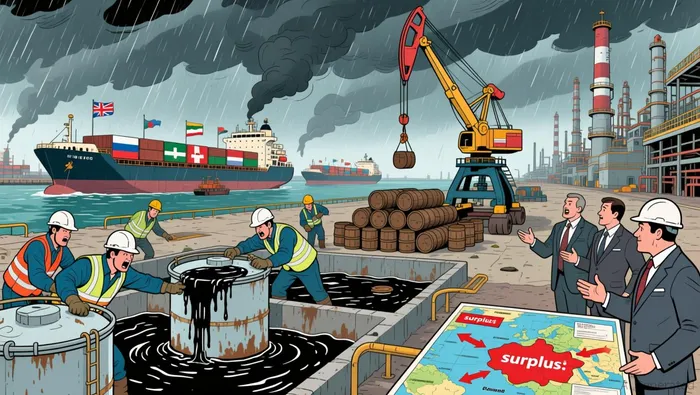
The market's immediate reaction confirms this disconnect. Key oil infrastructure, including the Jose port and Amuay refinery, remains operational, and production has not been disrupted by the strikes. This stability means the intervention does not alter the fundamental supply-demand imbalance. The International Energy Agency's forecast for a record oversupply aligns with the market's price action, . Our own forecast expects Brent crude to average , with prices pressured lower by weak demand and OPEC+ production increases.
The bottom line is that the oil market is pricing in a world where Venezuela's contribution remains negligible. The promised billions in U.S. investment to rebuild "badly broken infrastructure" is a distant prospect, requiring years and massive capital to even approach pre-2000s levels. For now, the market's focus is on the overwhelming oversupply, not the political upheaval in a country that produces less than a million barrels daily.
The Long-Term Investment and Political Calculus
The U.S. plan to rebuild Venezuela's oil industry faces a reality check on both the financial and political fronts. Lifting production to even a fraction of its former levels would require an immense, multi-decade commitment. Returning output to 2 million barrels per day by the early 2030s is estimated to need in investment. This scale of capital expenditure, spread over a decade or more, conflicts sharply with current market fundamentals, which are entering a period of oversupply and low prices. For oil majors, the calculus is simple: in a glutted market, they are unlikely to rush into a project of this magnitude and risk.
The political and legal hurdles are equally daunting. Major U.S. oil companies have been notably non-committal. ExxonMobilXOM-- and ConocoPhillipsCOP-- did not respond to requests for comment, while Chevron's statement focused only on compliance. Their caution is rooted in painful history. The industry was nationalized by a few years ago, leading to a years-long legal battle and billions in awards that remain unpaid. As one analyst noted, companies will want to see the country is stable enough before returning. The memory of nationalization and the risk of future expropriation are powerful deterrents.
Adding to the pressure is the existing U.S. blockade. Sanctions have already halved Venezuela's exports, which fell to after a U.S. order to block sanctioned oil tankers. This operational chokehold, combined with a cyberattack that disrupted PDVSA's systems, has crippled the industry's ability to move oil. The U.S. maintains that this pressure is key to forcing a change in Venezuela's government and recovering what it calls stolen assets. Yet this same blockade directly undermines the premise of a quick investment rebound.
The bottom line is that the U.S. political calculus for Venezuela's oil is immediate and strategic, while the commercial calculus for private investment is long-term and fraught. The path to meaningful production growth requires not just billions in capital, but a stable, predictable government and a global oil market that is willing to absorb more supply. Neither condition is currently in place.
Forward Scenarios and Key Catalysts
The geopolitical shock of Maduro's capture has created two starkly different forward paths for the oil market, hinging entirely on the political outcome in Caracas. The immediate market reaction is one of uncertainty, with analysts noting a potential flight to safe-haven assets as traders grapple with the new reality. Yet the long-term price impact will be determined by which scenario takes hold.
The Bearish Catalyst is a swift, stable transition to a pro-Western government. In this path, a new administration lifts sanctions and attracts the billions in private investment needed to revive the sector. The goal is to return Venezuela to its former status, with production potentially reaching . This influx of supply would be bearish for global prices, providing a long-term counterweight to OPEC+ output. The catalyst here is political stability and the removal of the investment barrier.
The Bullish Catalyst is a fragmented, unstable post-Maduro landscape resembling . Multiple opposition leaders are vying for power, and the country remains deeply divided. In this scenario, foreign capital would be loath to enter, fearing further instability and expropriation. The result would be a continued supply shock, with production remaining depressed. As geopolitical analyst Jorge León noted, this path would provide "slightly bullish support to global prices" in the short term due to heightened risk.
The Primary Risk is that the intervention's high cost and potential for prolonged instability may deter the very private investment needed to unlock reserves. Experts warn the plan to mobilize Venezuela's oil would cost billions and take up to a decade to produce a meaningful uplift. Even if a stable government emerges, companies would need to sign contracts and begin a slow ramp-up of investment in "badly broken" infrastructure. The bottom line is that any meaningful production growth is years away, not months. As one strategist put it, . For now, the intervention is a costly political gesture with a long, uncertain payoff.







Comentarios
Aún no hay comentarios