
Oil Market Dynamics Amid Diverging Macroeconomic Signals: Navigating Demand Uncertainties and U.S. Rate Cuts
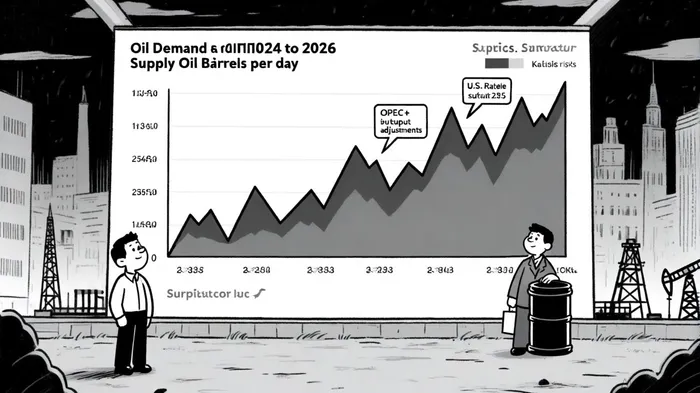
The global oil market in 2025 is navigating a paradox: robust supply growth coexisting with fragile demand. According to the International Energy Agency (IEA), global oil demand growth has been revised multiple times this year, reflecting the tug-of-war between resilient OECD consumption and slowing non-OECD demand[1]. While OECD countries have benefited from lower oil prices—driving 80,000 bpd growth in H1 2025—non-OECD regions, particularly China, have underperformed, with deliveries falling short of expectations[2]. This divergence creates a volatile backdrop for investors, compounded by the Federal Reserve's rate-cutting cycle and OPEC+'s supply management strategies.
Near-Term Demand Uncertainties: A Tale of Two Regions
The IEA's latest projections highlight a stark contrast between OECD and non-OECD dynamics. OECD demand, bolstered by lower prices, has shown resilience, but this growth is expected to stall in H2 2025 as seasonal factors wane[3]. Meanwhile, non-OECD demand—once a reliable growth engine—faces headwinds. China's oil consumption, which grew by 6 mb/d between 2015 and 2024, is now forecast to peak in 2027, two years earlier than previously expected, due to electric vehicle adoption and structural economic shifts[4]. India, however, is emerging as a bright spot, with demand projected to outpace China's in 2025[5].
This regional imbalance is exacerbated by global economic trends. The IEA notes that global GDP growth remains below trend at 3% annually, with trade tensions and fiscal imbalances further dampening demand[6]. For investors, this means hedging against regional overexposure: while OECD markets offer short-term stability, non-OECD regions require closer scrutiny of structural risks.
U.S. Rate Cuts: Stimulus or Signal of Weakness?
The Federal Reserve's rate cuts in 2025 have introduced another layer of complexity. A 25-basis-point cut in December 2024 and a 50-basis-point cut in September 2025 were intended to stimulate economic activity, but their impact on oil markets has been mixed. Lower borrowing costs typically boost energy consumption, yet persistent oversupply and weak U.S. fuel demand have limited this effect[7]. For example, the September 2025 rate cut, while priced in by traders, coincided with a decline in U.S. crude inventories and rising distillate stockpiles, signaling softer demand[8].
The dollar's role is pivotal. A weaker U.S. dollar, a byproduct of rate cuts, makes oil cheaper for foreign buyers, potentially boosting non-OECD demand[9]. However, this benefit is offset by China's reluctance to ease monetary policy, which has constrained global demand growth[10]. The Fed's cautious approach—emphasizing inflation control over aggressive stimulus—has also limited market optimism, keeping oil prices in a range-bound pattern[11].
Balancing Act: Supply, Demand, and Policy
OPEC+'s response to these dynamics underscores the fragility of the market. The cartel delayed planned output increases until April 2025 to address an oversupplied market, but rising non-OPEC supply from the U.S. and Iran has complicated this strategy[12]. The U.S. Energy Information Administration (EIA) forecasts global oil inventories to rise significantly in Q4 2025, with Brent crude averaging $59 per barrel and $49 per barrel in early 2026[13]. This surplus, combined with geopolitical risks like U.S.-China trade tensions, adds volatility to an already uncertain landscape.
For investors, the key lies in balancing short-term volatility with long-term trends. While rate cuts may provide temporary relief, structural shifts—such as China's energy transition and OPEC+'s production discipline—will shape the market over the next decade. Diversifying exposure across regions and hedging against dollar fluctuations could mitigate risks.
Strategic Considerations for Investors
- Monitor OPEC+ Discipline: The cartel's ability to manage supply will remain critical. A premature relaxation of production cuts could exacerbate the 2026 surplus.
- Leverage Regional Diversification: Overweighting India's growing demand while underweighting China's slowing consumption could yield asymmetric returns.
- Hedge Against Dollar Volatility: Given the Fed's rate-cutting cycle, investors should consider dollar-denominated assets or futures to offset currency risks.
- Factor in Geopolitical Risks: Sanctions on Iran and U.S.-China tensions could disrupt supply chains, creating short-term opportunities for nimble investors.
In conclusion, the oil market in 2025 is a microcosm of broader macroeconomic tensions. While U.S. rate cuts offer a lifeline to demand, they also signal underlying economic fragility. Investors must navigate this duality by combining tactical adjustments with a long-term lens, ensuring resilience in an era of divergent signals.







Comentarios
Aún no hay comentarios