
U.S. Oil Leverage in Venezuela: Strategic Implications for Energy and Commodity Investors
The U.S. military's 2025 intervention in Venezuela, culminating in the removal of President Nicolás Maduro, has redefined the geopolitical and economic calculus of global energy markets. By asserting control over Venezuela's vast oil infrastructure, the Trump administration has not only disrupted China's energy security strategy but also signaled a broader shift in great-power competition. For energy and commodity investors, the implications are profound, spanning short-term volatility, long-term market realignments, and the reconfiguration of supply chains in a world increasingly defined by resource nationalism.
Disrupting China's Energy Security Strategy
Venezuela, which holds the world's largest proven oil reserves, had become a critical supplier for China, exporting 800,000 barrels per day (bpd) of heavy crude in late 2025-nearly 4% of China's total oil imports according to a Forbes report. This relationship, forged under years of U.S. sanctions and geopolitical isolation, allowed Beijing to secure discounted crude while circumventing Western-dominated markets. The U.S. takeover, however, has abruptly curtailed this flow. According to a report by , the Trump administration's control of Venezuela's state-run oil company, PDVSA, has shifted the terms of oil exports, with China now facing uncertainty over pricing and supply continuity. While Trump has claimed that China will still receive oil shipments, the geopolitical leverage the U.S. now wields over Venezuela's production could force Beijing to pay higher prices or seek alternative suppliers, potentially straining its energy budget.
U.S. Investment Plans and the Road to Revitalization
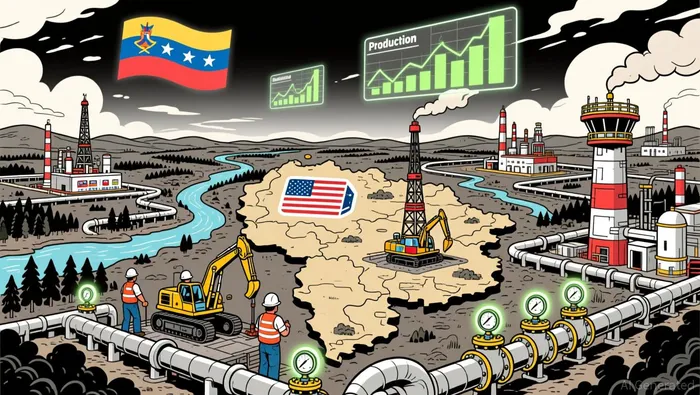 The Trump administration has positioned U.S. oil companies like ExxonMobilXOM--, ConocoPhillipsCOP--, and ChevronCVX-- as key players in revitalizing Venezuela's oil sector. In late 2025, Trump announced that these firms would invest billions to rebuild Venezuela's "badly broken infrastructure" and boost production from its current 800,000 bpd to levels closer to its historical peak of over 3 million bpd. This ambition, however, faces significant hurdles. Venezuela's oil industry has been crippled by decades of mismanagement, underinvestment, and U.S. sanctions. Even Chevron, the only major U.S. company currently operating in the country under special sanctions waivers, exports only 120,000–140,000 bpd. Analysts caution that restoring Venezuela's output will require years of capital expenditure and political stability, which remain uncertain given the country's fractured governance and regional tensions.
Geopolitical Shifts and Regional Instability
The U.S. intervention has also reshaped Venezuela's alliances, weakening its ties with Russia, Iran, and Cuba-key partners in its previous energy and political strategies. This realignment could reduce the influence of non-U.S. actors in Latin America, but it also risks escalating regional instability. As noted by Capital Economics, the U.S. presence in Venezuela has already strained relations with neighboring countries like Mexico and Colombia, which fear a domino effect of American interventionism. For investors, this instability introduces additional risks, including potential disruptions to supply chains, regulatory shifts, and the possibility of renewed sanctions or geopolitical conflicts.
Long-Term Market Dynamics and Investor Considerations
While the immediate impact of U.S. control over Venezuela's oil sector is likely to be volatile, the long-term implications could be transformative. If U.S. companies succeed in scaling up production, Venezuela could re-emerge as a mid-sized OPEC-level producer, increasing global oil supply and potentially lowering prices. However, this scenario hinges on sustained investment and political stability-both of which are far from guaranteed. For energy investors, the key variables will be the pace of infrastructure rebuilding, the geopolitical trajectory of U.S.-China relations, and the resilience of global oil demand in a post-pandemic, decarbonizing world.
Commodity investors, meanwhile, must also consider the indirect effects of Venezuela's oil realignment. A shift in crude supply patterns could alter refining margins, particularly for U.S. Gulf Coast refineries optimized for heavy crude-a commodity in which Venezuela specializes according to DW analysis. Additionally, the U.S. strategy to reengage with heavy crude may reduce reliance on Middle Eastern imports, further insulating American energy markets from regional shocks.
Conclusion: Navigating a New Energy Geopolitics
The U.S. leverage over Venezuela's oil sector underscores a broader trend: the weaponization of energy resources in great-power competition. For investors, this means that traditional market fundamentals must now be evaluated alongside geopolitical risks and strategic shifts. While the Trump administration's vision of a revitalized Venezuelan oil industry offers long-term upside, the path is fraught with uncertainty. Investors should closely monitor political developments in Venezuela, U.S.-China energy negotiations, and the capacity of American oil companies to navigate the complex regulatory and operational challenges of the region. In an era where energy is both a commodity and a geopolitical tool, the ability to anticipate and adapt to these dynamics will separate resilient portfolios from vulnerable ones.





Comentarios
Aún no hay comentarios