
U.S. Oil Firms and Venezuela's Energy Revival: Strategic Opportunities Amid Geopolitical Shifts
The U.S. military intervention in Venezuela in January 2026, which culminated in the arrest of President Nicolás Maduro, has triggered a seismic shift in the country's energy landscape. For U.S. oil firms, this geopolitical realignment presents both tantalizing opportunities and formidable risks. Venezuela's 303 billion barrels of proven oil reserves-the largest in the world-could become a linchpin of American energy security, but the path to unlocking this potential is fraught with political instability, infrastructure decay, and a globally oversupplied oil market.
Geopolitical Realignment and Strategic Access
The removal of Maduro, a key ally of China and Russia, has created a vacuum that the Trump administration is swiftly seeking to fill. According to a report, the U.S. has announced plans to manage Venezuela until a political transition occurs, with a stated goal of facilitating access to its oil reserves. This move aligns with broader U.S. energy security objectives, as Venezuela's heavy crude has historically supplied U.S. Gulf Coast refineries, which are uniquely suited to process such feedstock according to Modern Diplomacy.
However, the intervention has drawn sharp condemnation from Moscow and Beijing, raising concerns about a new era of geopolitical brinkmanship. As noted by Modern Diplomacy, the precedent of military action to secure resource access could embolden other powers to pursue similar strategies in regions like Taiwan or Greenland. For U.S. oil firms, this means operating in a context where geopolitical tensions could escalate, complicating long-term planning.
Energy Security and Market Dynamics
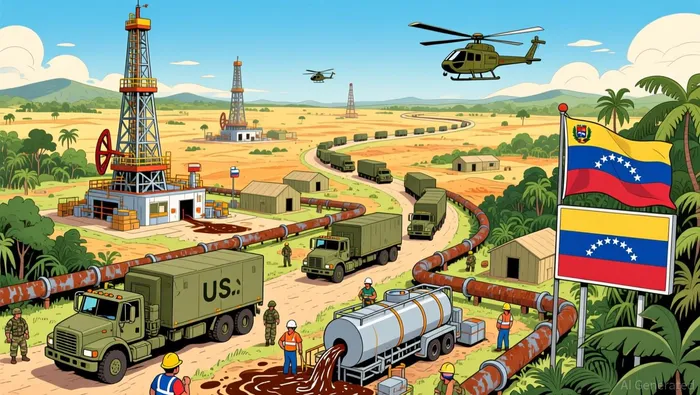 Venezuela's oil sector, once a global powerhouse, has languished under decades of mismanagement and sanctions. Production has plummeted to 800,000–900,000 barrels per day (b/d), a fraction of its historical peak of 3.5 million b/d. Restoring output to 1.5 million b/d within two years and 3.5 million b/d over a decade would require $110 billion in investment, according to industry estimates. For U.S. refiners, this could mean a stable, cost-effective supply of heavy crude, reducing reliance on Canadian or Russian sources.
Yet the economic calculus is murky. The International Energy Agency projects a global oil surplus of 3.8 million b/d in 2026, with prices near 2021 lows. Even if U.S. firms like ChevronCVX--, ExxonMobilXOM--, and ConocoPhillipsCOP-- secure contracts, the return on investment may be limited. Chevron, the only U.S. firm currently operating in Venezuela, is already producing 25% of the country's output through joint ventures with PDVSA, but expanding this will require navigating complex legal and operational challenges.
Investment Risks and Political Uncertainties
The Trump administration has emphasized the role of U.S. oil companies in rebuilding Venezuela's "badly broken" infrastructure. However, political instability remains a critical risk. Experts caution that governance transitions, security threats, and lingering arbitration claims-such as those held by ExxonMobil and ConocoPhillips from the Hugo Chávez era-could deter investment. ConocoPhillips, for instance, has only committed to "monitoring developments," reflecting industry caution.
Moreover, the global energy transition poses a long-term threat. Demand for heavy crude, which Venezuela produces in abundance, is expected to decline as refineries shift toward lighter, cleaner fuels. As The Energy Mix notes, this could render even revived Venezuelan production a less attractive asset in a decarbonizing world.
Conclusion: Balancing Ambition and Pragmatism
For U.S. oil firms, Venezuela represents a high-stakes gamble. The potential to secure a strategic energy source and profit from infrastructure contracts is undeniable. Yet the interplay of geopolitical risks, market oversupply, and energy transition trends demands a measured approach. Success will hinge on the ability of companies to navigate political volatility while aligning their investments with a global oil market in flux.
As the Trump administration pushes forward, investors must weigh the allure of Venezuela's vast reserves against the realities of a complex and uncertain environment. In this new era of geopolitical energy competition, the line between opportunity and overreach is perilously thin.





Comentarios
Aún no hay comentarios