
Ohio's Manufacturing Renaissance: How a Tripartite Partnership is Shaping the Future of Industry 4.0
The manufacturing sector, long the backbone of Ohio’s economy, is undergoing a transformative shift. A groundbreaking partnership between Ohio University, HTC VIVE, and Virtualware has launched the Digital Enterprise Collaboratory (DEC), a program designed to propel Ohio into the vanguard of Industry 4.0. By merging academia, cutting-edge extended reality (XR) technology, and advanced digital engineering tools, this initiative addresses both immediate workforce shortages and long-term innovation needs in a sector that contributes 17.5% of Ohio’s GDP.
The DEC: Bridging Innovation and Industry
At the core of the partnership are two interconnected labs—located at Ohio University’s Athens Campus and Dayton’s Digital Transformation Center (DTC)—equipped with HTC VIVE’s XR hardware and Virtualware’s VIROO platform. These labs enable real-time collaboration, digital twin creation, and immersive training for engineers and manufacturers across Ohio’s 2.5-hour geographic divide. This infrastructure not only connects researchers at Ohio University with industry stakeholders like the U.S. Air Force and Intel but also accelerates the validation of new products and processes.
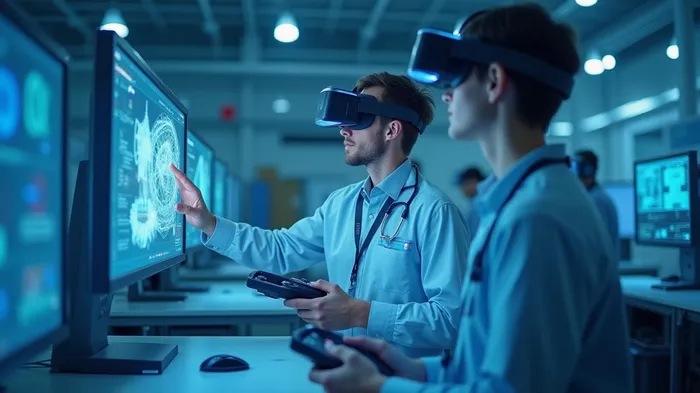
The DEC’s workforce development programs are equally critical. Ohio is on track to add 7,000+ new jobs in advanced manufacturing over the next decade, driven by projects such as Intel’s $20 billion chip plant in New Albany and Anduril’s advanced sensor factory. Yet, a skills gap persists: only 60% of Ohio’s manufacturing employers report having access to adequately trained workers. The DEC aims to close this gap by expanding Ohio University’s certification programs to include Industry 4.0 competencies like spatial problem-solving and digital twin manipulation.
Economic and Technological Synergies
The partnership’s success hinges on its alignment with global Industry 4.0 trends. By integrating XR and digital engineering tools, the DEC prepares workers to master technologies like AI-driven predictive maintenance, autonomous robotics, and smart supply chains—all critical to Ohio’s competitive edge. For investors, this initiative signals a strategic bet on Ohio’s capacity to attract capital-intensive manufacturing projects.
Consider the data:
While HTC’s stock performance may be modest, its role in supplying XR technology to this public-private venture underscores a growing demand for immersive tools in industrial settings. Meanwhile, Ohio’s manufacturing GDP has outpaced national growth by 1.2% annually since 2020, a trend the DEC aims to amplify.
A Blueprint for Regional Revitalization
The DEC’s model—combining academic research, corporate innovation, and workforce training—could serve as a template for other states grappling with similar economic transitions. By directly linking education to industry needs, Ohio is positioning itself as a magnet for high-tech manufacturing firms seeking both skilled labor and advanced infrastructure.
The partnership’s timing is also strategic. With the U.S. government’s $280 billion CHIPS and Science Act prioritizing semiconductor manufacturing and R&D, Ohio’s DEC aligns perfectly with federal priorities. The program’s May 2025 launch, alongside the Dayton Digital Transformation Summit, signals a coordinated effort to brand Ohio as a leader in Industry 4.0.
Conclusion: A New Era for Ohio’s Industrial Heartland
The DEC partnership is more than an educational initiative—it is a catalyst for economic transformation. By addressing the skills gap, leveraging XR and digital twin technology, and fostering cross-sector collaboration, Ohio is not only securing its current manufacturing dominance but also laying the groundwork for future growth. With $20 billion in projected private investment tied to Intel’s Ohio expansion alone, and a workforce pipeline now aligned with Industry 4.0 demands, the state is poised to capture a disproportionate share of the $12 trillion global manufacturing market by 2030.
Investors should take note: Ohio’s manufacturing renaissance is no fleeting trend. It is a deliberate, tech-driven evolution that promises sustained returns for those willing to bet on its success.







Comentarios
Aún no hay comentarios