
W&T Offshore (WTI) and the North Sea Crude Price Rally: A Contrarian Opportunity in a Troubled Sector
Earnings and Production: A Mixed Picture
W&T Offshore is scheduled to release its Q3 2025 earnings on November 5, with analysts forecasting a loss of $0.12 per share, a 29.4% year-over-year decline in profitability, according to Nasdaq. However, revenue is expected to rise to $141.18 million, driven by higher oil prices and operational efficiency in the Gulf of Mexico, as noted in a W&T Offshore press release. This divergence between top-line growth and bottom-line losses reflects the company's strategic focus on capital discipline amid cyclical market challenges.
Production growth figures remain undisclosed, but WTI's operational footprint-spanning 50 fields and 629,700 gross acres in the Gulf of Mexico-suggests potential for incremental output. The company's emphasis on cost control and disciplined capital allocation, as highlighted in W&T Offshore investor communications, positions it to benefit from any sustained price recovery. Yet, with a Zacks Rank of #3 (Hold) and an Earnings Surprise Probability of 0%, the market remains skeptical about its ability to outperform expectations, according to MarketBeat.
Insider Confidence: A Signal Amid Uncertainty
On October 2, 2025, CEO Tracy Krohn purchased 527,259 shares at $1.84 per share, a move that coincided with a 4.5% surge in WTI's stock price, according to Yahoo Finance. Insider transactions are often interpreted as a vote of confidence, and Krohn's purchase-part of a broader pattern of executive buying-suggests optimism about the company's near-term prospects. This is particularly notable given the broader North Sea market's turbulence, where Petrofac's administration filing and Tenaris's declining sales have cast shadows over the sector, as reported by the Meyka blog and Seeking Alpha.
However, Krohn's purchase must be contextualized. At $1.84 per share, WTI's valuation remains depressed, trading at a discount to its peers despite its Gulf of Mexico assets. The CEO's stake increase could reflect a belief in undervaluation rather than a fundamental turnaround. Investors must weigh this against the company's weak EBITDA margins and its reliance on volatile oil prices for profitability.
North Sea Price Rally: A Tailwind or a Mirage?
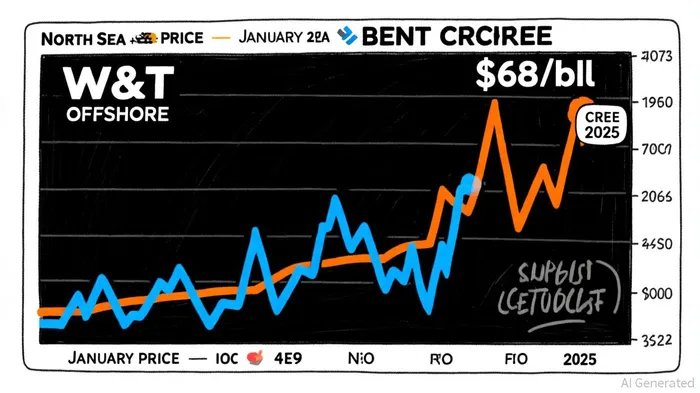
The North Sea crude price rally in October 2025-marked by Brent crude reaching $68/bbl-has been a bright spot in an otherwise lackluster year. By early October, prices had dipped to $64/bbl, reflecting a global supply surplus of 1.9 mb/d and geopolitical tensions, according to the IEA report. Yet, the rally underscores a critical point: energy markets remain sensitive to short-term shocks, and WTI's Gulf of Mexico operations could benefit from any sustained price rebound.
The challenge lies in alignment. While WTI's production is geographically distinct from the North Sea, its exposure to global oil prices means it could gain from a broader recovery. However, the sector's structural issues-such as Petrofac's collapse and Tenaris's cost pressures-highlight the fragility of such gains. For WTIWTI--, the rally is a double-edged sword: higher prices could boost revenues, but they also risk inflating input costs and reigniting inflationary pressures, as discussed in Seeking Alpha's Tenaris coverage.
The Contrarian Case: Risks and Rewards
Investing in WTI demands a contrarian mindset. The company's weak financial metrics-projected losses, a 1.9% dividend yield, and a Zacks Rank of #3-suggest caution. Yet, its insider confidence, Gulf of Mexico assets, and potential to capitalize on the North Sea rally create a compelling narrative for risk-tolerant investors.
The key question is timing. If the North Sea rally persists into Q4 2025 and WTI's Q3 earnings exceed expectations, the stock could experience a re-rating. Conversely, a relapse into bearish trends-exacerbated by Petrofac's fallout or a global supply glut-could deepen losses.
Conclusion: A Calculated Bet
W&T Offshore embodies the paradox of the 2025 energy sector: a company with tangible assets and insider confidence, yet burdened by weak fundamentals and macroeconomic headwinds. For investors willing to navigate the risks, the North Sea crude rally and Krohn's stock purchase offer a glimmer of hope. However, this opportunity should be approached with a clear exit strategy and a close eye on Q3 earnings. Until the company demonstrates consistent profitability and aligns with broader market trends, WTI remains a high-risk proposition.





Comentarios
Aún no hay comentarios