
U.S. Offshore Wind Sector Volatility and Strategic Opportunities
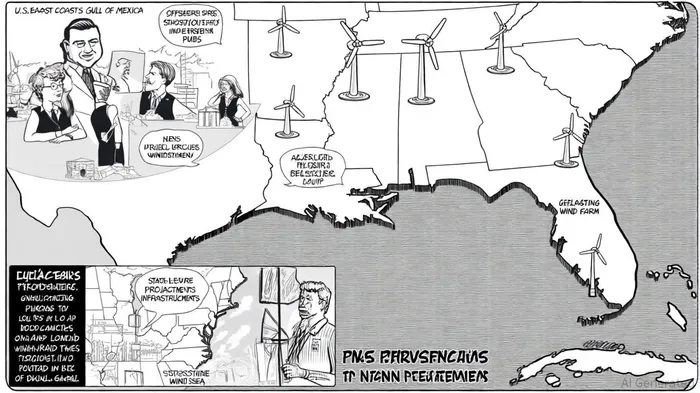
The U.S. offshore wind sector is navigating a period of profound volatility, shaped by conflicting federal policy shifts and resilient state-level initiatives. While the Trump administration's 2025 executive order to pause federal offshore wind leasing has introduced regulatory uncertainty, coastal states are accelerating their own infrastructure and supply chain investments, creating a dual narrative of risk and opportunity for investors. This analysis examines the interplay between policy risk and long-term growth potential, drawing on recent developments, financial trends, and strategic case studies.
Policy Risk: Federal Uncertainty and Regulatory Overhaul
The federal government's indefinite pause on offshore wind leasing, announced in January 2025, has disrupted project timelines and investor confidence. According to a report by the U.S. Department of the Interior, the Bureau of Ocean Energy Management (BOEM) and the Bureau of Safety and Environmental Enforcement (BSEE) are conducting a comprehensive review of offshore wind regulations, including financial assurance requirements and decommissioning cost estimates[1]. This overhaul, framed as a shift toward “energy reliability and national security,” has rescinded all Designated Wind Energy Areas on the Outer Continental Shelf and eliminated the five-year lease sale schedule[1].
Industry stakeholders, including the U.S. Chamber of Commerce, argue that the regulatory freeze undermines permitting certainty, a critical factor for capital-intensive projects[2]. For example, seven offshore wind projects in early development stages now face delays, with lease sales in the Gulf of Mexico and Central Atlantic regions put on hold[2]. Legal challenges have further compounded the uncertainty: the Revolution Wind Project, nearly complete by August 2025, was ordered to halt work by BOEM and subsequently filed a lawsuit alleging violations of the Outer Continental Shelf Lands Act (OCSLA) and the Administrative Procedure Act (APA)[3]. Such cases underscore the sector's vulnerability to abrupt policy changes and protracted litigation.
Long-Term Growth: State-Level Momentum and Supply Chain Resilience
Despite federal setbacks, state governments are emerging as the sector's primary drivers. At least eight coastal states introduced over 24 pieces of legislation in 2025 to advance offshore wind, focusing on port infrastructure, workforce development, and gigawatt deployment goals[4]. New York and New Jersey, for instance, have allocated $700 million and $1.2 billion respectively to port and manufacturing infrastructure, with five ports under development in New York and the nation's first purpose-built offshore wind marshaling port in New Jersey[4]. Louisiana, leveraging its offshore energy expertise, is positioning itself as a hub for wind turbine manufacturing and servicing[4].
Regional collaborations, such as the SMART-POWER initiative among Virginia, Maryland, and North Carolina, further demonstrate the sector's decentralized momentum[4]. As of May 2024, the U.S. offshore wind pipeline had grown to 80,523 megawatts (MW) of potential generating capacity, sufficient to power 28 million homes[5]. This growth is supported by $2.1 billion in domestic supply chain investments since 2023, including port development and vessel orders[5].
Financial Metrics and Strategic Opportunities
Investor confidence remains buoyed by the sector's long-term economics. Offshore wind projects offer higher capacity factors than onshore alternatives, with costs projected to decline through scale and standardization[6]. The Inflation Reduction Act (IRA) has also addressed financial solvency concerns by streamlining tax credit transfers, though permitting inefficiencies and domestic content regulations persist as barriers[6].
State-level procurement goals provide additional stability: eight states aim to secure 45.7 GW of offshore wind capacity by 2040, with 12.4 GW already contracted through 15 agreements[5]. Floating wind projects, with a 25 GW pipeline in the Gulf of Maine and along Oregon's coast, represent a high-growth niche[5]. However, companies must navigate risks such as tax credit uncertainty and supply chain bottlenecks, as seen in the Empire Wind Project's legal battles over stop-work orders[3].
Conclusion: Balancing Risk and Reward
The U.S. offshore wind sector remains a high-stakes investment, with federal policy volatility offset by state-level innovation and supply chain resilience. While regulatory overhauls and legal disputes create near-term headwinds, the sector's long-term potential—driven by state commitments, technological advancements, and IRA incentives—suggests a path toward sustained growth. Investors should prioritize projects with diversified funding sources, robust state partnerships, and adaptive regulatory strategies to mitigate federal uncertainty. As the sector evolves, the interplay between policy risk and strategic opportunity will define its trajectory in the U.S. renewable energy landscape.







Comentarios
Aún no hay comentarios