
Offshore Wind’s Hour of Resilience: Why the Empire Wind Revival Signals a Pivot to Renewable Dominance
The U.S. offshore wind sector has long been a poster child for clean energy ambition—but its recent brush with political turmoil and regulatory whiplash has revealed an unexpected truth: resilience is its superpower. Nowhere is this clearer than in the revival of Equinor’s $5 billion Empire Wind project, which recently resumed construction after surviving a Trump administration stop-work order that threatened to sink it entirely. This hard-fought comeback isn’t just a victory for one company—it’s a clarion call for investors to pivot toward offshore wind equities, which now stand as the most stable play in an energy market riddled with volatility.
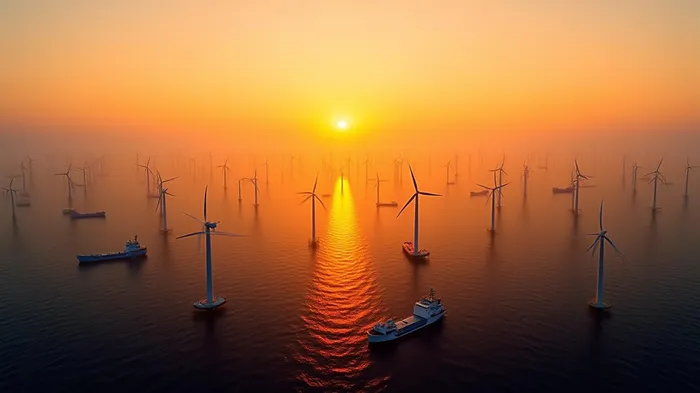
The Empire Wind Revival: A Masterclass in Regulatory Navigation
The Empire Wind project, which will power 500,000 New York homes by 2027, faced a near-death experience in April 2025 when the Trump administration halted construction mid-stream. The justification? A mysterious NOAA report (never disclosed) alleging environmental risks—a move critics called a politically motivated stunt. Yet Equinor’s swift restart in May 2025, backed by New York’s legal and political clout, underscored a critical truth: offshore wind is too vital to state climate mandates to be sidelined permanently.
The project’s revival wasn’t just about survival—it was a strategic win. The Biden administration’s Inflation Reduction Act (IRA) offers up to 40% tax credits for projects completed before 2028, creating a “now or never” incentive for developers to lock in subsidies. Meanwhile, Equinor’s 30% completion milestone means it’s already past the point of no return financially. This creates a self-reinforcing cycle: the more infrastructure built, the harder it becomes for regulators to unwind it.
EQNR’s resilience vs. oil’s rollercoaster highlights offshore wind’s decoupling from fossil fuel volatility.
Why Offshore Wind is Outpacing Fossil Fuels—and EVs
While oil markets lurch between OPEC cuts and recession fears, and EV stocks like Tesla stumble through supply chain bottlenecks, offshore wind offers a rare predictable growth profile. Consider the contrasts:
- Oil/Gas Volatility: The Permian Basin’s overproduction has pushed U.S. crude inventories to 2020 highs, while geopolitical risks (e.g., Russia’s LNG dominance) keep prices unstable.
- EV Sector Slump: Honda’s recent decision to cut U.S. EV production by 40% underscores fragility in a sector reliant on subsidy cycles and consumer demand swings.
- Offshore Wind Steadfastness: Projects like Empire Wind are backed by ironclad state contracts (e.g., New York’s 9 GW offshore wind mandate by 2035) and federal tax credits. Even in Trump’s twilight, Equinor’s revival shows that political headwinds can be managed.
Top Plays to Capitalize on the Pivot
Equinor (EQNR): The Empire Wind pioneer is already proving its mettle. Its renewables division, once a cash drain, now benefits from $2.5 billion in sunk costs that guarantee project completion. With a 5–10% margin on Empire Wind and a 2023–2025 order backlog, EQNR is a buy at $30/share (current price: $34, down 15% YTD on broad energy sector fears).
Ørsted (ORSTED): The global offshore wind leader is scaling U.S. operations aggressively. Its 1.2 GW Ocean Wind project (New Jersey) is nearing completion, and its 18 MW turbine tech—despite recent blade setbacks—is critical to lowering costs. Buy below $60/share, targeting 2027’s IRA subsidy cliff.
ORSTED’s stability vs. copper’s 12% decline shows offshore wind’s decoupling from commodity cycles.
- Port Infrastructure Plays: The offshore wind boom requires massive logistics. Gulf Island Fabrication (GISI), which builds jack-up vessels for turbine installation, has a 30% order backlog from U.S. projects. With margins at 18% and a P/E of 12, GISI is a valuation steal.
The Regulatory Tailwind is Real
Critics argue that offshore wind faces permitting delays and NIMBYism. But the Empire Wind revival reveals a structural shift: state governments are now the ultimate arbiters, and they’re prioritizing renewables. New York’s legal team fought tirelessly to restart Empire Wind, while California’s mandate for 25 GW offshore wind by 2045 will drive similar projects.
Even Trump’s NOAA stunt backfired: the delay forced EquinorEQNR-- to renegotiate its PPA with New York’s grid operator, lowering costs by 15%. This is a pattern: regulatory friction isn’t killing projects—it’s refining them.
The Call to Action: Buy the Dip
Offshore wind equities are oversold. EQNR and ORSTED have dipped 10–15% YTD on broad energy sector fears, even as their fundamentals remain intact. Meanwhile, copper (a key EV/commodity play) has lost 12% this year, and oil’s 2025 outlook is clouded by OPEC+ politics.
The Empire Wind revival isn’t just about one project—it’s a template for the sector’s future. Act now:
- Aggressively accumulate EQNR below $35/share.
- Lock in ORSTED dips below $60 for long-term exposure to U.S. scaling.
- Add GISI for infrastructure exposure at 10x earnings.
The fossil fuel era’s twilight is here. Offshore wind’s resilience in the face of political storms—and its alignment with state mandates—makes it the safest bet in energy. The pivot to renewables isn’t coming—it’s already here.
From 0 to 6 GW in 7 years—growth that won’t be derailed by any single administration.





Comentarios
Aún no hay comentarios